There are 870 million internet users (98 percent of internet users) who have accessed the internet in Indic languages, and 57 percent of urban internet users say they prefer accessing internet content in Indic languages.
This insight sets the direction for 2026.
India’s digital ecosystem now operates in a multilingual default. Across search, commerce, and public services, non-English usage is no longer emerging. It is established.
Looking ahead to 2026, three forces are shaping how localization must be executed. AI-driven systems are increasing the speed and frequency of multilingual updates. Regulatory and accessibility requirements are raising expectations for language inclusion across public and private platforms. At the same time, digital growth is increasingly driven by Tier 2 and Tier 3 markets, where Indic languages dominate user interaction.
In this context, following website localization best practices 2026 is essential for building digital experiences that remain relevant, reliable, and future-ready in India’s multilingual internet.
Key Takeaways
- Website localization in 2026 is a core digital system, not translation. It must integrate design, content, engineering, SEO, accessibility, and governance.
- India’s internet is multilingual by default. Indic-language users drive growth across search, commerce, and public services.
- Continuous localization has replaced one-time translation. Always-on pipelines are required to keep all language versions synchronized.
- Early design and architecture decisions determine scalability and cost. Language-agnostic UI and centralized content infrastructure reduce long-term risk.
- Indian language SEO and accessibility directly impact reach and compliance.
- Success is measured by outcomes, not pages translated. Traffic, engagement, conversions, and update speed matter most.
- Platforms like Anuvadak enable secure, scalable multilingual delivery for India.
How Website Localization Has Changed Since 2024–25
The most significant change since 2024–25 is not why organizations localize, but how localization is executed and maintained.
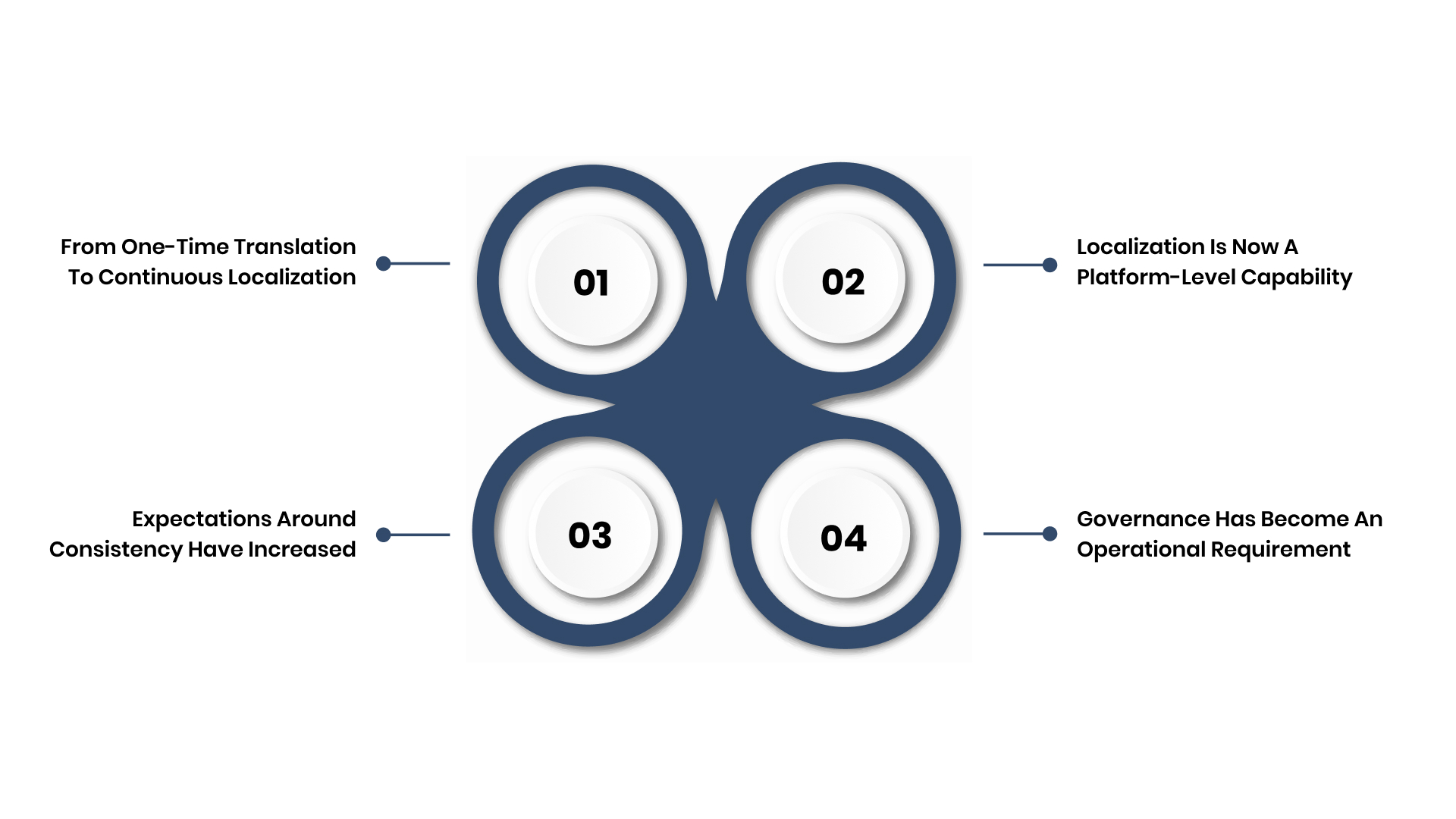
From One-Time Translation to Continuous Localization
Earlier localization approaches were built around projects. Content was translated at launch or during major updates, often resulting in delays and misalignment between language versions. In 2026, this model no longer fits how websites function.
Modern websites change frequently. Content updates, feature releases, and policy revisions happen continuously. Localization now needs to run in parallel with these changes, ensuring that all language versions remain synchronized without manual intervention.
Localization Is Now a Platform-Level Capability
Localization is no longer handled after content is finalized. It has moved upstream into content authoring, design systems, and development workflows.
Teams now expect localization to be embedded into the tools they already use, rather than managed through separate, disconnected processes. This shift reduces handoffs, minimizes coordination overhead, and allows multilingual updates to move at the same pace as the primary website.
Expectations Around Consistency Have Increased
In 2026, inconsistency across languages is treated as a failure, not a limitation. Users expect the same structure, completeness, and freshness across every language experience.
This means localization must support parity by default. Partial translations, outdated pages, or broken layouts are no longer acceptable outcomes. Operational maturity is measured by how consistently languages stay aligned over time.
Governance Has Become an Operational Requirement
As localization scales across teams and languages, visibility and control become essential. Organizations need clear oversight into what content is translated, when updates occur, and how quality is verified.
Governance is no longer an advanced feature. It is a baseline requirement for managing multilingual websites reliably at scale.
Core Website Localization Best Practices for 2026
With localization now embedded into how modern websites are built and operated, the focus in 2026 shifts to executional best practices. The following principles address how teams should design, manage, and scale localization in practice.
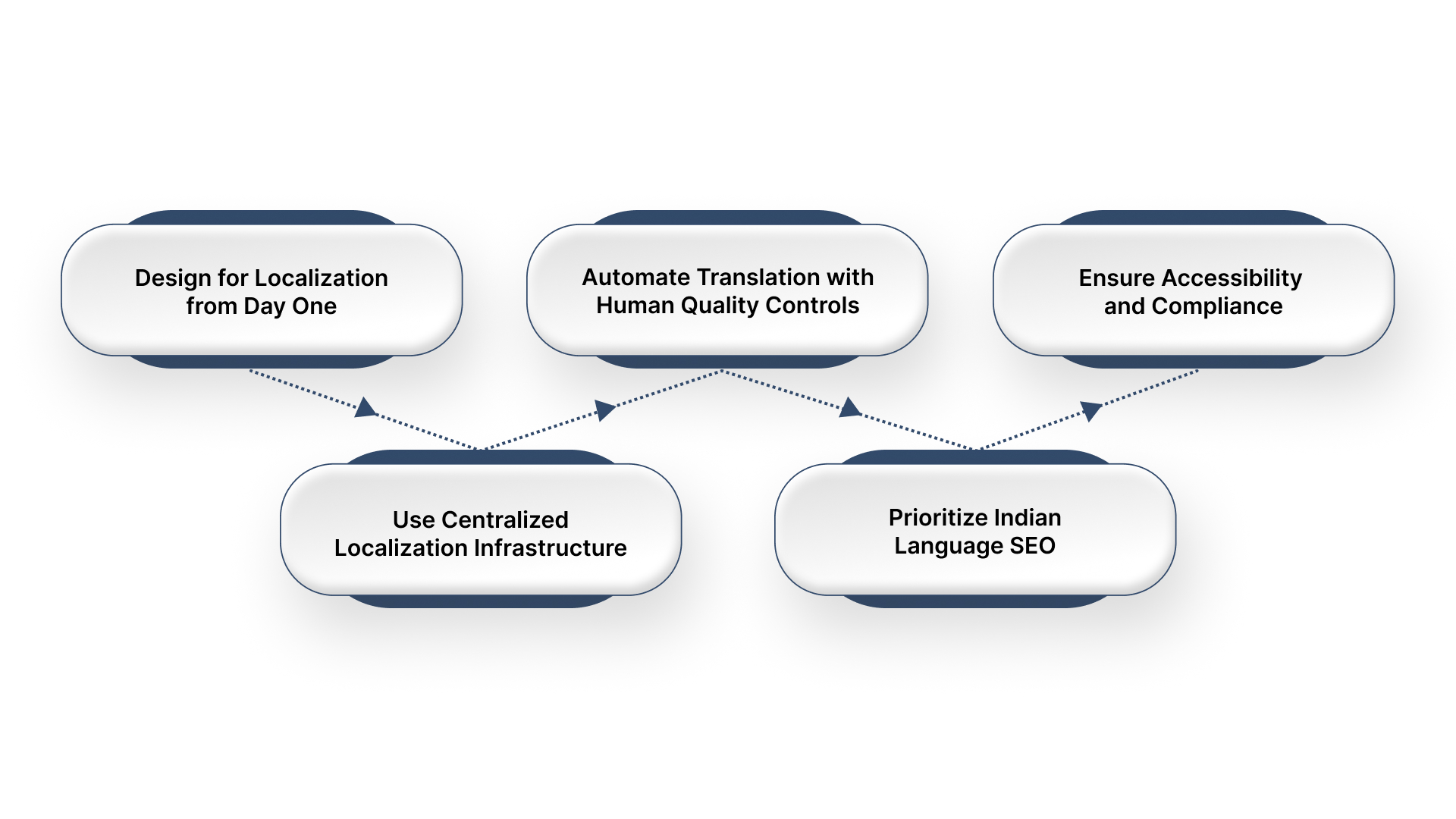
Design for Localization from Day One
Localization failures in 2026 are rarely linguistic. They are structural.
Websites that are not designed with multilingual expansion in mind tend to accumulate hidden technical debt that becomes expensive to fix later. Designing for localization from the start ensures that adding new languages does not require redesigning interfaces or rewriting code.
Key practices include:
- Language-agnostic UI and UX: Interfaces should be built without assumptions about text length, reading order, or script type. Labels, buttons, and navigation must adapt naturally across languages without breaking layouts.
- Flexible layouts for Indian scripts: Indian languages often require more vertical space and different typographic handling than English. Responsive components, scalable line heights, and adaptable containers prevent truncation and overlap.
- Avoid hardcoded text: Text embedded directly into code or design assets blocks automation and slows updates. All user-facing content should be externalized and managed as translatable resources.
Designing this way reduces friction later and allows localization to scale cleanly as the website evolves.
Use Centralized Localization Infrastructure
As content volume grows, decentralization becomes a liability. In 2026, scalable localization depends on having a single operational backbone rather than fragmented tools and processes.
Best practices include:
- Single source of truth for content: All translatable content should be managed centrally, ensuring consistency across pages, languages, and channels. This prevents duplication and conflicting versions.
- Version control for multilingual assets: Language content must follow the same discipline as source content. Tracking changes, rollbacks, and updates across languages is essential for accuracy and auditability.
- Deep CMS and codebase integration: Localization systems should integrate directly with content management systems and development workflows. This allows updates to flow automatically without manual handoffs or copy-paste processes.
A centralized infrastructure turns localization from a coordination problem into a predictable, repeatable process.
Automate Translation with Human Quality Controls
Automation is essential for speed in 2026, but quality still defines user trust. The most effective localization models combine both.
Core practices include:
- Translation APIs for speed and scale: Automated translation enables rapid turnaround for large volumes of content and frequent updates, keeping all language versions aligned with the source.
- Structured linguistic QA workflows: Human review is applied where it adds the most value, such as critical user journeys, legal content, and brand-sensitive pages. This ensures accuracy without slowing the entire pipeline.
- Domain-specific glossaries and terminology control: Consistent terminology across industries like BFSI, healthcare, and government is non-negotiable. Maintaining approved glossaries improves clarity and reduces rework over time.
This approach allows organizations to move fast without compromising on correctness or user experience.
Prioritize Indian Language SEO
In 2026, visibility in Indian languages depends on search-native localization, not translation. Search engines increasingly evaluate regional relevance, structure, and intent, making Indian language SEO a distinct discipline rather than an extension of English SEO.
Key best practices include:
- Language-specific URLs: Each language version should have a clear, crawlable URL structure, such as subdirectories or subdomains. This helps search engines correctly index content and serve the right language to users based on intent and location.
- Localized metadata, not reused English tags: Page titles, meta descriptions, alt text, and structured data must be localized with language-appropriate phrasing. Directly copying English metadata weakens search performance and click-through rates in regional markets.
- Regional keyword research over literal translation: Search behavior varies significantly across languages and regions. Effective Indian language SEO is built on how users actually search, not on translated English keywords. This includes understanding colloquial terms, spelling variations, and region-specific intent.
Prioritizing these practices ensures that localized websites are discoverable, not just readable.
Ensure Accessibility and Compliance
Accessibility expectations in 2026 go beyond basic compliance. Multilingual websites are expected to be usable by all users, regardless of language, ability, or assistive technology.
Best practices include:
- WCAG-aligned multilingual design: Accessibility standards must be applied consistently across all language versions, including contrast ratios, keyboard navigation, and semantic structure.
- Screen reader compatibility in Indian languages: Localized content should be tested with screen readers that support Indian scripts. Proper tagging, language attributes, and reading order are essential for accurate narration.
- Government and public-sector readiness: Public-facing platforms must meet stricter accessibility and language inclusion expectations. Readiness includes auditability, documentation, and the ability to demonstrate compliance across languages.
Accessibility and localization are now tightly linked. A website that is multilingual but inaccessible fails to serve its audience fully.
Together, these practices form the operational foundation of website localization best practices 2026. In the next section, we examine how these principles are applied differently across industries operating in India’s multilingual digital landscape.
Website Localization Best Practices by Industry in India
While the core principles of localization remain consistent, execution differs sharply by industry. In 2026, successful localization reflects sector-specific risks, user expectations, and regulatory environments.
BFSI: Trust, Terminology Accuracy, and Compliance
In banking, financial services, and insurance, localization errors directly affect credibility. Content must use approved financial terminology, maintain semantic precision, and remain consistent across languages. Even minor inaccuracies can create compliance risk or erode user trust. Localization workflows in BFSI must prioritize controlled vocabularies, rigorous review, and traceability.
eCommerce: Conversion-Led Localization
For eCommerce platforms, localization is tightly linked to performance. Product discovery, pricing clarity, checkout flows, and customer support content must all align with regional language behavior. High-performing teams localize not just product descriptions, but also filters, CTAs, and trust signals to reduce friction and improve conversion rates.
Healthcare: Patient Comprehension and Safety
In healthcare, localization directly impacts understanding and outcomes. Medical instructions, consent information, and service details must be clear, unambiguous, and culturally appropriate. Quality assurance is critical, as mistranslations can create safety risks. Healthcare localization prioritizes clarity and consistency over speed.
Government: Accessibility, Inclusion, and Scale
Government platforms operate at unmatched scale and scrutiny. Localization must support accessibility standards, auditability, and uniform experience across languages. The focus is on reach and inclusion, ensuring citizens receive accurate and up-to-date information regardless of language preference.
Technical Best Practices for Scalable Website Localization
Scalability in 2026 depends on technical choices made early. Localization that cannot integrate cleanly with modern web stacks quickly becomes a bottleneck.
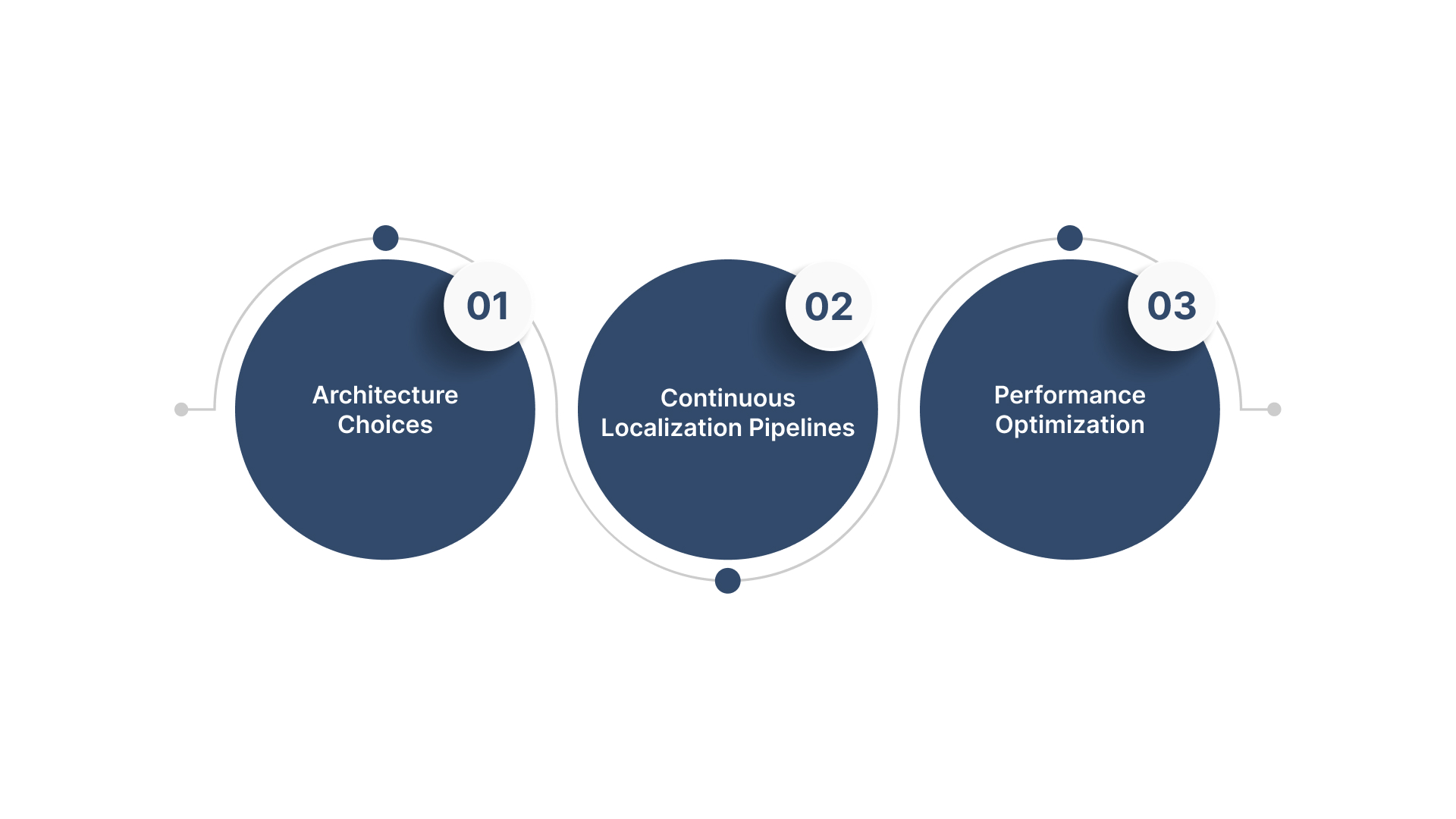
Architecture Choices
- Static vs dynamic localization: Static approaches work for fixed content but struggle with frequent updates. Dynamic localization allows content to be updated and published across languages without redeploying the entire site.
- Headless CMS compatibility: Headless architectures make it easier to manage multilingual content centrally while delivering it consistently across platforms. Localization systems must integrate seamlessly with these setups to avoid duplication and delays.
Continuous Localization Pipelines
- CI/CD integration: Localization workflows should align with development pipelines, ensuring language updates move in step with code releases.
- Automated content updates: When source content changes, localization should trigger automatically. This prevents language versions from falling out of sync and reduces manual coordination.
Performance Optimization
- Page speed across languages: Multilingual websites must maintain performance parity. Heavy fonts or unoptimized assets in certain scripts can degrade experience.
- Font and script optimization: Efficient font loading, script subsetting, and caching are essential to ensure fast rendering across Indian languages.
Common Website Localization Mistakes to Avoid in 2026
Even with the right intent, many organizations struggle due to avoidable mistakes.
- Treating localization as a one-time task: Websites evolve constantly. Localization that does not keep pace quickly becomes outdated and unreliable.
- Ignoring regional cultural nuance: Literal translations miss context. Content that feels unnatural or inappropriate reduces engagement and trust.
- Relying on manual workflows at scale: Manual coordination cannot handle volume, speed, or consistency in 2026. It introduces delays and errors as complexity grows.
- Lack of governance and audit trails: Without visibility into changes, approvals, and versions, quality and compliance suffer.
Pro Tip: Manual localization breaks at scale because it cannot keep up with content velocity, cross-team coordination, or quality control across languages.
Together, these industry-specific insights, technical practices, and cautionary lessons complete the operational picture of website localization best practices 2026, helping organizations avoid common pitfalls while scaling multilingual digital experiences effectively.
Website Localization KPIs That Matter in 2026
As website localization matures into a core operational capability, success in 2026 is measured by outcomes, not output. Counting the number of translated pages is no longer meaningful. What matters is how localized experiences perform across languages.
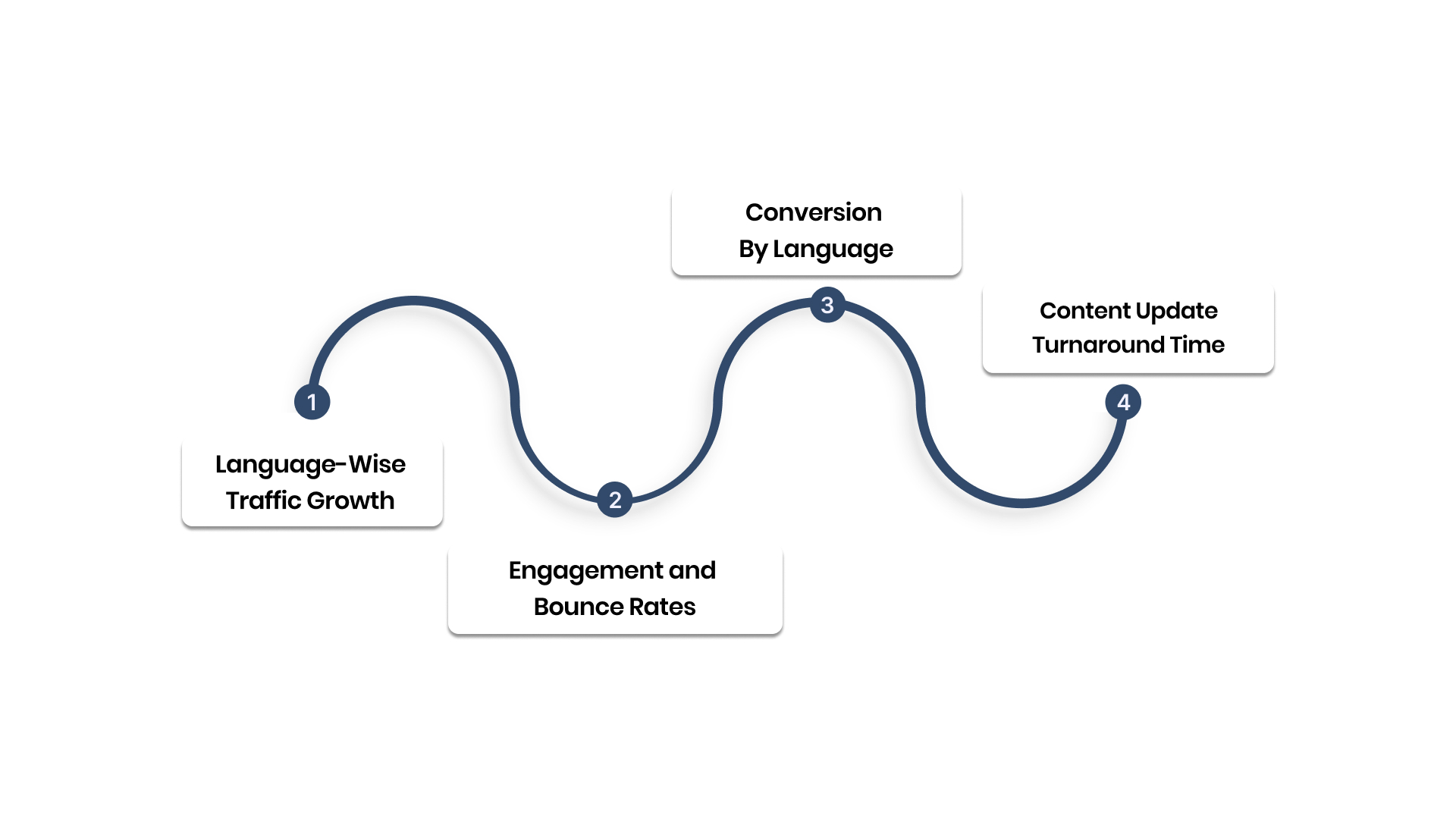
Key KPIs to track include:
- Language-wise traffic growth: Monitor organic and direct traffic by language to understand which localized versions are gaining visibility and adoption. This helps prioritize languages and content types that deliver measurable impact.
- Engagement and bounce rates: Time on page, scroll depth, and bounce rates reveal whether localized content feels native and usable. High bounce rates in specific languages often indicate UX, terminology, or contextual issues rather than translation quality alone.
- Conversion by language: Measuring conversions separately for each language uncovers gaps in user journeys. A well-localized website should reduce conversion disparity between the primary and secondary languages over time.
- Content update turnaround time: Track how long it takes for updates in the source language to appear accurately across all localized versions. Faster turnaround reflects healthier localization pipelines and better operational maturity.
Together, these KPIs shift localization measurement from activity-based reporting to business and experience impact, which is essential for sustained investment and optimization.
Website Localization vs Translation in 2026
In 2026, the distinction between translation and localization is no longer semantic. It is operational.
Translation focuses on converting text from one language to another. It answers a narrow question: Is the content readable?
Website localization, by contrast, addresses a broader set of concerns that determine whether a digital experience actually works across languages. This includes layout behavior, navigation clarity, search visibility, accessibility compatibility, and update synchronization.
The difference becomes visible at scale. A translated website may technically support multiple languages, but localized websites ensure that:
- Interfaces behave consistently across scripts
- Search engines index and rank each language version correctly
- Updates propagate without delay or mismatch
- Users complete journeys without friction
In 2026, organizations that still treat localization as translation often struggle with broken layouts, uneven user experience, and operational bottlenecks. Localization succeeds when it is treated as a cross-functional capability, spanning design, engineering, content, and governance.
How Many Languages Should a Website Support in India
There is no universal number, and in 2026, coverage matters less than prioritization.
Leading organizations approach language expansion incrementally. Instead of launching many languages at once, they start with a focused set aligned to business and service goals, then expand based on performance signals.
Effective prioritization is driven by:
- Traffic and demand patterns by region
- Conversion and engagement data by language
- Content readiness and update frequency
- Operational capacity to maintain quality
A common mistake is expanding language coverage faster than teams can support ongoing updates. This leads to outdated or incomplete experiences that undermine trust.
In practice, mature teams treat language rollout as a continuous program, not a one-time decision. Languages are added when systems, workflows, and quality controls are ready to support them sustainably.
This approach ensures that every supported language delivers a complete, current, and reliable experience rather than superficial coverage.
Scaling Website Localization with Anuvadak
As localization moves into the core of digital infrastructure, tools alone are not enough. What organizations need in 2026 is a platform that supports continuous, governed multilingual delivery at scale.
How Anuvadak Enables Scalable Localization
- Automation at scale: Anuvadak supports high-volume, high-frequency content updates without breaking workflows. Automation ensures language versions stay aligned with source content as websites evolve.
- Indian language depth: Designed for India’s linguistic complexity, Anuvadak supports multiple Indic languages with domain-aware handling, ensuring consistency and clarity across use cases and industries.
- Enterprise security and compliance: Localization workflows operate within enterprise-grade security frameworks, supporting auditability, access control, and compliance requirements across regulated sectors.
Infrastructure, Not Just a Tool
Anuvadak is positioned as localization infrastructure, not a standalone translation utility. It integrates into existing CMS, development, and release workflows, enabling localization to function as a continuous system rather than a series of manual interventions.
By acting as an enabler of always-on multilingual delivery, Anuvadak helps enterprises and public platforms operationalize website localization best practices for 2026, without adding complexity or slowing down digital velocity.
Conclusion
By 2026, the challenge is no longer whether a website should support multiple languages, but how reliably it can sustain them over time. Localization has become part of the digital operating model, shaping release cycles, content governance, and consistency across language experiences.
Organizations that succeed treat localization as a system rather than a set of tasks. They align design, content, engineering, and compliance around shared workflows and clear ownership, ensuring multilingual experiences evolve in step with the primary website.
Looking ahead, the true differentiator will not be the number of languages supported, but the ability to maintain quality, performance, and compliance across all of them. Building future-ready multilingual websites requires thinking beyond translation and investing in infrastructure for continuous localization. Platforms built for India’s linguistic complexity, such as Anuvadak, help organizations operationalize localization as a core digital capability.
FAQs
Q: What is the process of website localization?
A: Website localization involves adapting content, design, SEO, and accessibility to a target language and region while keeping all versions synchronized over time.
Q: How can a company practice localization?
A: Companies practice localization by embedding translation, review, and publishing workflows into their CMS and development processes instead of treating it as a one-time task.
Q: What is the best way to translate the content on your website for a new market?
A: The best approach is to combine automated translation for speed with human review for accuracy, cultural relevance, and industry-specific terminology.
Q: What is the difference between website translation and website localization?
A: Translation converts text into another language, while localization adapts the entire website experience including UX, SEO, and accessibility for that market.
Q: What are localization techniques?
A: Localization techniques include externalizing content, using flexible layouts, regional SEO optimization, terminology management, and continuous update automation.