Today, translating CMS content has become a strategic necessity for digital growth. India’s internet scene is evolving: the country’s active user base is set to surpass 900 million by 2025, with rural users driving much of this growth and regional languages dominating engagement.
Nearly all internet users in India now access content in Indic languages, and more than half of urban users prefer regional‑language content over English. This shift matters because users are more likely to engage, trust, and convert when content feels native to them.
For enterprises, from eCommerce and BFSI to healthcare and government services, manually translated or sporadically updated content can’t keep pace. Manually exporting content, managing spreadsheets, and importing translated text leads to delays, inconsistencies, and higher costs.
In contrast, automated CMS translation offers speed, accuracy, and cultural relevance. This guide breaks down what it takes for translation CMS content effectively in 2026, helping you reach broader audiences and build digital experiences that truly resonate.
Quick Glance
- CMS translation is essential: It drives user engagement, conversions, and SEO in India’s growing regional language market.
- Automation enhances efficiency: Direct integration with your CMS streamlines translation and keeps content up to date in real time.
- AI + human review ensures quality: AI speeds up translations, but human oversight ensures accuracy and cultural relevance.
- Real-time syncing prevents inconsistencies: Automating updates across all languages ensures consistent user experiences and better SEO.
- Localised SEO drives visibility: Translating titles, descriptions, and keywords improves rankings in regional searches.
- Scalable without extra strain: Expand into new languages without system overhauls, maintaining efficiency and high-quality content.
Why Translation CMS Content Matters in 2026
Translating CMS content isn’t just a localisation tactic but a business imperative in markets where consumers expect digital experiences in their own languages.
Translation CMS refers to a system where multilingual content is translated, updated, and governed directly within your content management system rather than handled through manual exports.
India’s online ecosystem exemplifies this shift. The country’s internet user base is set to surpass 900 million by 2025, with rural users accounting for over 55% of that growth and 98% accessing content in Indic languages. More than half of urban users prefer regional-language content to English online.
This profound preference influences how people discover, consume, and interact with digital experiences:
- Content relevance drives engagement. Users are significantly more likely to stay, trust and convert when information appears in a familiar language, especially on eCommerce and service platforms.
- CMS translation directly impacts usability. When users encounter interfaces, help articles, product descriptions or forms in their native language, friction drops and conversions improve.
- Regional uptake influences search patterns. Multilingual CMS content helps brands appear in local search queries, which are increasingly driven by non‑English keywords.
Additionally, platforms like YouTube report that 77% of Gen Z users in India consume content translated from other languages, indicating that language‑agnostic access is quickly becoming the norm among younger audiences.
In short, CMS translation gives deeper engagement, stronger search presence and better conversions by aligning content with how users naturally interact online.
Now that we understand why CMS translation is crucial, let’s see how you can simplify and automate the translation process for maximum impact.
How to Efficiently Translate CMS Content
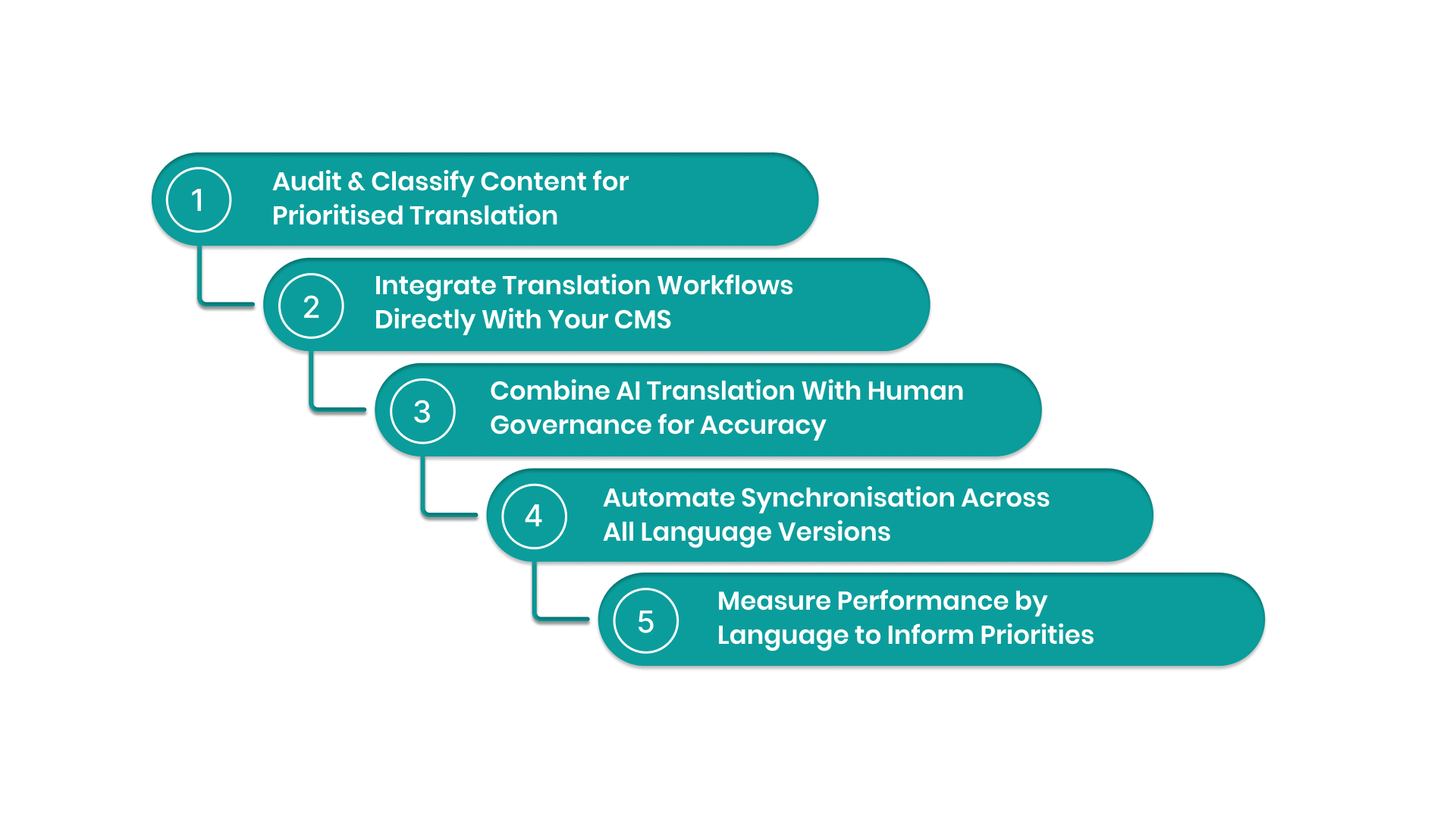
Translating CMS content at scale isn’t a one‑off task. It’s a continuous, automated workflow that powers consistent, culturally relevant digital experiences.
To achieve this at an enterprise level, you must shift from manual localisation to a structured, computerised system that drives productivity, quality and scalability.
1. Audit & Classify Content for Prioritised Translation
Start by analysing your CMS to identify what needs translation and when.
- Classify content by frequency of updates, user impact and regulatory importance.
- High‑priority content includes product pages, support articles, policy updates and pricing pages because outdated translations here directly affect user decisions.
Enterprises that segment content this way reduce redundancy and focus automation where it drives maximum ROI. It prevents translation backlogs and ensures critical pages are always up‑to‑date.
2. Integrate Translation Workflows Directly With Your CMS
Exporting files for translation introduces delays and errors. Modern CMS translation should use API‑driven automation that connects your CMS to translation workflows.
- When a source page changes, the system should automatically trigger translation tasks and track status across languages.
- Automated handoffs eliminate manual exports and imports, significantly reducing turnaround times. API‑integrated translation workflows shorten turnaround times and improve accuracy by reducing human intervention.
This approach ensures your CMS becomes the single source of truth, keeping every language version aligned with the latest content without manual coordination.
3. Combine AI Translation With Human Governance for Accuracy
AI translation accelerates throughput, but accuracy and cultural nuance still matter, especially in enterprise contexts. Use AI for first‑pass translation to scale quickly.
- Implement review checkpoints to ensure experts validate translations for cultural relevance, tone, and regulatory compliance.
- Use translation memory so previously validated phrases are reused automatically, enhancing consistency and reducing effort over time.
This hybrid model is critical in regulated and sensitive sectors such as BFSI, healthcare, and government services, where errors can have legal or trust-related implications.
4. Automate Synchronisation Across All Language Versions
A core challenge in CMS translation is keeping multiple languages in sync when updates occur. An efficient system must:
- Detect changes in the source content.
- Trigger translation updates across all linked languages automatically.
- Prevent “stale” or inconsistent experiences for users in different regions.
Automation at this level ensures all localised versions evolve in lockstep with your primary content, eliminating gaps that damage user trust and SEO performance.
5. Measure Performance by Language to Inform Priorities
Translation isn’t just deployment, it’s optimisation. Use analytics to track:
- Engagement metrics by language (page views, time on page).
- Conversion rates segmented by language version.
- Regional bounce or exit rates.
These insights help prioritise which languages or sections need refinement, ensuring CMS translation drives visible business value rather than just ticking a localisation checkbox.
Efficient CMS translation in 2026 requires structured workflows that integrate with your CMS. A platform like Anuvadak automates your CMS translation process, ensuring content stays up to date and consistent without delays or extra operational costs.
Key Benefits of Translating CMS Content Effectively
Translating CMS content effectively does more than tick a localisation box; it drives measurable business impact. For enterprise decision‑makers in 2026, these benefits translate directly into user engagement, revenue growth and operational excellence.
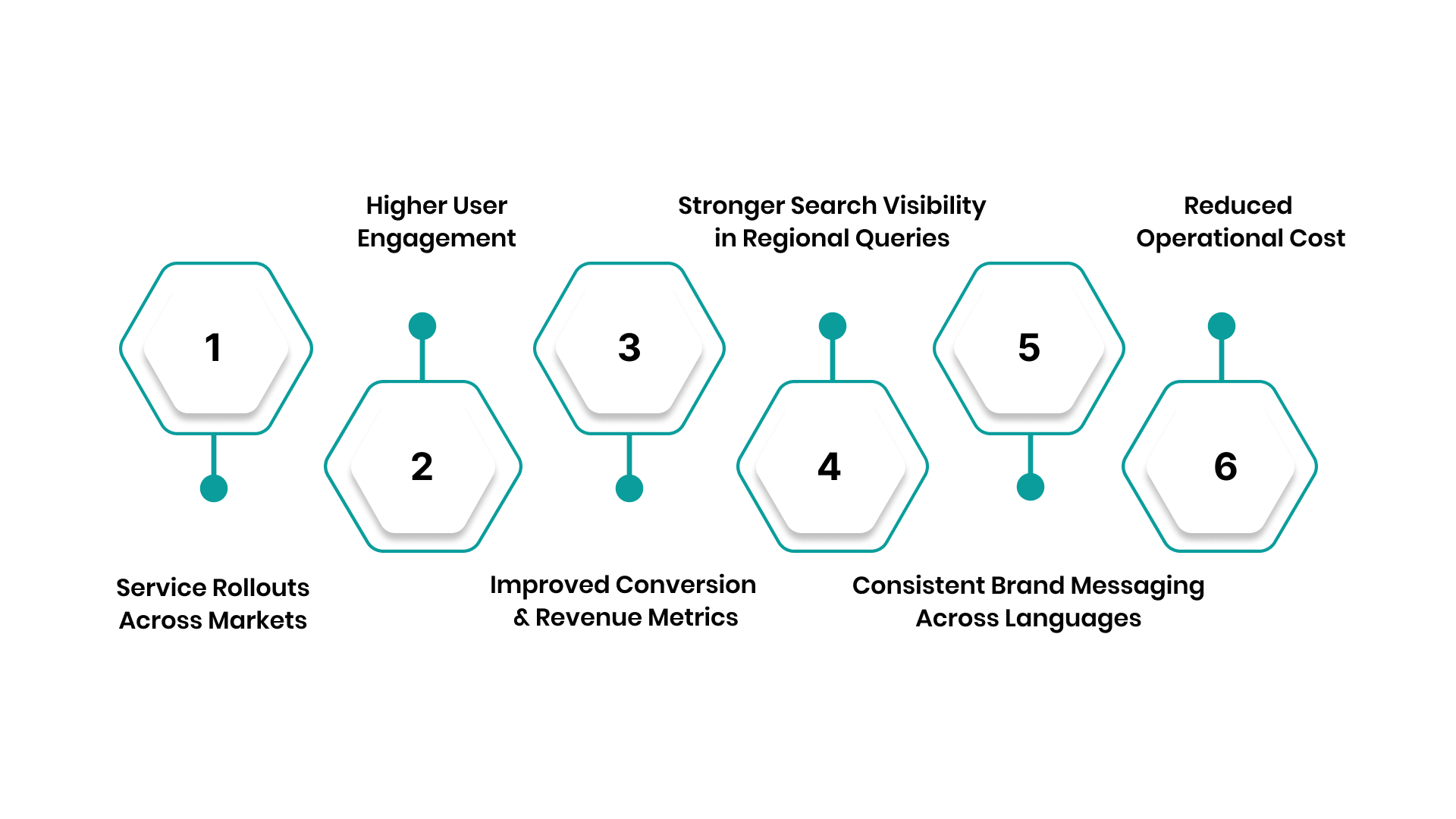
- Faster Product and Service Rollouts Across Markets
When your CMS content is linked to automated translation workflows, product launches and service updates don’t stall waiting for manual localisation.
Faster rollout means your business can respond to market needs quickly, a key advantage in competitive verticals where first‑mover advantage matters.
- Higher User Engagement Through Native Language Experiences
Users engage more deeply with content presented in their preferred language. This is not a hypothesis; it’s reflected in user behaviour across India’s vernacular internet.
In multilingual markets, users are more likely to explore product details, help resources and transactional content when it’s readable and relatable in their native language.
- Improved Conversion and Revenue Metrics
Multilingual experiences reduce friction at key decision points, especially in checkout flows, support portals and self‑service knowledge bases.
For enterprise portfolios with low adoption in regional markets, translated CMS content can generate new revenue streams by presenting offers, pricing and policies in users’ preferred language.
- Stronger Search Visibility in Regional Queries
Localised metadata, hreflang implementation and keyword variants aligned with regional search intent can significantly improve search rankings for non‑English queries.
In India, searches in regional languages like Tamil, Telugu and Bengali have grown faster than English for specific vertical keywords.
- Consistent Brand Messaging Across Languages
Automation ensures that messaging, from taglines to policies, remains consistent across languages rather than being “localised on the fly.” Translation memory and glossary controls reduce semantic drift, so key terms, brand voice and legal phrasing stay aligned.
- Reduced Operational Cost and Resource Strain
Manual translation involves recurring vendor costs, coordination overhead, and high turnaround times. Automated CMS translation tools reduce repetitive work by enabling translation reuse and memory libraries.
Over time, this translates into measurable savings in operational expenses and faster content cycles.
Also Read: How to Translate Chat Messages in Native Languages
Now, as we’ve seen, translating CMS content effectively can provide powerful benefits. Next, let’s look at the best practices to manage this at scale.
7 Best Practices for Managing Translated CMS Content in 2026
Effectively translating CMS content at scale requires more than tools; it demands systems, processes and measurable quality controls. The following practices are designed for enterprise teams tackling high volumes, frequent updates, and performance‑oriented goals.
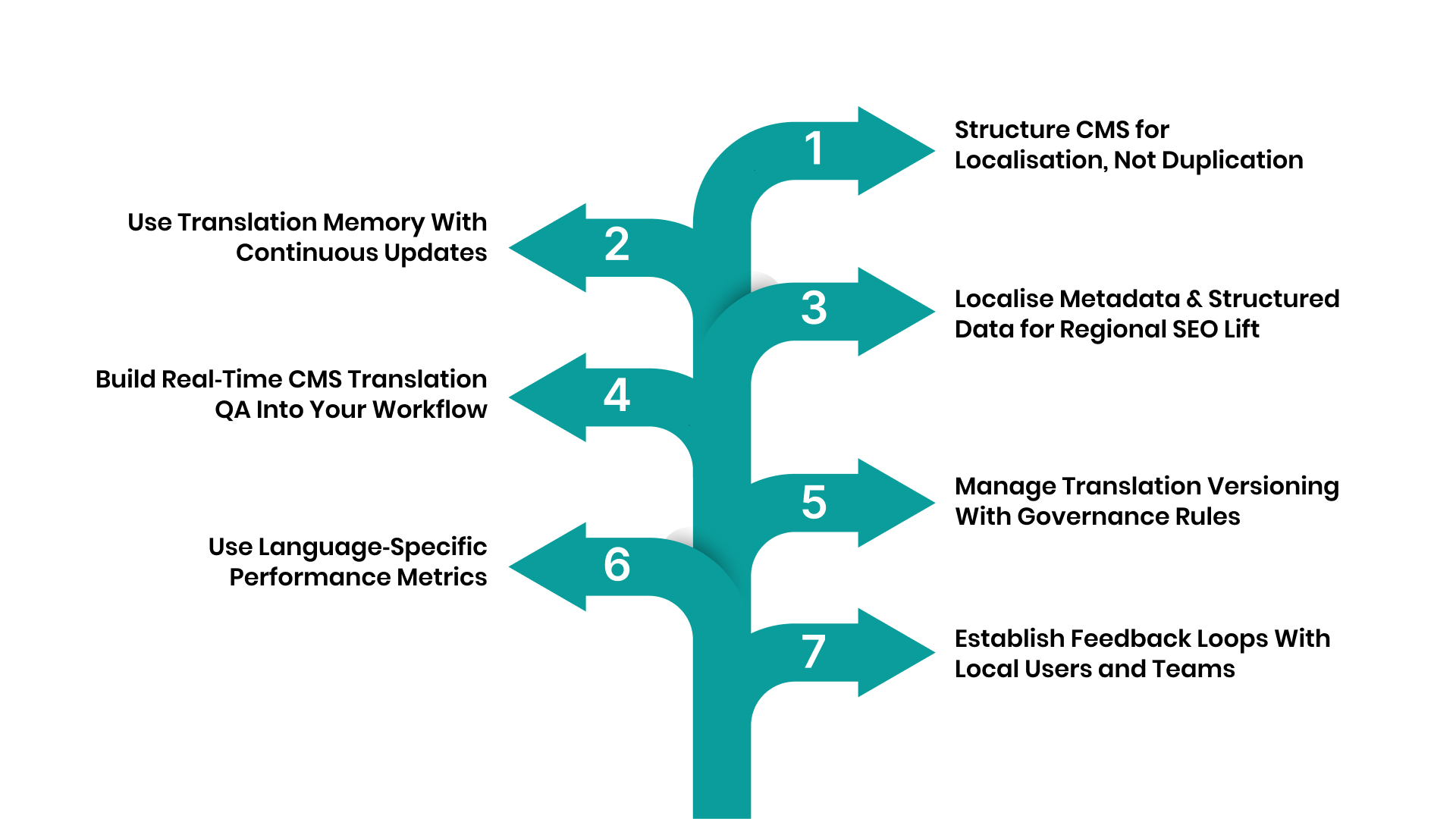
1. Structure CMS for Localisation, Not Duplication
A well‑architected CMS is a precursor to seamless translation.
- Avoid duplicating entire pages per locale. Instead, use locale‑aware content fields that link language variations directly to a single source.
- Define shared content blocks (e.g., headers, footers) separately from localised blocks (e.g., product descriptions) to reduce redundant translations.
This approach reduces content debt, a common problem when managing hundreds of translated pages, and significantly lessens future update overhead.
2. Use Translation Memory With Continuous Updates
Translation memory (TM) isn’t just a repository. It must be continuously refined.
- Store approved translations and contextual usage so phrases don’t just match text but match intent.
- Regularly update TM with new validated translations to improve future automation accuracy.
When TM grows intelligently, you don’t just translate. You standardise your brand’s language across regions and teams.
3. Localise Metadata & Structured Data for Regional SEO Lift
Translating visible CMS text isn’t enough. You must also translate SEO‑critical elements.
- Localise titles, meta descriptions and URL slugs for each language version.
- Include region‑specific keywords based on local search intent, not just literal translations.
For example, search patterns in Tamil and Telugu differ significantly even for the same vertical. Using region‑specific search data rather than English equivalents improves organic rankings.
4. Build Real‑Time CMS Translation QA Into Your Workflow
Quality assurance isn’t a final checkpoint; it must be embedded.
- Use in‑context review tools that let reviewers see translated content as end users would see it, not in isolated spreadsheets.
- Configure automated QA checks for missing translations, punctuation mismatches and inconsistent terminology.
This real‑time feedback loop catches issues early, especially for dynamic content such as promotions, alerts or legal updates.
5. Manage Translation Versioning With Governance Rules
Without versioning discipline, translated content quickly becomes inconsistent.
- Define clear rules for version control, especially for high‑impact content such as pricing, terms, compliance text, and regulatory updates.
- Maintain an audit trail for every translation, showing who reviewed and approved changes.
This governance is especially vital in regulated sectors (BFSI, healthcare, legal) where even minor localisation errors can expose companies to compliance risks.
6. Use Language‑Specific Performance Metrics to Refine Strategy
Data shouldn’t be an afterthought. It should direct localisation priorities. Track metrics like:
- Engagement per language (bounce rate, time on page)
- Conversion rates by locale
- Search visibility trends for regional keywords
These insights tell you not just what needs translation, but what needs improvement. For example, a localised FAQ with low engagement may indicate translation quality issues or a need for better cultural adaptation.
7. Establish Feedback Loops With Local Users and Teams
User behaviour is the ultimate quality signal.
- Collect feedback via in‑product surveys, live chat sentiment, or regional focus groups.
- Bring regional product, UX, and customer support teams into your localisation process, so contextual insights inform translation priorities.
This bridges automation and lived experience, a critical factor for nuanced language differences that AI alone often misses.
Enterprises that implement these practices turn translated CMS content into a differentiator and drive deeper engagement and stronger trust in multilingual markets.
Suggested Read: What is Language Translation and How Does It Work
However, implementing best practices is key, but challenges remain. Let’s take a look at how to overcome common hurdles in translating CMS content.
Overcoming Common Challenges in Translating CMS Content
Even with the right systems in place, enterprises encounter specific challenges when translating CMS content at scale. The key is not just recognising these hurdles. You have to apply strategic solutions that ensure quality, efficiency and consistency across languages.
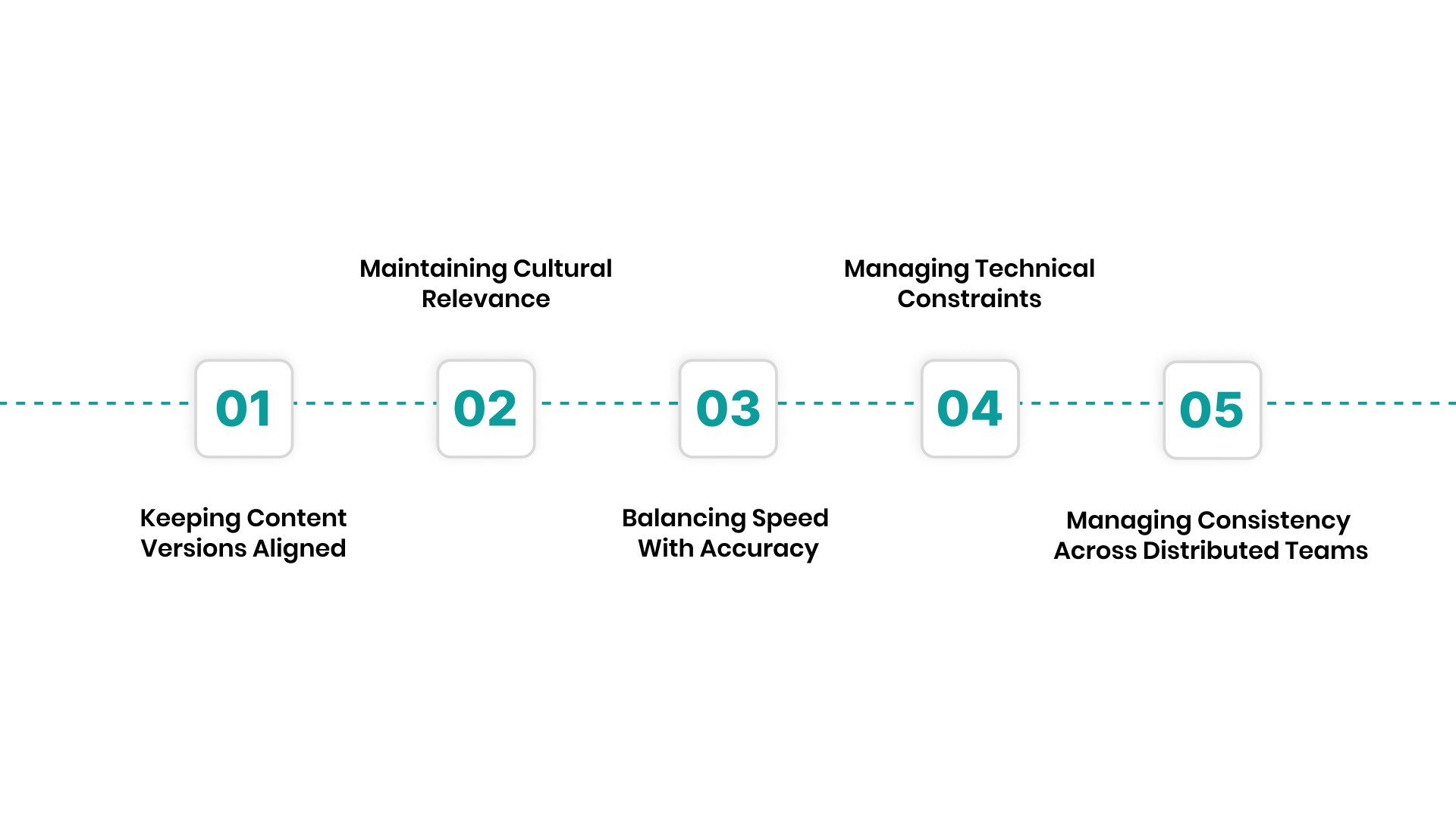
1. Keeping Content Versions Aligned Across Languages
When source content changes frequently, such as pricing, product features or policy pages, translated versions can quickly fall out of sync, this creates inconsistent user experiences and undermines trust.
Solution:
- Adopt a translation system that auto‑detects changes in source CMS content and automatically triggers update workflows for all linked languages.
- Implement version tracking and rollback capabilities so teams can see what changed, when, and why.
Enterprises with automated synchronisation reduce translation lag time to near-real-time, significantly improving user trust and operational agility.
2. Maintaining Cultural Relevance, Not Just Literal Translation
Literal translations may be technically accurate but contextually awkward or culturally inappropriate, especially in markets with nuanced linguistic preferences. Specific phrases or UX calls‑to‑action that work in English or Hindi can feel out of place in languages such as Marathi or Telugu.
Solution:
- Build workflows that combine AI first‑pass translation with regional linguistic review by native speakers.
- Use feedback loops from local support data (e.g., chat transcripts or help requests) to refine future translations.
Content that feels “native” rather than “translated” delivers better comprehension and user satisfaction.
3. Balancing Speed With Accuracy in High‑Priority Content
Enterprises often prioritise speed over quality, which can backfire, especially for sensitive or regulated content. In sectors like BFSI or healthcare, minor inaccuracies in translated policy pages or disclaimers can lead to compliance risks or user confusion.
Solution:
- Define tiered translation policies:
- Tier 1: High‑impact content (legal disclaimers, pricing, terms) goes through stringent human review.
- Tier 2: Routine content (blogs, static pages) uses AI with lighter review cycles.
- Use high-quality scoring metrics to monitor translation quality across content types objectively.
Enterprises maintain compliance without slowing overall delivery.
4. Managing Technical Constraints of Legacy CMS Platforms
Many organisations operate with legacy CMS platforms that lack built‑in localisation support or modern APIs, making automated workflows difficult.
Solution:
- Use middleware integration layers that bridge your legacy CMS with modern translation systems via API connectors.
- Gradually migrate content templates to locale‑aware structures that support multi‑field language variants instead of isolated clones.
Enterprises lower technical debt and unlock automation without a complete CMS overhaul.
5. Managing Consistency Across Distributed Teams
When localisation work is spread across multiple teams, regional content teams, product owners, marketing and legal, inconsistency becomes a risk.
Solution:
- Centralise terminology control via shared glossaries and style guides accessible through the translation workflow.
- Use role‑based workflows so reviewers and translators see exactly what context is required for each CMS update.
This reduces semantic drift and aligns stakeholders on brand voice and quality standards.
By applying these solutions, businesses can turn multilingual CMS translation from a hurdle into an advantage. With Anuvadak, automated updates, real-time translation workflows, and advanced quality checks eliminate these bottlenecks.
Stop wasting time on manual processes and let Anuvadak provide the scalability and control you need to deliver high-quality translations at speed.
Future of Translating CMS Content: What’s Next in 2026
AI translation is no longer just about converting text from one language to another. Next‑generation models now understand context, tone and cultural nuance, crucial for CMS content that must resonate with regional audiences.
Generative AI and large language models are already being used to draft content (like product descriptions and FAQs) directly in target languages, not just translate pre‑existing text.
This shift means CMS translation will increasingly blend translation and creation, enabling teams to generate new language versions without waiting for manual input.
Also, translation isn’t isolated to text anymore. Future CMS strategies will integrate:
- Multimodal localisation (audio, video, interactive UI text).
- Cross‑channel synchronisation between CMS, support systems and voice interfaces.
- Context‑aware multilingual content generation adapted to user behaviour and preferences.
This means CMS translation becomes part of a holistic multilingual content experience, not a backend task.
But, despite AI advances, human review and cultural expertise will remain crucial. Research shows that while machine translation achieves strong grammatical fidelity, cultural nuance, especially idioms and tone, still performs best with expert human validation.
Enterprises that embrace these trends will create richer, more relevant multilingual experiences that drive engagement, trust and competitive advantage.
Also Read: AI-Powered Indian Language Translation: A Glimpse into the Future
As the future of CMS translation evolves, let’s see how Anuvadak can support your journey toward scalability and accuracy.
How Anuvadak Supports Scalable CMS Content Translation
Anuvadak simplifies managing multilingual CMS content at an enterprise scale, eliminating operational burdens. Its integrated localisation system automates translation updates, ensuring accuracy and consistency across all language versions of your content.
Anuvadak provides the control, speed, and precision required to deliver high‑quality digital experiences in multiple languages.
Here’s how Anuvadak enhances your CMS content translation process:
- Automated CMS Translation WorkflowsAnuvadak scans your CMS, identifies translatable content, and automates translation. This reduces manual steps and ensures all language versions are updated simultaneously, reducing delays and errors.
- Centralised Dashboard for Multilingual Content ManagementAnuvadak’s centralised dashboard lets you manage all languages from one interface. This simplifies collaboration across teams, product, content, legal, and compliance, and ensures oversight across every translation task.
- Context-Aware Translation Memory & Glossary ControlsBy storing previously approved translations and key terms, Anuvadak ensures consistency across all languages. This reduces redundancy in future translations and enhances efficiency for recurring content updates.
- Real-Time CMS IntegrationAnuvadak integrates directly with your CMS or custom backend, allowing new content to be translated and deployed automatically, without requiring engineering involvement.
- AI-Assisted Translation with Human Review SupportAnuvadak combines AI-powered translation with robust review workflows, allowing internal or external teams to refine content for contextual accuracy and cultural relevance.
- Script-Friendly Rendering and Layout SupportAnuvadak ensures your content remains readable across various Indian scripts, without requiring significant redesigns. This improves user experience while supporting diverse languages with different script requirements.
- Enterprise-Grade Security and ComplianceAnuvadak uses secure infrastructure and encrypted data flows to protect sensitive content, ensuring compliance with BFSI, healthcare, and government regulations, where privacy and security are paramount.
- Scalable Architecture for Language ExpansionAs your business expands, Anuvadak allows you to quickly add new languages and manage them through the same unified workflow, without needing to overhaul your systems.
All in all, Anuvadak eases the entire CMS content translation process, enabling faster, more accurate localisation while maintaining quality and consistency across languages.
Conclusion
Translating CMS content isn’t just an operational task but a strategic advantage for enterprises looking to scale and connect with diverse audiences. By automating content translation, businesses can ensure consistency, speed, and cultural relevance across every language version of their website, app, or platform.
With Anuvadak, your enterprise can easily automate CMS content translation. Whether you’re figuring out complex content, frequent updates, or regulatory requirements, Anuvadak simplifies the process and scales effortlessly.
Don’t let language barriers slow down your digital growth. Connect with the Anuvadak team for a guided walkthrough or customised support to optimise your localisation strategy.
FAQs
1. What’s the difference between CMS translation and CMS localisation?
CMS translation converts text from one language to another. At the same time, CMS localisation adapts content to cultural norms, formats, and regional expectations (e.g., idioms, currency, date formats) for a truly native user experience.
2. Can I translate just part of my CMS content without affecting the rest of the site?
Yes. Most CMS translation solutions let you select specific pages, sections or fields for translation, so you can prioritise high‑impact content without translating every element of your site.
3. How does translation automation integrate with a traditional CMS?
Modern workflows use API‑driven integration, so your CMS detects changes and automatically triggers translation tasks, eliminating manual export/import cycles and keeping all language versions aligned.
4. Is machine translation alone enough for enterprise CMS content?
Machine translation is efficient for initial drafts, but review and human validation remain essential for accuracy, nuance, and brand tone, especially on high‑stakes pages such as legal, product, or compliance content.
5. How do I ensure translated CMS content is SEO‑friendly?
Translating visible text isn’t enough. Titles, meta descriptions, URLs and locale‑specific keywords must also be localised to match search patterns in each language, improving discoverability in regional search results.