Language has emerged as one of the most decisive factors shaping e-commerce growth in 2026. As digital commerce expands across geographies and demographics, customers increasingly expect shopping experiences that feel familiar, trustworthy, and easy to navigate in their preferred language. For e-commerce platforms, this expectation directly impacts discovery, engagement, and conversion.
A widely cited research found that 76% of consumers prefer to buy products in their native language, even when they understand English. This insight highlights a fundamental shift in how online businesses must approach scale. Language is no longer a secondary consideration. It is a primary driver of customer confidence and purchasing behavior.
This reality is particularly relevant in markets like India, where the next wave of e-commerce growth is coming from Indian-language internet users. As regional language adoption accelerates across mobile-first audiences, English-only interfaces create friction rather than convenience. Product descriptions, navigation elements, checkout flows, and customer support journeys all need to reflect linguistic and cultural context to be effective.
At the same time, the operational complexity of e-commerce has increased sharply. Platforms manage thousands of SKUs, frequent content updates, and multiple internal stakeholders across product, marketing, customer experience, and compliance teams. Manual translation processes cannot keep pace with this scale or speed.
This is why AI-powered translation platforms have become essential for modern e-commerce. By combining automation with governance, collaboration, and linguistic intelligence, these platforms enable businesses to localize continuously without compromising accuracy, brand consistency, or operational efficiency.
In 2026, successful e-commerce brands will be defined not by how many markets they enter, but by how effectively they communicate in every language that matters to their customers.
Key Takeaways
- In 2026, language is a primary driver of e-commerce performance, directly influencing discovery, trust, and conversion across markets.
- Consumer preference for native-language experiences has made localization a core growth requirement, not a supporting feature.
- The biggest challenge for e-commerce teams is no longer translation quality alone, but executing localization at scale across fast-changing catalogs, campaigns, and channels.
- High-volume content, fragmented systems, cross-team dependencies, and governance requirements make manual or ad-hoc translation workflows unsustainable.
- Modern AI translation platforms address these challenges by enabling continuous localization, centralized control, and collaboration across product, marketing, CX, and compliance teams.
- Not all AI translation tools are built for e-commerce; platforms must support CMS integrations, real-time updates, terminology governance, and enterprise-grade security.
- India-focused growth requires deeper Indian-language capabilities, where accuracy, cultural context, and regulatory readiness matter as much as speed.
- Among available solutions, tools like Anuvadak, Lokalise, Smartcat, Unbabel, OneSky, and Stepes serve distinct roles in the e-commerce localization landscape.
- E-commerce leaders in 2026 will differentiate themselves not by the number of languages they offer, but by how effectively localization is embedded into everyday operations.
The E-commerce Localization Challenge in 2026
Understanding the need for multilingual experiences is no longer the challenge. The real difficulty in 2026 lies in executing localization at e-commerce scale, without slowing down business velocity or compromising quality.
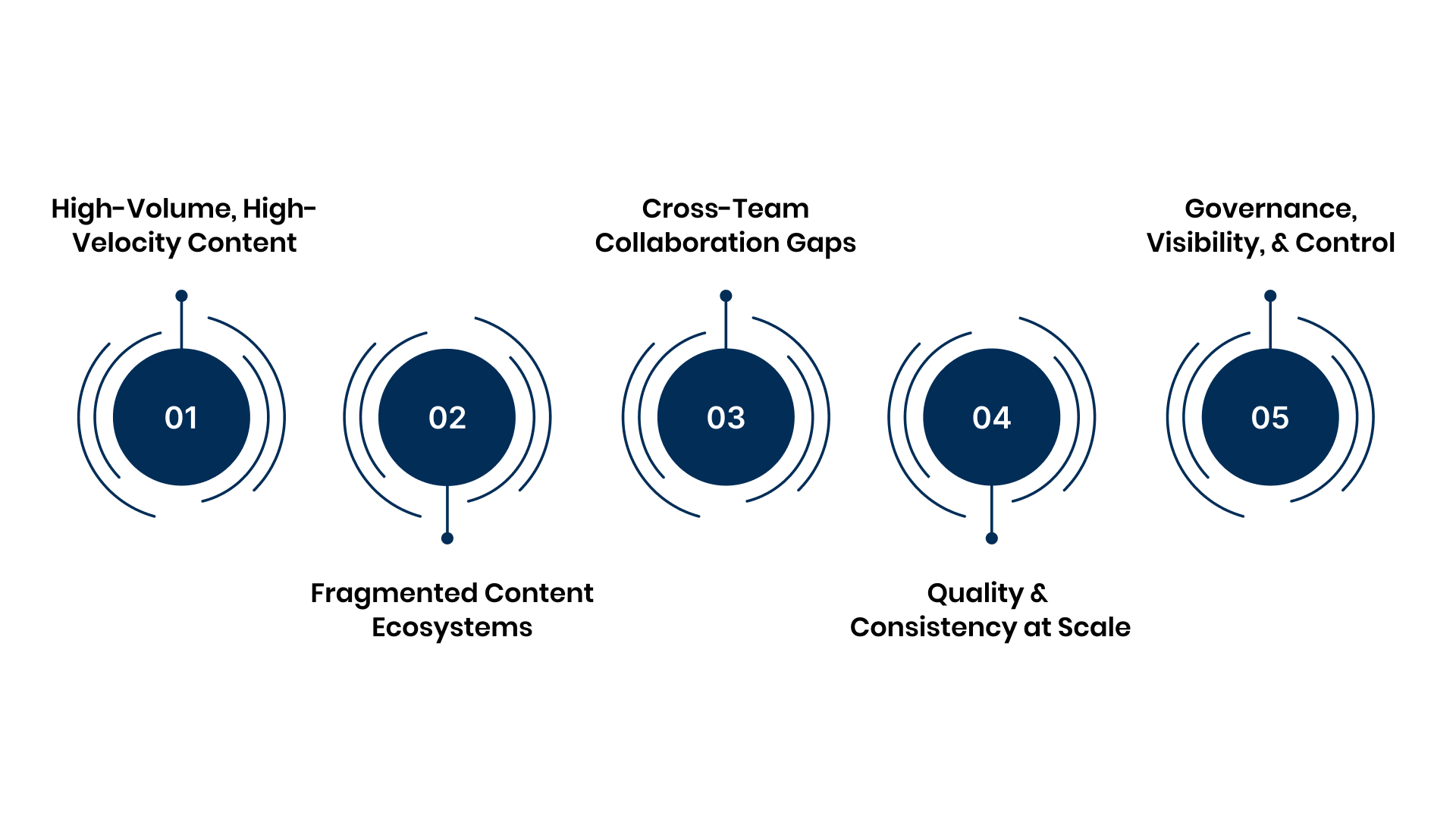
1. High-Volume, High-Velocity Content
E-commerce platforms manage content that changes constantly:
- Large and frequently updated product catalogs
- Dynamic pricing, offers, and promotional banners
- Seasonal campaigns with tight launch timelines
Traditional, static translation workflows struggle to keep up with this pace.
2. Fragmented Content Ecosystems
Localization today extends far beyond product descriptions. Content is distributed across:
- Website navigation and UI components
- Checkout flows and transactional messages
- Marketing landing pages and SEO content
- Customer support articles, chat responses, and emails
When these assets live in disconnected systems, maintaining consistency becomes difficult without centralized localization control.
3. Cross-Team Collaboration Gaps
Localization is no longer owned by a single team. It requires coordination between:
- Product and engineering teams
- Marketing and growth teams
- Legal, compliance, and policy stakeholders
- Customer experience and support teams
Without role-based workflows and structured approvals, teams often duplicate effort or introduce conflicting terminology.
4. Quality and Consistency at Scale
As language coverage expands, quality risks increase:
- Inconsistent terminology across pages and channels
- Loss of brand tone across languages
- Contextually incorrect translations due to lack of in-context review
Without translation memory, glossaries, and automated quality checks, errors scale silently.
5. Governance, Visibility, and Control
Enterprises need answers to questions such as:
- What content has been translated and approved
- Who made linguistic or terminology decisions
- Whether localized content meets internal and regulatory standards
Manual processes and point tools provide little visibility or auditability.
Top AI Translation Tools for E-commerce Websites in 2026
Not all AI translation tools are built for e-commerce environments. The platforms below stand out in 2026 for their ability to handle high-volume content, continuous updates, collaboration across teams, and enterprise-grade governance.
The list is ordered by e-commerce readiness and localization depth, not generic popularity.
1. Anuvadak
Best for: Enterprises scaling multilingual e-commerce across Indian languages with governance and compliance
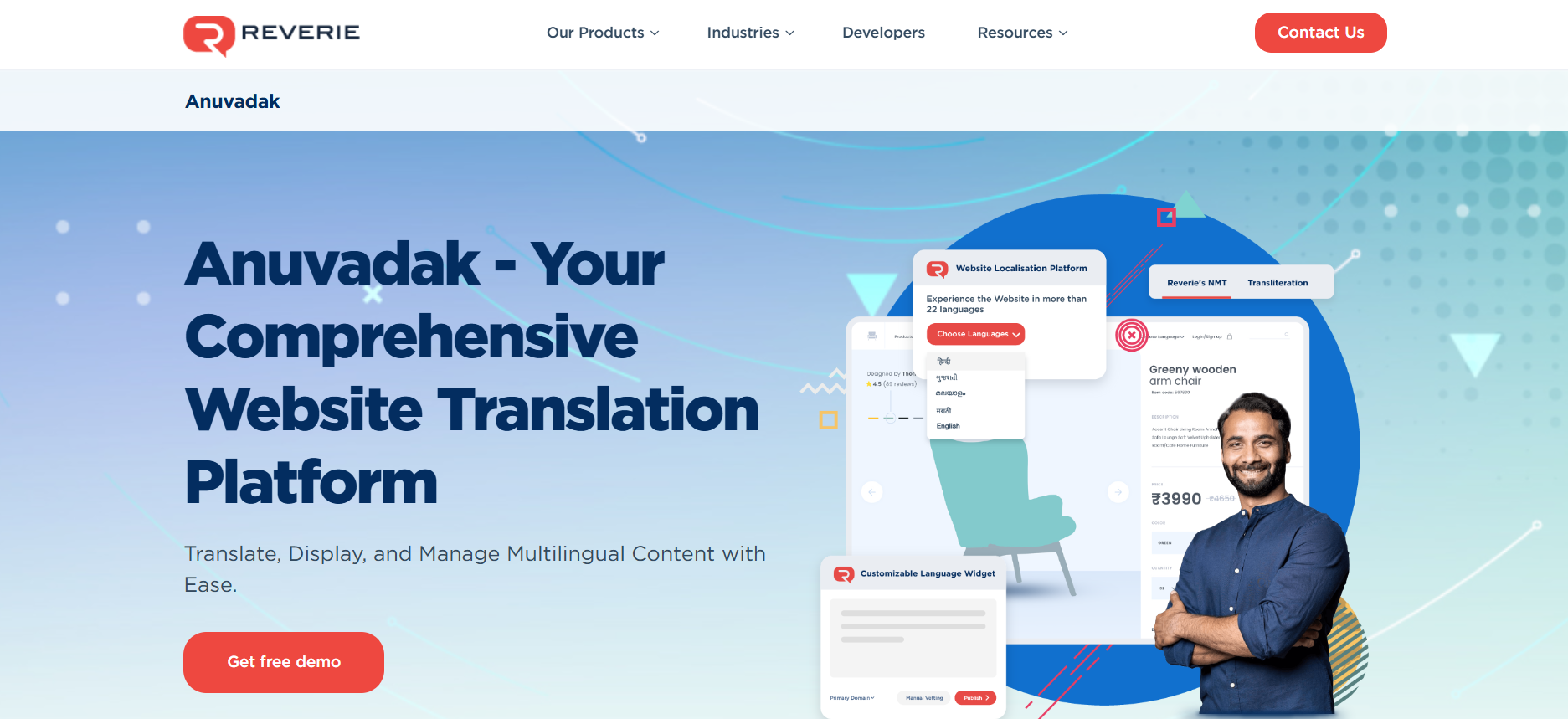
Anuvadak is an AI-powered localization platform designed specifically for India’s multilingual digital ecosystem. Unlike global-first tools, Anuvadak is built to address the linguistic, operational, and regulatory realities of Indian-language commerce.
Key strengths for e-commerce:
- AI translation across 12+ Indian languages
- Continuous localization for websites, apps, and dynamic catalogs
- Centralized glossary and terminology governance
- Role-based workflows for product, marketing, legal, and CX teams
- APIs for real-time content updates
- Enterprise-grade security, access control, and auditability
Why it leads in 2026: As Indian-language users drive the next phase of e-commerce growth, Anuvadak delivers accuracy, cultural relevance, and operational control that generic global tools are not optimized to provide.
2. Lokalise
Best for: Developer-led and design-heavy localization workflows
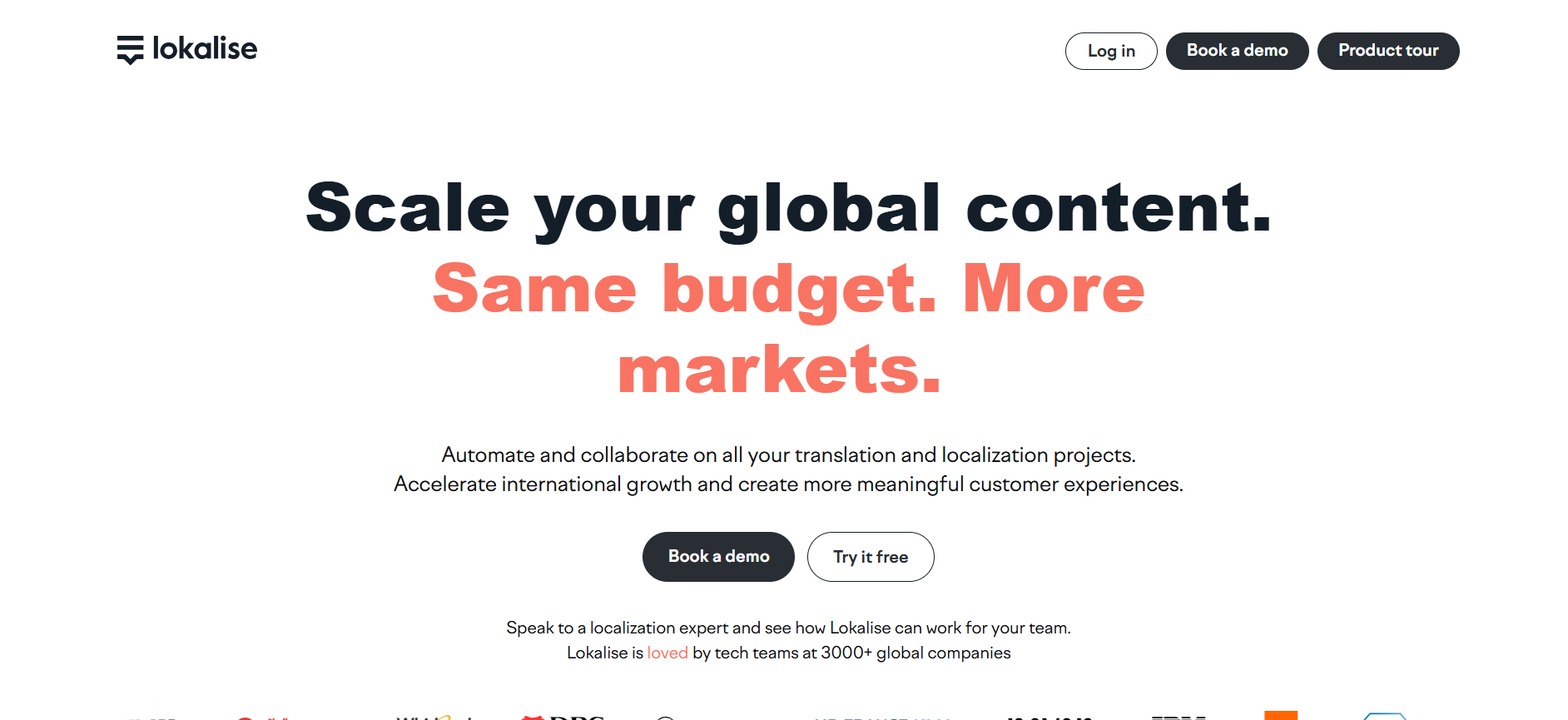
Lokalise is widely used by SaaS and product teams for continuous localization. It integrates well with developer and design ecosystems.
Strengths:
- Strong CI/CD and developer integrations
- In-context editing for UI content
- Good collaboration between product and design teams
Limitations for e-commerce:
- Limited depth in Indian-language localization
- Governance and compliance features are less mature for regulated environments
3. Smartcat
Best for: Hybrid AI and human translation at global scale
Smartcat combines AI translation with a global linguist marketplace, making it suitable for organizations that rely on external translators.
Strengths:
- AI + human-in-the-loop workflows
- Broad language coverage
- Marketplace-based scalability
Limitations for e-commerce:
- Less optimized for continuous, real-time catalog updates
- Governance depends heavily on manual configuration
4. Unbabel
Best for: Customer support and CX localization
Unbabel focuses on translating customer interactions using AI with human post-editing.
Strengths:
- Strong for support tickets, emails, and chat
- Quality-focused workflows
Limitations for e-commerce:
- Not designed for full website or catalog localization
- Limited CMS and commerce platform integrations
5. OneSky
Best for: Agile app and SaaS localization
OneSky is commonly used for mobile apps and software products with frequent release cycles.
Strengths:
- Continuous localization for product teams
- Developer-friendly workflows
Limitations for e-commerce:
- Less suited for marketing and SEO-heavy content
- Limited governance features for large enterprises
6. Stepes
Best for: Fast, mobile-first translation collaboration
Stepes offers a mobile-first approach to translation and review.
Strengths:
- Quick turnaround for short-form content
- Easy collaboration for distributed teams
Limitations for e-commerce:
- Limited depth for large catalogs and automation
- Not built for enterprise-scale governance
At a glance:
| Legend: |
| ✓ = Strong native support ! = Partial / requires customization X = Not supported |
| Evaluation Criteria | Anuvadak | Lokalise | Smartcat | Unbabel | OneSky | Stepes |
| Continuous localization | ✓ | ✓ | ! | X | ✓ | ! |
| E-commerce & CMS integrations | ✓ | ✓ | ! | X | ! | X |
| Translation memory reuse | ✓ | ✓ | ! | ! | ✓ | ! |
| Glossary & terminology governance | ✓ | ! | ! | ! | X | X |
| Role-based workflows & approvals | ✓ | ! | ! | ! | X | X |
| In-context review | ✓ | ✓ | ! | X | ! | X |
| Indian language depth | ✓ | X | ! | X | X | X |
| Enterprise security & auditability | ✓ | ! | ! | ! | X | X |
| Best suited for e-commerce scale | ✓ | ! | ! | X | ! | X |
How AI Translation Tools Enable Cross-Team Collaboration
In modern e-commerce organizations, localization functions as a shared operational layer rather than a linear handoff. AI translation platforms enable multiple teams to work simultaneously on multilingual content while maintaining control and consistency.
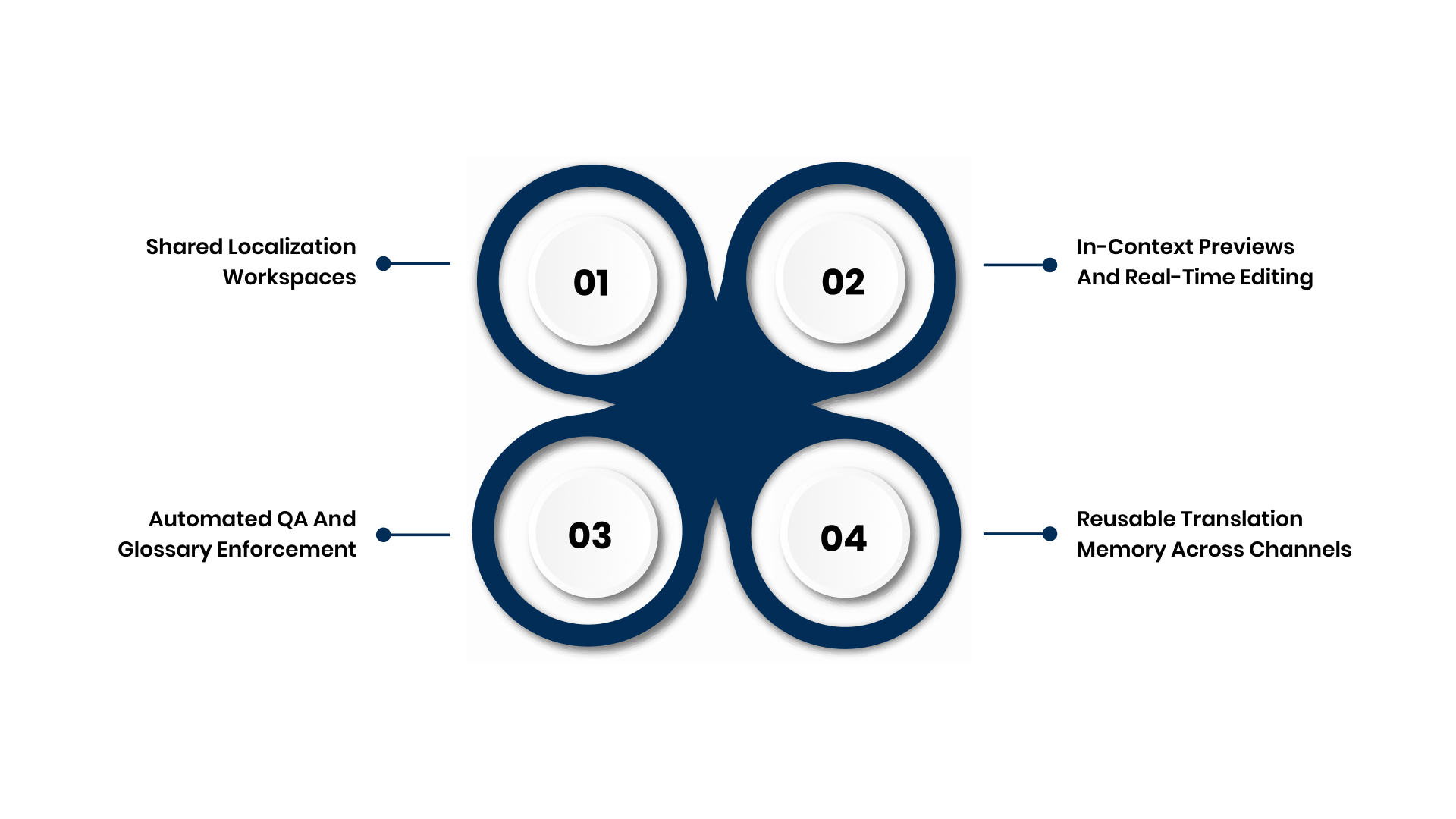
Shared Localization Workspaces
Centralized workspaces allow:
- A single source of truth for all localized content
- Real-time visibility into content status and ownership
- Reduced duplication across teams working on overlapping assets
This structure replaces fragmented handoffs with coordinated execution.
In-Context Previews and Real-Time Editing
Instead of reviewing strings in isolation, teams can:
- Validate translations within live page or UI contexts
- Catch layout, truncation, and meaning issues early
- Make immediate adjustments without restarting workflows
This shortens review cycles and lowers post-release corrections.
Automated QA and Glossary Enforcement
AI-powered quality controls:
- Apply approved terminology automatically
- Detect deviations in tone, formatting, and placeholders
- Block non-compliant content from advancing
Quality becomes continuous rather than reactive.
Reusable Translation Memory Across Channels
Centralized translation memory enables:
- Consistent reuse of approved translations across touchpoints
- Faster localization of similar or recurring content
- Lower marginal effort as content volume grows
This supports scale without proportional increases in effort.
E-commerce Use Cases in 2026
By 2026, AI translation platforms are embedded across core commerce functions, supporting both customer-facing and operational workflows.
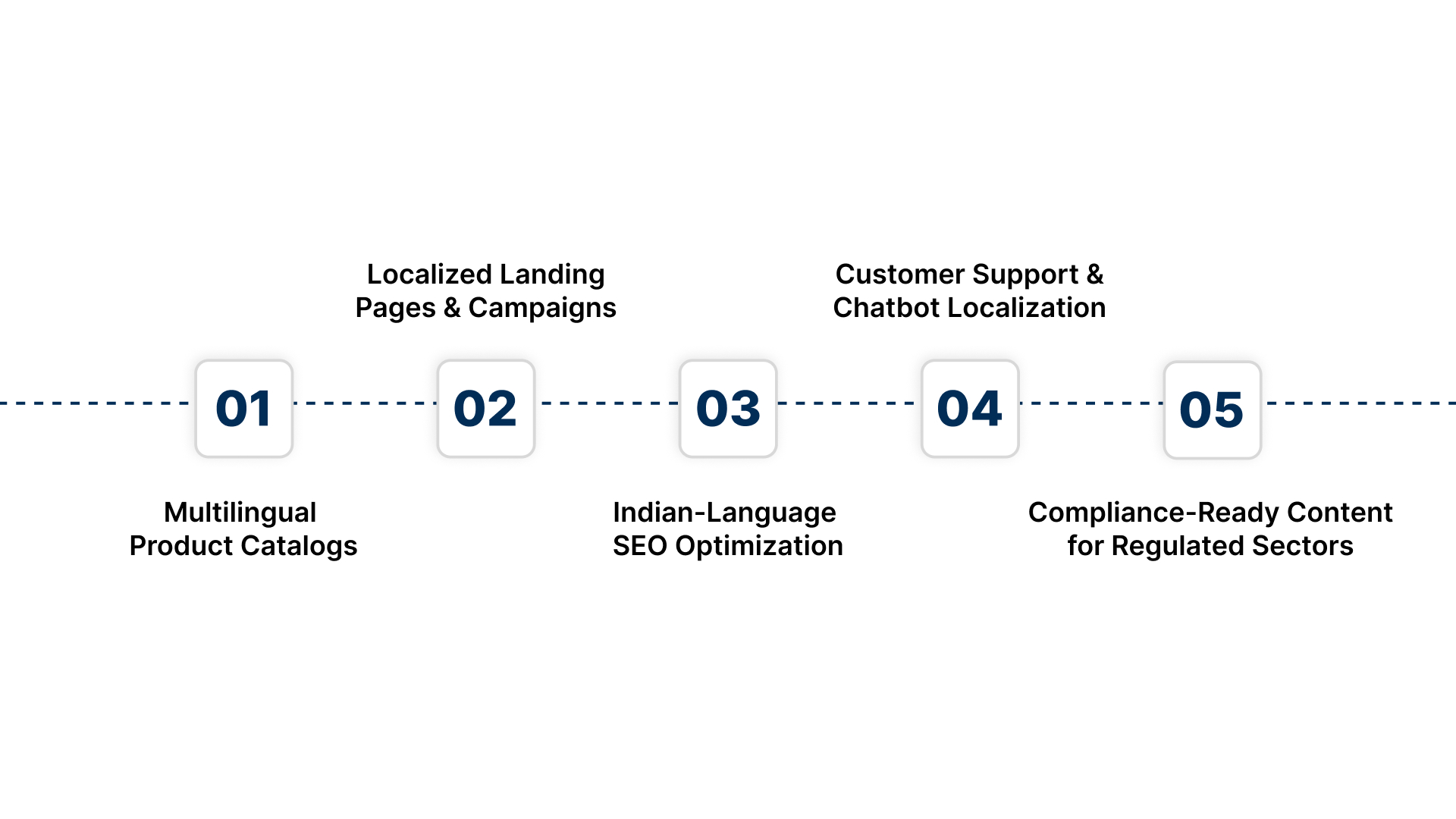
Multilingual Product Catalogs
- Automated localization of large SKU inventories
- Consistent translation of attributes and specifications
- Rapid propagation of updates across languages
Catalog localization becomes continuous rather than episodic.
Localized Landing Pages and Campaigns
- Parallel campaign launches across regions
- Faster turnaround for promotions and seasonal initiatives
- Alignment between global messaging and local tone
This enables synchronized go-to-market execution.
Indian-Language SEO Optimization
- Localization of metadata, navigation paths, and content structure
- Consistent keyword usage across categories and product pages
- Better alignment with regional search behavior
SEO localization integrates with broader search strategy.
Customer Support and Chatbot Localization
- Synchronized updates between product content and support assets
- Multilingual chatbot responses aligned with current offerings
- Reduced misinterpretation in customer interactions
Support experiences remain consistent across languages.
Compliance-Ready Content for Regulated Sectors
- Controlled translation of disclosures and policy content
- Structured approval workflows involving compliance teams
- Traceability for audits and internal reviews
Localization aligns with governance requirements, not just speed.
Building a Future-Ready AI Translation Workflow
A sustainable AI translation strategy requires a defined operational framework that integrates localization into everyday publishing and decision-making.
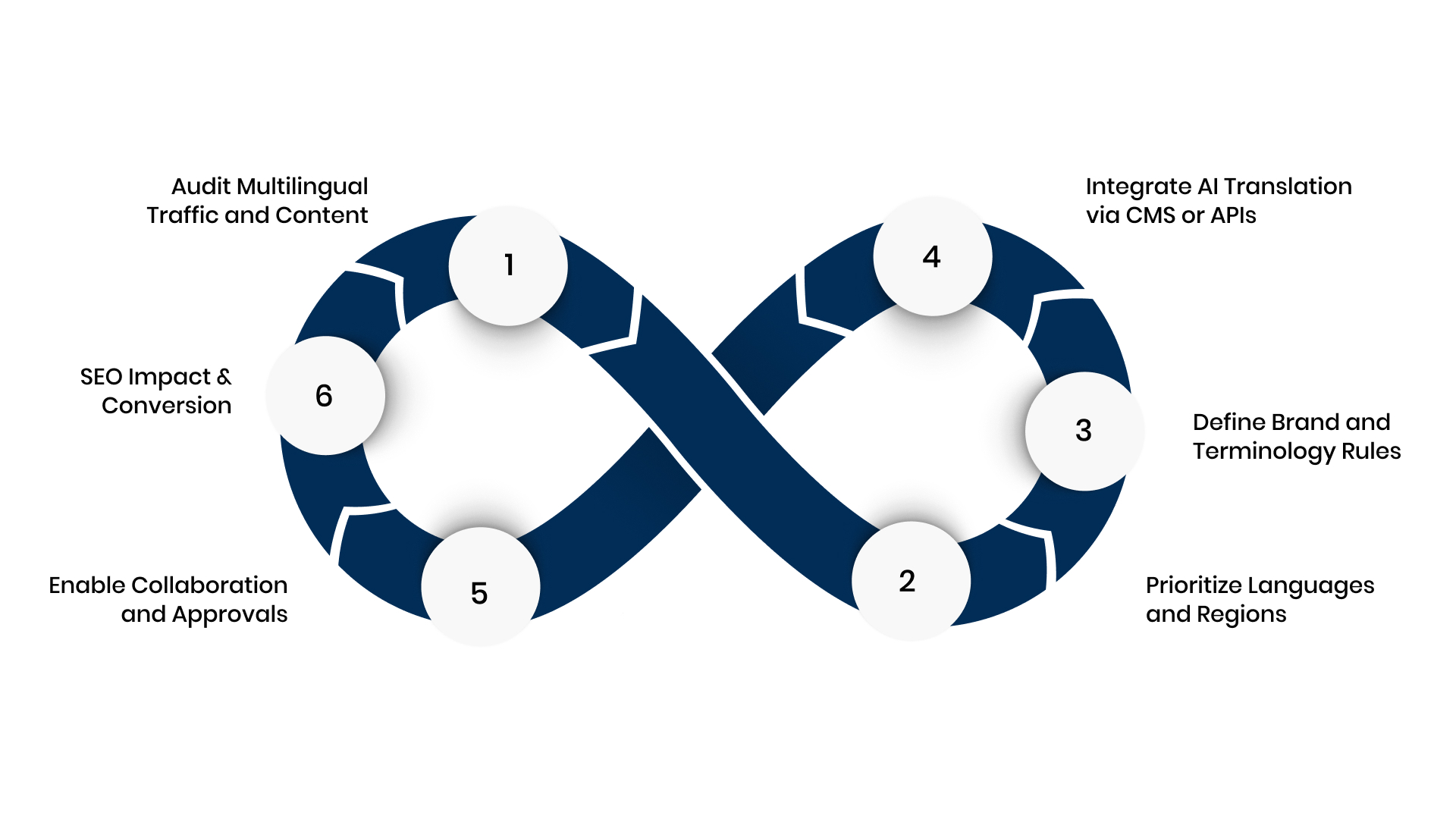
1. Audit Multilingual Traffic and Content
- Identify high-impact pages and content types
- Map dynamic versus static assets
- Focus localization where it influences outcomes
This establishes prioritization before execution.
2. Prioritize Languages and Regions
- Sequence rollout based on business readiness
- Align language expansion with operational support
- Avoid overextending localization scope early
Controlled expansion reduces complexity.
3. Define Brand and Terminology Rules
- Establish approved glossaries and naming standards
- Set tone guidelines by content category
- Lock critical terms to prevent drift
Governance precedes automation.
4. Integrate AI Translation via CMS or APIs
- Embed localization directly into content systems
- Automate translation triggers for updates
- Minimize manual handling
Localization becomes part of standard publishing.
5. Enable Collaboration and Approvals
- Assign clear roles for review and sign-off
- Configure approval paths by content sensitivity
- Maintain visibility into workflow progress
Speed and accountability coexist.
6. Measure Quality, SEO Impact, and Conversion
- Track turnaround time and error rates
- Monitor search performance by language
- Assess conversion changes on localized pages
Localization performance becomes measurable and optimizable.
Conclusion
In 2026, AI translation has moved beyond experimentation and become a core part of how e-commerce businesses operate across markets. The real differentiator is no longer how many languages a platform supports, but how effectively localization is embedded into everyday workflows across product, marketing, customer experience, and compliance teams.
E-commerce organizations that treat localization as infrastructure rather than a one-off task are better positioned to move faster, maintain consistency, and adapt to market changes without operational friction. This shift is especially critical in multilingual environments, where scale and accuracy must coexist.
Anuvadak is designed for this stage of maturity. Built for India’s multilingual digital ecosystem, it enables enterprises to manage Indian-language localization with the same rigor, governance, and automation as their core commerce systems.
To see how Anuvadak can support scalable, enterprise-ready multilingual e-commerce in 2026 and beyond, book a demo.
FAQs
Q: What is AI translation for e-commerce websites?
A: AI translation for e-commerce websites uses machine learning models to automatically translate product content, UI elements, and customer communications into multiple languages. In 2026, these tools are typically integrated directly into content and publishing workflows.
Q: How accurate are AI translation tools for e-commerce in 2026?
A: AI translation accuracy has improved significantly for common e-commerce content, especially product descriptions and interface text. Accuracy still depends on glossary control, domain tuning, and review workflows for sensitive content.
Q: Can AI translation tools handle large product catalogs?
A: Modern AI translation platforms are built to process large and frequently changing product catalogs at scale. They rely on automation and translation memory to avoid re-translating repetitive content.
Q: Is AI translation good for multilingual SEO?
A: AI translation can support multilingual SEO by translating metadata, headings, and structured content across languages. SEO outcomes depend on proper CMS integration and alignment with regional search intent.
Q: Do AI translation tools support Indian languages for e-commerce?
A: Some AI translation tools support Indian languages, but coverage and accuracy vary by platform. Tools designed for Indian-language localization typically perform better for regional scripts and terminology.