Most Indian enterprises struggle with outbound campaigns that fail to scale because they rely on manual dialers and inconsistent human agents. You likely face rising costs per acquisition while your “Right Party Contact” rates plummet because customers ignore unidentified ten-digit numbers.
Traditional robocalls often trigger spam filters and frustrate high-value prospects, but modern automated outbound calls use conversational AI to solve this. India’s call center outsourcing market, which includes outbound services, generated USD 3,859.7 million in revenue in 2024, projected to grow at 15.2% CAGR to USD 9,037.8 million by 2030.
These intelligent agents handle complex debt collections, lead qualification, and order verification by speaking naturally and understanding regional nuances in real time.
In this guide, we will break down the frameworks for launching voice AI campaigns, the latest TRAI compliance mandates for 2026, and the metrics you need to track ROI.
Quick Look
- With the February 2026 deadline fast approaching, all large NBFCs and IRDAI-regulated insurance entities must finalize their transition to the 1600-series prefix.
- Success in collections is now measured by the ratio of positive verbal commitments to total connected calls.
- Intelligent outbound agents use NLU to eliminate the “robotic pause,” ensuring the conversation starts the millisecond a human says “Hello.”
- High-performing systems sync daily with TRAI’s Distributed Ledger Technology (DLT) to prevent heavy penalties and blacklisting.
- Automated calls in 2026 must support “Hinglish” and regional dialects to maintain high engagement in the Indian market.
What Are Automated Outbound Calls?
Automated outbound calls have shifted from one-way pre-recorded broadcasts to two-way, AI-powered voice interactions. Modern systems utilize Natural Language Understanding (NLU) to process customer intent in real-time, allowing the AI to answer questions or negotiate payments dynamically.
Instead of a “press 1” menu, the recipient simply speaks to a digital agent that sounds and behaves like a trained human professional.
Moving from static broadcasts to interactive conversations is essential for maintaining brand reputation and driving actual business outcomes.
Are you struggling to hit your monthly collection or sales targets with a manual calling team? CubeRoot’s AI-powered outbound agents scale your reach instantly by handling thousands of simultaneous, human-like conversations.
Why Your Business Needs an Automated Outbound Strategy
Deploying an automated strategy allows your business to move beyond the limitations of physical call centers and manual labor. You can finally execute high-volume campaigns with precision while ensuring every customer receives a consistent, high-quality experience.
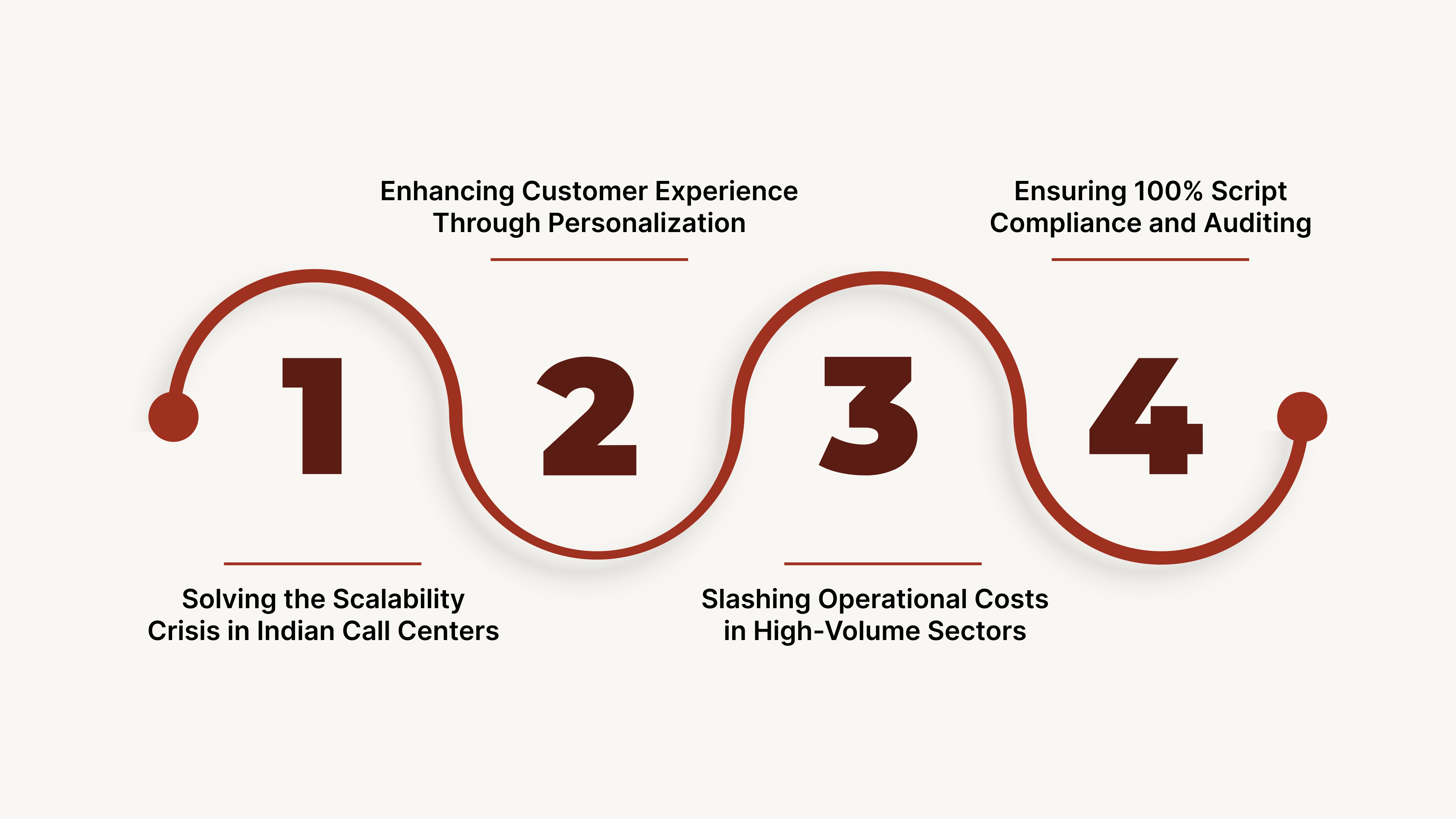
The following factors make automation a necessity for modern Indian enterprises:
1. Solving the Scalability Crisis in Indian Call Centers
Hiring and training hundreds of agents for massive outbound campaigns, such as end-of-month debt collection cycles, is a logistical bottleneck. Automated systems deploy in minutes and handle unlimited concurrent calls, ensuring you reach every customer at the optimal time without extra headcount.
This elasticity allows your business to react to market shifts or seasonal peaks without the friction of a traditional recruitment cycle.
2.Enhancing Customer Experience Through Personalization
Data-driven automated calls feel more like a helpful service and less like a cold, intrusive sales pitch. By pulling live data from your CRM, the AI can reference specific details like the customer’s name, their recent purchase, or the exact due date of a loan.
This context builds immediate rapport and significantly reduces the “spam” perception that often kills outbound conversion rates.
3. Slashing Operational Costs in High-Volume Sectors
Traditional outbound centers carry heavy overheads, including seat costs, management layers, and high agent attrition rates. AI-driven automated outbound calls reduce the cost-per-interaction while operating 24/7 without fatigue or performance dips
For sectors like D2C or Fintech, this massive reduction in OpEx directly improves the bottom-line profitability of every customer acquired.
4. Ensuring 100% Script Compliance and Auditing
Human agents often deviate from scripts, especially in highly regulated sectors like BFSI, where specific legal disclosures are mandatory. Automated agents follow your predefined logic with absolute precision, ensuring every call is compliant with your internal standards and government regulations.
Every interaction is automatically logged and transcribed, providing an unalterable audit trail for your compliance and quality assurance teams.
Establishing a strong business case is the first step toward building a campaign that delivers measurable results.
Also Read: What is a Voice Bot and How to Use It?
How to Build and Launch a High-Conversion Outbound Campaign
The difference between a successful campaign and a blocked number lies in the technical and creative design of the interaction. You must align your data, logic, and technology to create a flow that feels natural and serves a clear purpose for the recipient.
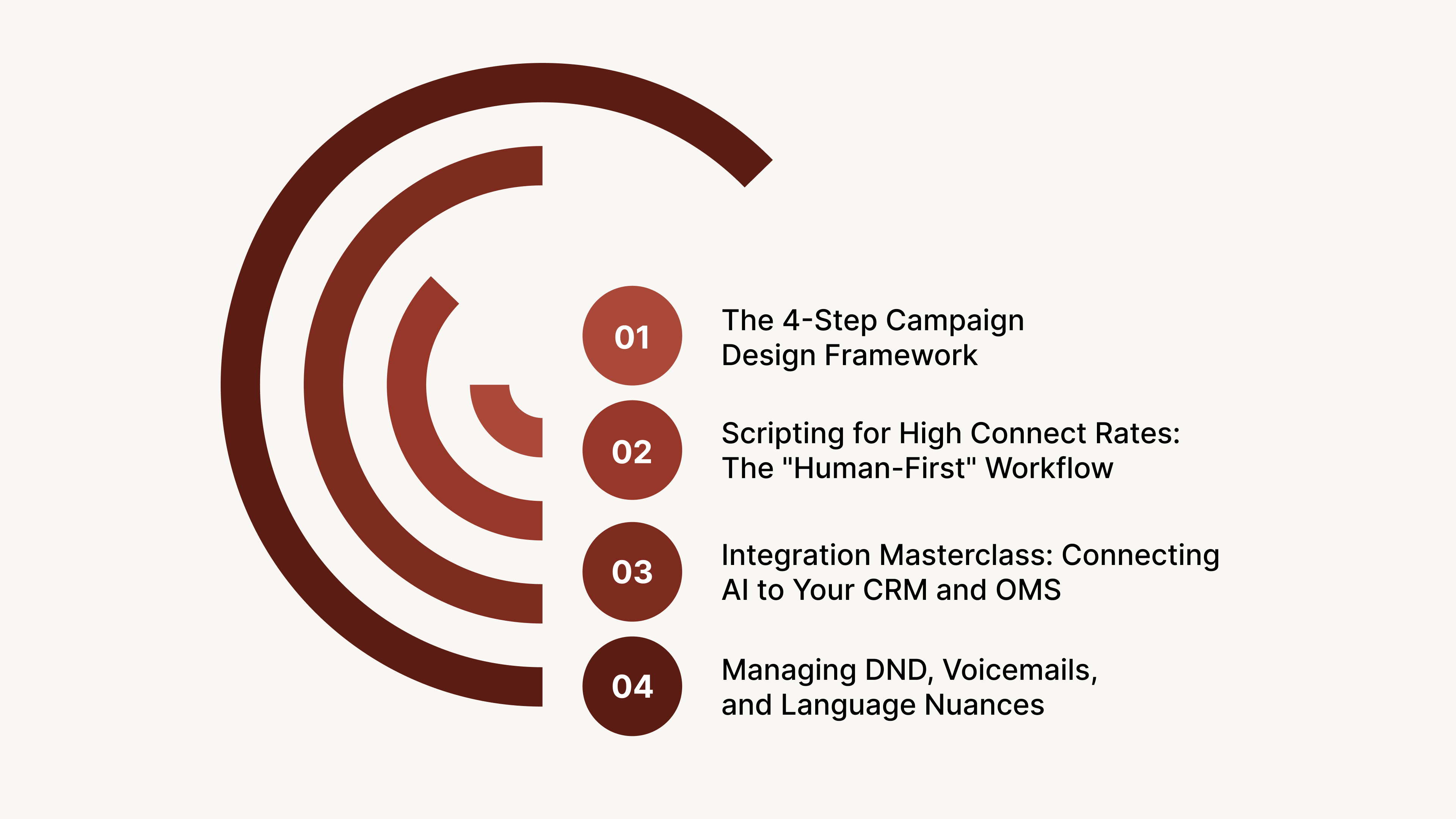
Follow these H3-level steps to design a world-class outbound engine:
1. The 4-Step Campaign Design Framework
A structured workflow ensures you don’t waste budget on low-intent leads or broken logic paths. Start with Data Segmentation to target the right audience, followed by Intent Mapping to predict what the customer might say.
Then, build your Script Logic to handle variations, and always conclude with Pilot Testing on a small sample size before scaling.
- Segment your calling list by customer value or urgency (e.g., 1-day vs. 30-day overdue).
- Create a “Decision Tree” that accounts for common customer objections.
- Set up automated triggers so the AI calls as soon as an event (like a missed payment) occurs.
- Monitor initial call logs to refine the NLU model based on real customer responses.
- Analyze drop-off points in the test phase to shorten the conversation flow where needed.
2. Scripting for High Connect Rates: The “Human-First” Workflow
To avoid the “Robotic Gap” that causes instant hang-ups, your AI must use a Hook-Value-Ask structure. The “Hook” immediately identifies the customer, the “Value” explains the reason for the call, and the “Ask” is a clear, simple call to action.
Avoiding stiff, formal language and using natural openers like “Hi [Name], I’m calling from…” helps the AI bypass the mental filters people have against automated systems.
3. Integration Masterclass: Connecting AI to Your CRM and OMS
Technical success depends on your AI having access to live customer data through an API-first deployment. If the agent knows a customer just placed an order five minutes ago, the call becomes a confirmation service rather than a generic outreach.
- Ensure your CRM pushes lead data to the calling engine in real-time.
- Configure “Write-Back” logic to update the CRM with the call outcome (e.g., “PTP Confirmed”).
- Verify that API latencies are under 200ms to prevent pauses during the conversation.
- Sync your order management system (OMS) to handle returns or order edits via voice.
4. Managing DND, Voicemails, and Language Nuances
In India, your system must intelligently handle regional dialects and technical hurdles like answering machines. Advanced AI models can detect if they’ve hit a voicemail and will either hang up or leave a personalized message as per your preference.
Furthermore, the system must automatically filter out numbers on the National Customer Preference Register (NCPR) to stay on the right side of the law.
Designing a campaign is only half the battle; you must also know how to measure its performance accurately.
Key Metrics to Measure and Optimize Outbound Performance
You cannot optimize what you do not measure, and outbound calling requires a specific set of KPIs that go beyond simple “total calls.” You must focus on the quality of the connection and the customer’s actual conversion intent.
Use these benchmarks to track your success:
1. The Calculation Guide: From Pickup Rates to Intent-to-Pay
The most critical metric for BFSI and Collections is the Intent-to-Pay (ITP), which tracks how many connected calls resulted in a verbal payment commitment. Other essential formulas include the ASR (Answer Seizure Ratio) and the Conversion Rate.
- Conversion Rate = Positive Outcomes / Total Calls Connected * 100
- ASR = Answered Calls / Total Calls Dialed * 100
- ITP Ratio = Verbal Commitments / Total Unique Contacts
Tracking these allows you to pinpoint whether your problem lies in the data quality (ASR) or the script effectiveness (Conversion).
2. Benchmarking Success: Comparing AI vs. Human Agent ROI
To justify the shift to automated outbound calls, you should maintain a “Before and After” table comparing cost-per-minute and efficiency. AI agents typically increase calls-per-hour compared to humans because they do not require breaks or wrap-up time.
By looking at the Cost per Successful Resolution, you will likely find that AI is significantly more efficient for routine transactional tasks.
Measuring ROI ensures your strategy remains profitable as you scale your operations.
Ensuring Compliance: Navigating TRAI Guidelines and Data Privacy
In India’s strict regulatory market, outbound strategies must prioritize transparency to avoid massive fines. Unregistered telemarketer complaints reached 750,000 in the first half of 2024 alone, prompting TRAI regulatory reviews.
Businesses must distinguish between promotional 140-series and transactional 160-series prefixes. BFSI and IRDAI-regulated entities must finalize their 160-series transition by mid-February 2026 to ensure compliance and maintain customer trust.
Enterprises must also maintain encrypted voice logs for full auditability. In banking and healthcare, these records are vital for proving verbal consent and resolving disputes.
Using automated PII redaction ensures sensitive data like OTPs remains masked, preventing misuse while keeping every interaction traceable and secure.
Are you worried about the latest TRAI mandates and the 1600-series transition? CubeRoot provides fully compliant, SOC2-certified voice AI solutions that automatically handle DND filtering and secure auditing. Contact us today.
Even with a compliant platform, strategic missteps can undermine your campaign’s effectiveness.
Common Mistakes That Kill Your Outbound ROI and How to Fix Them
Even the best AI technology can fail if the strategy behind it ignores customer behavior and technical best practices. You must avoid these common pitfalls to ensure your outbound campaigns don’t end up being marked as “Spam” by the community.
1. Ignoring Call Timing and Frequency
Calling a customer three times in one morning is a guaranteed way to get blocked and lower your brand’s reputation. “Spamming” leads not only to poor ROI but also triggers TRAI’s automated spam detection filters, which can blacklist your headers.
- Fix: Implement “Pacing” rules that limit the number of attempts per lead and only call during optimal windows (e.g., 10 AM to 7 PM).
- Pro Tip: Use historical data to identify the specific hour when your target ICP is most likely to answer the phone.
2. Poor Audio Quality and Unnatural Latency
If there is a two-second delay after a customer says “Hello,” they will immediately assume it’s a bot and hang up. High latency and “crackly” audio are the biggest killers of conversion rates in automated outbound calls.
- Fix: Choose a provider with local Indian servers and low-latency NLU to keep the response gap under 500ms.
- Pro Tip: Use high-quality neural voices that include natural “filler” sounds to make the transition between listening and speaking feel more human.
Avoiding these mistakes ensures your campaign maintains a high “Right Party Contact” rate.
Also Read: What Is A Conversational UI? A Simple Guide
Choosing the Right Automated Outbound Tool: A Checklist
Selecting an enterprise platform requires evaluating beyond basic features. Use this checklist to assess vendors for long-term success.
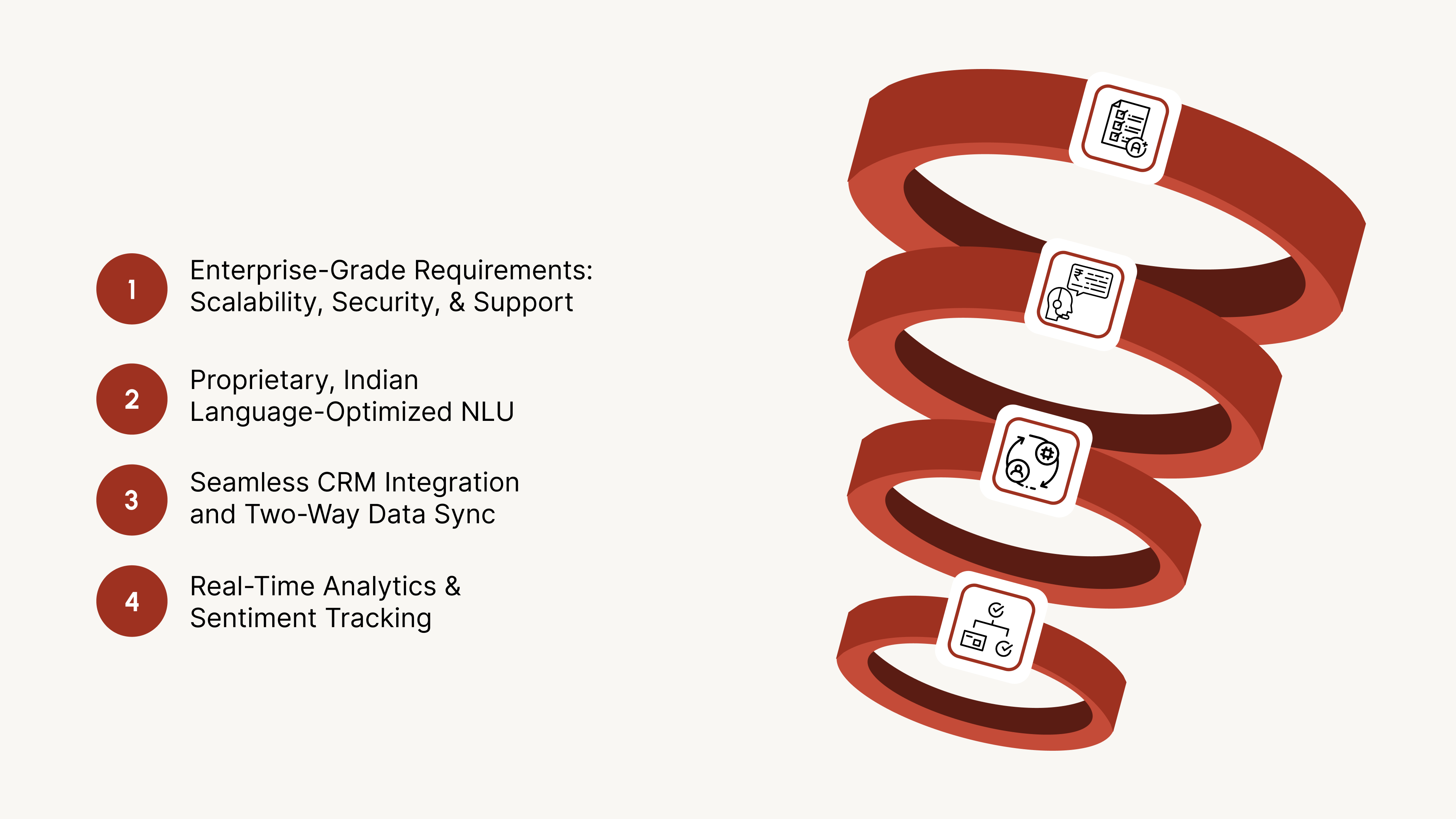
1. Enterprise-Grade Requirements: Scalability, Security, and Support
Your vendor must offer:
- True Scalability: Ability to handle from 100 to 100,000+ calls daily without performance degradation.
- Strong Security: Certifications like ISO 27001/SOC 2, data encryption, and role-based access controls.
- Dedicated Support: A dedicated success manager during implementation and accessible technical support.
2. Proprietary, Indian Language-Optimized NLU
The AI’s brain must understand India’s linguistic diversity. A platform using a generic, global NLU will fail with regional accents and Hinglish.
- Pro Tip: Ask for a live demo using a mix of English and a regional language. Test if the AI can comprehend and respond contextually.
3. Seamless CRM Integration and Two-Way Data Sync
The platform should offer pre-built connectors or a flexible API for your core systems (Salesforce, Zoho, Microsoft Dynamics).
- Pro Tip: Request a proof-of-concept integration for one key data flow, like pulling a customer’s last invoice amount, to test ease and reliability.
4. Real-Time Analytics and Sentiment Tracking
You need a dashboard that shows live campaign metrics (calls, pickups, outcomes). In-call sentiment analysis is crucial for identifying frustrated customers and escalating them.
- Pro Tip: Review a sample analytics dashboard. Ensure it provides the metrics from Section 4 and allows for data export.
The right platform unlocks maximum value when applied to well-defined, high-impact business scenarios.
Top Use Cases for Automated Outbound Calls
The most successful deployments of this technology focus on high-volume, repetitive interactions that are traditionally difficult for humans to manage at scale.
- BFSI: Debt Collections and Payment Reminders: Banks and NBFCs deploy AI agents to call thousands of customers before an EMI is due, ensuring funds are available. If a payment is missed, the AI negotiates a “Promise to Pay” date and updates the CRM instantly, significantly improving recovery rates while reducing legal workloads.
- Retail & eCommerce: COD Confirmations and Re-engagement: High-volume retailers use voice AI to verify the address and purchase intent for every “Cash on Delivery” order. This simple verification step can reduce Return to Origin (RTO) rates by up to 25%, while automated re-engagement calls can win back customers who haven’t purchased in months.
- Edtech & SaaS: Lead Qualification and Onboarding: Speed is the most critical factor in conversion; calling a student within seconds of a form submission dramatically increases demo booking rates. AI agents qualify leads via basic eligibility checks and route “hot” prospects to counselors, ensuring your sales team only focuses on high-intent targets.
Harnessing these use cases effectively requires a platform built for the unique demands of the Indian enterprise landscape.
Also Read: How AI Cold Calling Transforms Sales Strategies in 2025
How CubeRoot Transforms Your Outbound Operations
Today’s enterprises face outbound campaigns that are slow, expensive, and suffer from low connection rates. Inconsistent compliance scripts and calls marked as spam hinder your ability to scale sales or collections, leaving revenue on the table.
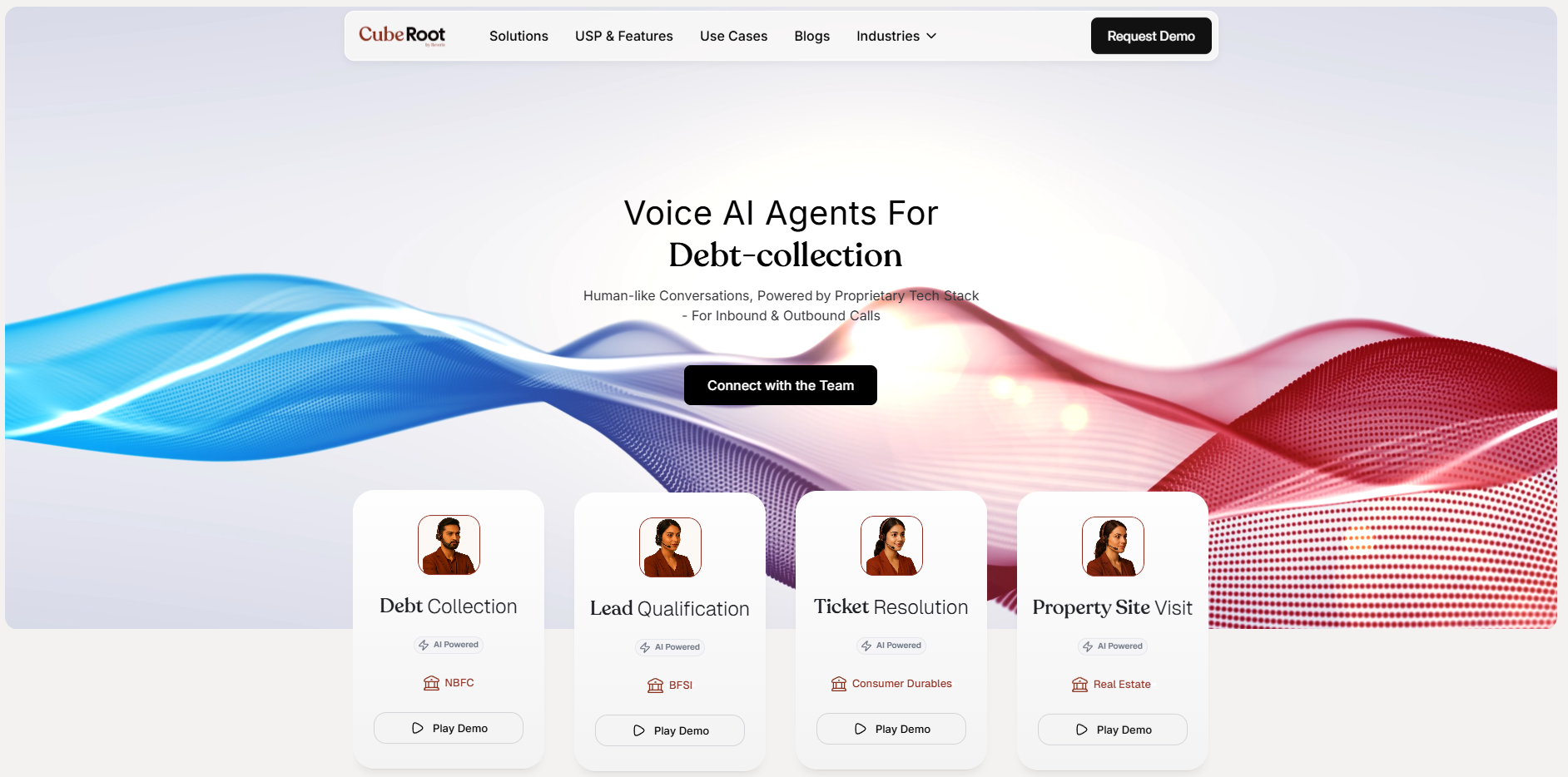
CubeRoot solves this with an enterprise Voice AI platform for high-scale outbound automation. Our intelligent agents converse in multiple Indian languages, managing the entire call from greeting to resolution without human help.
- Multilingual Voice Agents: Reach customers in their preferred regional language with natural-sounding AI that understands local accents.
- TRAI-Compliant Infrastructure: We handle the transition to 1600-series numbers and ensure 100% compliance with DND and DLT guidelines.
- Deep CRM Integrations: Our API-first approach connects your calling campaigns to your existing data, enabling hyper-personalized interactions.
- Predictive Dialing & Answering Machine Detection: Maximize agent productivity by filtering out voicemails and only connecting live prospects.
- Real-Time Analytics & Audit Trails: Track every KPI and access full call transcripts for total transparency and quality control.
CubeRoot provides the enterprise-scale technology needed to execute these campaigns. Our AI voice agents manage critical workflows like debt collection and order verification, delivering superior engagement and results. We handle the technical depth, freeing you to strengthen customer relationships and improve ROI.
Ready to see how intelligent outbound automation can scale your business? Book a demo with CubeRoot today and transform your calling strategy.
FAQs
Q. What is the difference between a robocall and an AI voice agent?
A robocall is usually a one-way, pre-recorded message that cannot respond to the customer. An AI voice agent uses Natural Language Understanding (NLU) to have a real-time, two-way conversation, answering questions and negotiating outcomes just like a human.
Q. How do I comply with TRAI’s new 1600-series mandate?
If you are in the BFSI or Insurance sector, you must apply for a 1600-series number through your telecom provider. This series is reserved for transactional and service calls to help customers identify legitimate business communications and reduce fraud.
Q. Can automated calls handle regional Indian languages?
Yes, advanced platforms like CubeRoot are trained on various Indian dialects and accents. This allows the AI to communicate effectively in Hindi, Tamil, Telugu, and other languages, which is essential for national campaigns.
Q. Will automated outbound calls increase my spam reports?
Actually, intelligent AI calls often decrease spam reports compared to manual calling. Because the AI can be personalized and follows strict pacing/timing rules, the calls are more relevant to the customer, leading to higher trust and lower block rates.
Q. What happens if the AI cannot understand the customer?
Most professional AI platforms include a “Human-in-the-Loop” feature. If the AI detects that it cannot resolve the query or if the customer expresses frustration, it can instantly transfer the call to a live agent with the full transcript attached.