Most Indian enterprises are trapped in a cycle of “support debt,” where hiring more agents only provides temporary relief against an endless tide of customer queries. You likely see your CSAT scores dropping during peak hours while your operational costs continue to spiral out of control.
Traditional automation often feels robotic and frustrates callers, but conversational AI for customer service has changed the landscape. Modern AI agents now understand intent, emotion, and regional dialects, allowing you to provide a human-like experience at a fraction of the traditional cost.
This strategic shift is driving massive market growth, with the Indian conversational AI market expected to reach USD 1,846.0 million by 2030.
In this guide, we will break down how to deploy conversational AI, provide the formulas to measure its success, and show you how to build a high-conversion voice support strategy.
Key Takeaways
- Intent over Keywords: Modern AI understands why a customer is calling (intent), rather than just scanning for specific words.
- The ROI Formula: True success is measured by the “Cost per Resolved Query” rather than just the number of calls handled.
- Multilingual Advantage: High-scale Indian brands use conversational AI to support English and regional languages 24/7 without night shifts.
- Integration is Non-negotiable: AI agents must have deep API access to your CRM/OMS to provide real-time, personalized resolutions.
- Zero Latency Matters: For voice AI, any response delay over 1.5 seconds kills the human-like experience and leads to hang-ups.
What is Conversational AI for Customer Service?
Conversational AI combines technologies like Natural Language Understanding (NLU), Automated Speech Recognition (ASR), and Text-to-Speech (TTS) to let machines communicate naturally.
Unlike legacy IVR systems that force you to press buttons, this technology allows customers to speak freely in their own words. It bridges the gap between mechanical efficiency and empathy by interpreting context and sentiment in real-time to provide immediate, accurate resolutions.
Understanding the technology is the first step toward building a scalable support engine that outperforms traditional call centers.
Is your current support system failing to keep up with your growth? CubeRoot’s conversational AI agents help you scale instantly while maintaining a human-like experience. Book a demo to see our voice AI in action.
Also read: AI Voice Assistants: Advantages & Applications For Indian Enterprises
Why Conversational AI Matters for Enterprise Growth
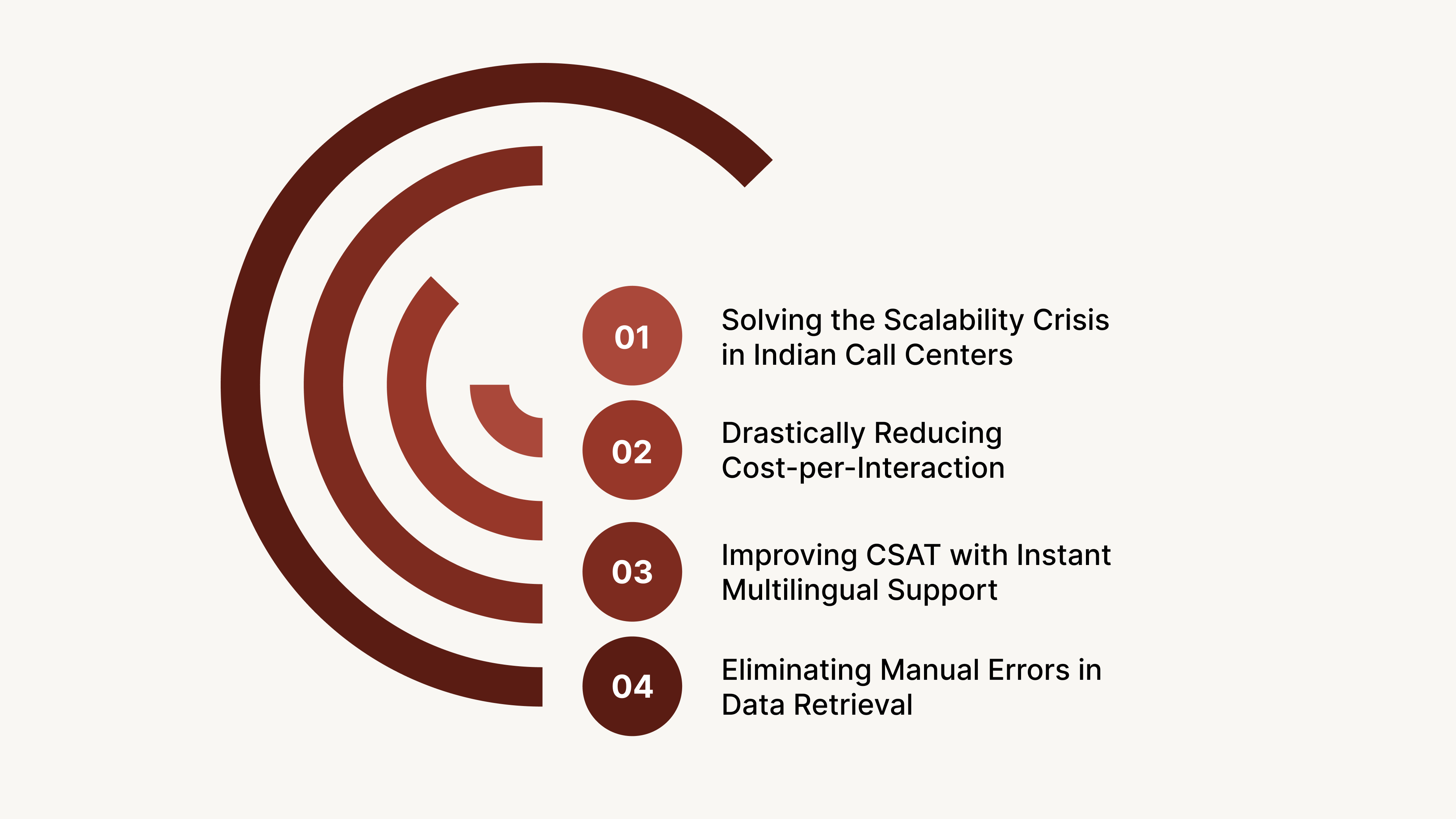
Deploying conversational AI is no longer about saving pennies; it is about creating a resilient infrastructure that handles millions of interactions without quality drops. You can finally move away from the linear relationship between your customer volume and your support headcount.
The following benefits represent why top Indian firms are switching to voice AI:
1. Solving the Scalability Crisis in Indian Call Centers
Recruiting and training hundreds of agents for seasonal sales or payment cycles is a logistical nightmare for most operations managers. AI agents provide infinite, instant capacity that scales up or down based on your live traffic without extra hiring costs.
This flexibility ensures you never miss a customer call during high-traffic festive periods or product launches.
2. Drastically Reducing Cost-per-Interaction
Human-led call centers carry heavy overheads, including salaries, office space, and training infrastructure that increase as you grow. Shifting routine queries to conversational AI can reduce your operational expenses per ticket while maintaining high service standards.
These savings allow you to reinvest capital into product development or aggressive marketing strategies.
3. Improving CSAT with Instant Multilingual Support
Indian customers speak a variety of regional languages, and they expect to be understood in their mother tongue at any time. AI agents provide 24/7 support in Hindi, Tamil, Kannada, and other dialects without the need for expensive night shift teams.
This immediate availability reduces frustration and builds deep brand trust across diverse geographic markets.
4. Eliminating Manual Errors in Data Retrieval
Human agents often struggle to switch between multiple tabs and databases while trying to keep a customer engaged on the phone. AI agents connect directly to your backend to pull live data with total accuracy, ensuring no mistakes in order numbers or balances.
This precision reduces the need for follow-up calls and improves the overall speed of resolution.
A clear understanding of these benefits allows you to plan a deployment that focuses on high-impact business areas.
Also read: Agentic AI Voice Agents: Future-Ready Customer Engagement 2026
Types of Conversational AI for Customer Service
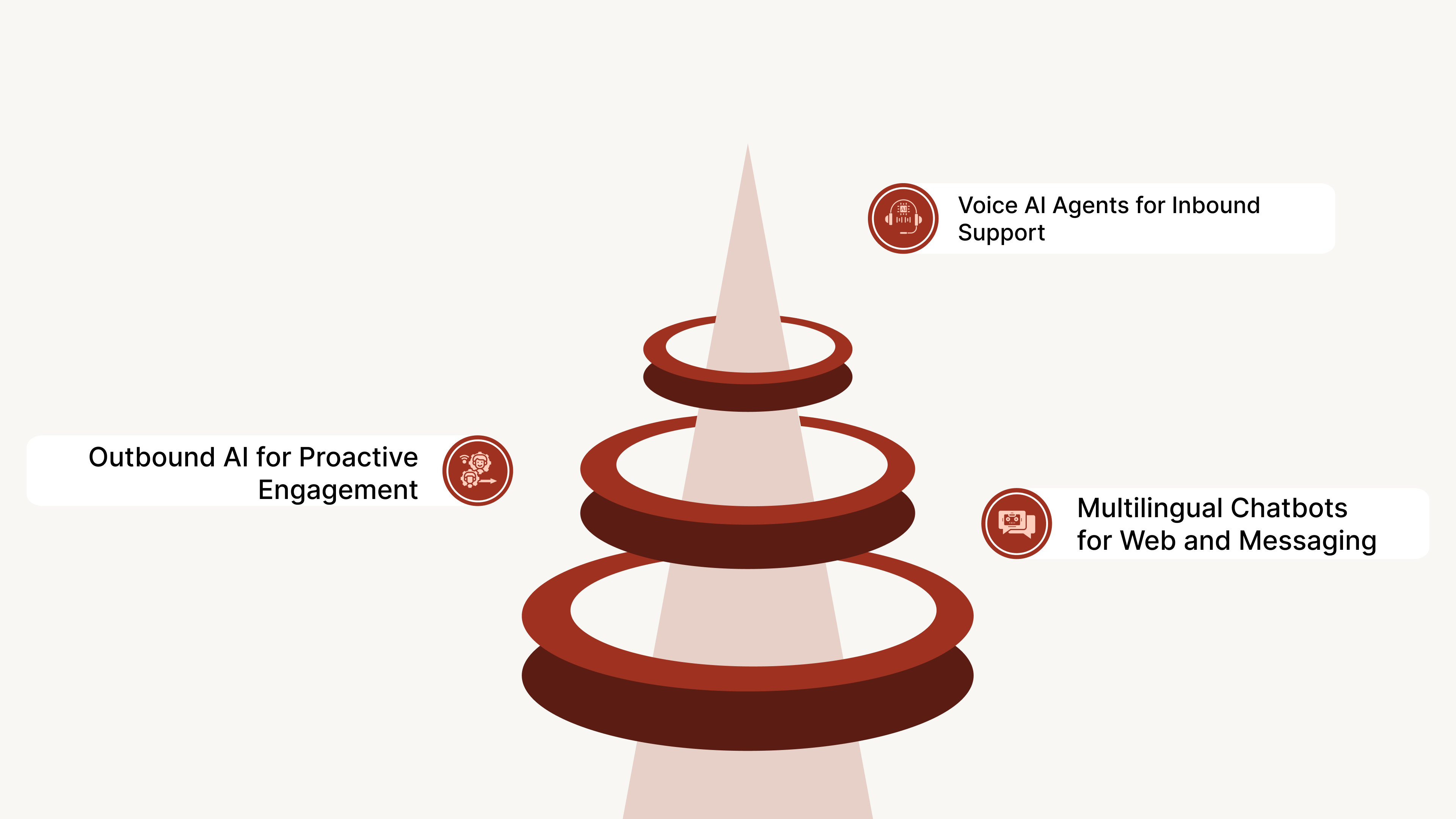
The choice between different AI formats depends on where your customers interact with your brand most frequently and the complexity of their needs. You should deploy a mix of channels to ensure your support is accessible wherever your audience chooses to hang out.
Consider these primary formats for your 2026 support strategy:
1. Voice AI Agents for Inbound Support
These agents handle incoming phone calls by using advanced speech-to-text and intent engines to resolve queries without human help. They are perfect for resolving urgent issues like blocking a lost credit card or checking the status of a late delivery.
Voice agents provide the fastest path to resolution for customers who prefer talking over typing.
2. Outbound AI for Proactive Engagement
Outbound agents call your customers to confirm high-value orders, remind them of upcoming payments, or collect feedback after a service. This proactive approach reduces missed payments for NBFCs and lowers Return-to-Origin (RTO) rates for eCommerce brands by verifying COD orders. It turns your support center into a proactive value-driver.
3. Multilingual Chatbots for Web and Messaging
These text-based agents live on your website or WhatsApp to handle queries through a chat interface using natural language processing. They are ideal for sharing rich media like return labels, PDF invoices, or product images that cannot be easily conveyed over a voice call. Combining these with voice AI creates a truly comprehensive support experience.
Once you have identified the types of AI you need, you must follow a structured path to launch them successfully.
4 Simple Steps to Implement Conversational AI for Customer Service
The difference between a robotic bot and a human-like agent lies entirely in how you design the logic and the technical integrations. You need a workflow that accounts for the nuances of human speech and the technical realities of your existing databases.
Follow these steps to build a high-performing AI support engine:
1. The 4-Stage Deployment Framework
You must begin by auditing your current call logs to identify the top three repetitive queries that consume your team’s time. Move from intent discovery to mapping the conversation flows, then integrate your systems before starting the final training phase.
- Analyze historical transcripts to find high-volume, low-complexity intents.
- Map every possible customer path, including “What if” scenarios for each intent.
- Conduct a pilot with a small group of users to gather initial performance data.
- Apply Reinforcement Learning from Human Feedback (RLHF) to sharpen accuracy before a full launch.
- Set up a monitoring dashboard to track live interactions for any unexpected logic gaps.
2. Scripting for Natural Dialogue and Intent Handling
Your AI needs to sound professional yet approachable, avoiding the rigid scripts that make traditional automation so frustrating for callers. Focus on building “Recovery Paths” so the AI can ask for clarification if it does not understand the user the first time.
- Write scripts in a conversational tone that matches your specific brand identity.
- Program the AI to handle “Digressions” where customers ask a side question mid-flow.
- Ensure the AI can handle synonyms (e.g., “refund,” “money back,” “reversal”) for the same intent.
- Build in confirmation steps for sensitive actions like changing a shipping address.
- Avoid long monologues; keep the AI’s responses short and prompt for user input.
3. Technical API Integration: Connecting AI to Reality
Conversational AI is useless if it cannot access your live data to perform actions like rescheduling a delivery or checking a balance. You must connect the AI platform to your CRM or Order Management System through secure, low-latency API links.
- Identify the specific data points the AI needs (e.g., Order ID, Customer Name, Account Balance).
- Test API response times to ensure the AI does not have long pauses while fetching data.
- Set up secure authentication protocols to protect customer data during the exchange.
- Ensure the AI can write data back to your CRM to log the call outcome.
- Create a fallback plan for when your internal systems or APIs are temporarily down.
4. Managing Accents, Noise, and Interruptions
In the real world, customers call from noisy streets or speak with heavy regional accents that can confuse standard AI models. Your system must be trained to filter background noise and handle “Barge-in” where the user speaks while the AI is talking.
- Select an AI model trained on diverse Indian accents and regional language nuances.
- Configure noise-cancellation settings to focus only on the primary caller’s voice.
- Enable “Barge-in” so the AI stops talking immediately when the customer interrupts.
- Set up logic to handle silence or “dead air” if the customer gets distracted.
- Provide a clear path for the AI to gracefully hand over to a human if it gets stuck.
After your system is live, you must use specific metrics to prove its value and find areas for further improvement.
Also read: Voice AI Agents for Pharmacy Refill Requests: Healthcare in 2026
3 Key Metrics to Measure Conversational AI Success
You must move beyond vanity metrics to understand the true impact of AI on your bottom line and customer experience. Hard data will help you justify the investment and fine-tune the AI’s performance over time.
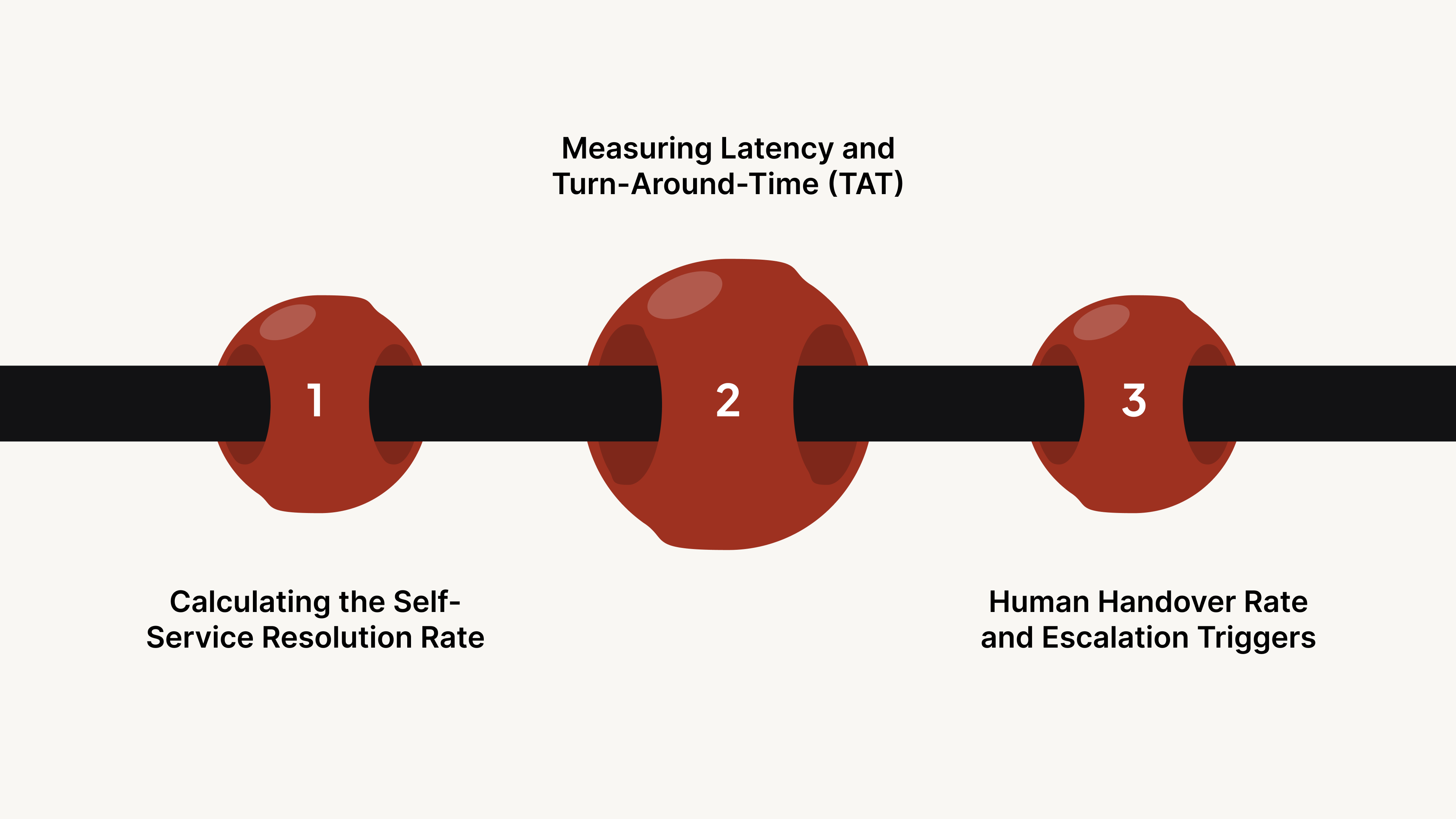
Measure these key indicators to track your progress:
1. Calculating the Self-Service Resolution Rate
This is your “North Star” metric because it tracks the percentage of queries the AI resolved without any human help. A high resolution rate proves that your AI is effectively handling the workload and providing real value to your customers.
Resolution Rate = Queries Resolved by AI / Total AI Interactions * 100
Aim for a resolution rate above 70% for routine tasks like tracking or simple account updates.
2. Measuring Latency and Turn-Around-Time (TAT)
In voice support, every millisecond of silence feels like an eternity and can cause a customer to hang up in frustration. You must monitor the delay between a customer finishing their sentence and the AI starting its response.
High-performance systems keep this latency under 1.5 seconds to maintain a natural conversation flow that feels human.
3. Human Handover Rate and Escalation Triggers
Track how often the AI passes a call to a live agent and, more importantly, the reasons behind those transfers. If the handover rate is high for a specific topic, it means your AI script or data integration for that intent needs improvement.
Reducing unnecessary escalations is the fastest way to lower your overall support costs and improve efficiency.
Ensuring your metrics are healthy is only possible if your system is built on a foundation of total security.
Ensuring Compliance and Data Security
In the BFSI and healthcare sectors, conversational AI requires a “Privacy by Design” foundation to prevent legal penalties and maintain trust. Compliance with India’s DPDP Act is mandatory, requiring local data residency and clear consent mechanisms for every voice interaction.
Your system must also feature automated PII redaction to mask sensitive data like CVVs or OTPs in transcripts. This layer of defense prevents internal misuse and ensures that customer information remains secure during quality audits.
Are you worried about the security of your customer data in the age of AI? CubeRoot provides SOC2-compliant voice AI solutions with full audit trails and data encryption. Contact us today.
Beyond compliance, excellence is achieved by focusing on nuanced user experience details.
Best Practices for Conversational AI Excellence
Building a successful AI agent requires more than just code; it requires a focus on the user experience and continuous refinement. These habits will ensure your AI remains a valuable asset that customers actually enjoy using.
1. Design for “Barge-In” and Natural Interruptions
Allow users to interrupt the AI mid-sentence just as they would a human agent in a normal conversation. If a customer says, “I already know my order number,” the AI should stop talking immediately and move to the next step.
This prevents the “robotic” feeling of a machine that just follows a script regardless of what the user says.
2. Implement “Persona-Consistent” Voice and Tone
Your AI’s voice should reflect your brand, professional for a bank, or more casual and friendly for a D2C retail brand. Use high-quality neural voices that sound natural and avoid the flat, mechanical tones associated with old computer systems.
Consistency in tone across all your automated channels helps reinforce your brand identity.
3. Prioritize Contextual Continuity During Handovers
Ensure that when a call moves to a human, the agent receives a full transcript of what has already happened. This prevents the customer from having to repeat their name, order ID, and the entire problem.
Contextual handovers turn a potential point of frustration into a smooth and professional service experience.
4. Use RLHF to Iterate Based on Real Conversation Gaps
Regularly review calls where the AI reached a “dead end,” or the customer expressed frustration with the automated response. Use Reinforcement Learning from Human Feedback (RLHF) to retrain the model on these specific edge cases every single week.
Continuous improvement is the only way to stay ahead of changing customer behaviors and expectations.
Transitioning from best practices to reality often means identifying and eliminating the frequent errors that stall project progress.
Also read: AI Voice Agents for E-commerce: The Complete Guide
Common Mistakes in Conversational AI Deployment
Many AI projects fail because they prioritize the technology over the actual needs and feelings of the customer. You can save time and budget by avoiding these predictable traps that lead to poor CSAT scores.
Mistake 1: Ignoring the “Human Escape” Path
The biggest mistake is trapping a customer in a loop where the AI cannot solve their problem but refuses to let them talk to a human. This leads to immediate hang-ups and angry social media posts about your brand’s poor service.
- Solution: Always provide a clear verbal path (e.g., “Would you like to speak with an agent?”) if the AI fails to resolve a query twice.
Mistake 2: Over-complicating the First Interaction
Trying to automate your entire support catalog on day one usually results in a system that does many things poorly rather than one thing well. Complex logic trees are harder to debug and often lead to higher error rates during the launch.
- Solution: Start by automating your top three most common, high-volume queries and expand only after those are running perfectly.
Once you sidestep these foundational pitfalls, you can confidently focus on deploying conversational AI where it delivers the most immediate and significant business impact.
Top Use Cases for Conversational AI
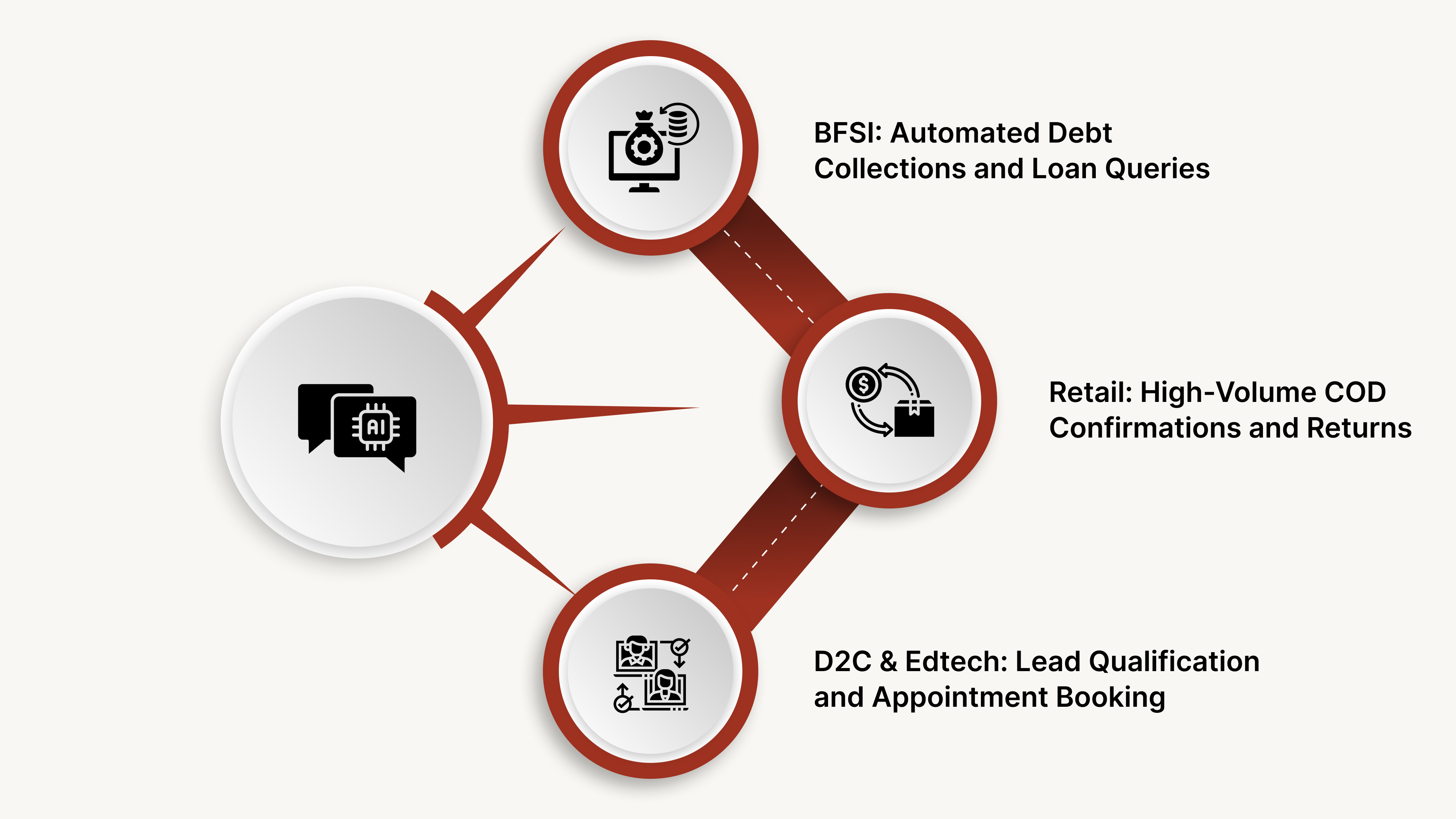
The most successful brands deploy conversational AI, which provides the highest value and the most immediate relief to their human staff. Focus on these high-impact areas to see the fastest return on your investment:
1. BFSI: Automated Debt Collections and Loan Queries
Banks use AI to handle thousands of payment reminders and “Promise to Pay” confirmations simultaneously without increasing their call center headcount.
AI agents can also provide instant updates on loan eligibility or account balances, freeing human agents for complex wealth management tasks
This automation ensures total compliance with regulatory scripts on every single call.
2. Retail: High-Volume COD Confirmations and Returns
eCommerce brands use voice AI to call customers and confirm “Cash on Delivery” orders before shipping, which significantly reduces shipping losses.
The AI can also handle the entire return initiation process, including scheduling a pickup time and explaining the refund policy.
This keeps your lines clear for sales inquiries during massive holiday shopping events.
3. D2C & Edtech: Lead Qualification and Appointment Booking
Consumer brands use AI to call new leads within seconds of a form submission to check their interest and qualify them for a sales rep.
In Edtech, AI agents handle student inquiries and automate the scheduling of demo classes, ensuring no lead goes cold due to a slow response.
This speed-to-lead advantage directly improves your final conversion rates.
This focus on tangible outcomes is what drives leading enterprises to partner with specialized platforms.
Also read: AI Voice Agents vs IVR: ROI Breakdown and Key Differences
How CubeRoot Powers Intelligent Customer Engagement
Many Indian enterprises find themselves overwhelmed by customer queries that their current staff simply cannot handle, leading to long hold times and abandoned calls. You might be using basic chatbots that only frustrate your users or legacy IVRs that offer no real resolution, which can damage your brand reputation.
Managing seasonal spikes or regional language support through manual hiring is slow, expensive, and difficult to maintain at a high quality.
CubeRoot solves these challenges with an enterprise-grade Voice AI platform built specifically for the complexities of the Indian market. Our conversational AI agents provide a natural, multilingual experience that resolves issues rather than just deflecting them to a help page.
- Multilingual Indian Accents: Our models are trained on diverse regional dialects, ensuring your customers are understood clearly in Hindi, Tamil, and other local languages.
- Hyper-Scalable Infrastructure: Handle a 10x surge in call volume during festive sales without any degradation in response speed or service quality.
- No-Code Workflow Builder: Design and deploy complex conversational flows in days, not months, without needing a dedicated team of developers.
- Regulatory Compliance: Built with BFSI security in mind, we offer full audit trails, secure voice logging, and automated PII redaction.
- Human-in-the-Loop Escalation: Complex cases move to live agents with full context, ensuring a fluid transition that never breaks the customer journey.
Our technology ensures that every customer interaction is smart, empathetic, and resolved.
The ability to handle high-volume, multilingual interactions 24/7 is the new standard for excellence in customer service. CubeRoot provides the enterprise-grade infrastructure and domain-specific AI models you need to lead this transformation.
Our platform is designed to handle the unique challenges of the Indian market, from regional accents to high-scale seasonal surges. We help you turn your support center from a cost burden into a streamlined, high-performance asset for your business.
Ready to transform your customer service with conversational AI? Book a demo with CubeRoot today to build your custom AI voice agent.
FAQs
Q. How is conversational AI different from a regular chatbot?
Regular chatbots usually follow a rigid, button-based path or look for specific keywords. Conversational AI uses Natural Language Understanding to process the intent and sentiment behind a user’s words, allowing for a much more natural and flexible conversation.
Q. Can conversational AI understand regional Indian languages?
Yes, platforms like CubeRoot are specifically trained on diverse Indian dialects and regional accents. This ensures that the AI can understand and respond in languages like Hindi, Tamil, and Kannada as naturally as it does in English.
Q. What is the average cost saving with conversational AI?
Most enterprises see a reduction of 60% to 80% in their cost-per-interaction when they shift routine queries to AI. This is because AI agents do not require salaries, office space, or extensive training periods like human staff.
Q. Is it hard to integrate conversational AI with my existing CRM?
Modern AI platforms use an API-first approach, meaning they can connect to popular tools like Salesforce, Zendesk, or custom databases relatively quickly. With a no-code builder, you can often go live with a new workflow in just a few weeks.
Q. How does conversational AI handle angry or frustrated customers?
The AI uses real-time sentiment analysis to detect the tone of the customer’s voice. If it identifies high levels of frustration, it can immediately change its tone to be more empathetic or trigger a priority handover to a human supervisor.