India’s internet user base recently topped 886 million, and nearly all of them access content in one or more Indic languages. For front-end teams working with React, this means multilingual demands are no longer an afterthought; they are central to design and delivery.
i18next is one of the most widely adopted internationalisation frameworks in JavaScript. Combined with its React binding react-i18next, it enables dynamic language switching and modular localisation logic. But simply installing a library is not enough. Large organisations supporting 10 or more regional languages, multiple teams, and strict compliance must plan for architecture, workflows, and scalability from the start.
In this guide, you’ll learn how to implement i18next in React, how to scale localisation across teams and content, and how to build a modern multilingual stack that delivers both performance and inclusion.
Key Takeaways
- Framework and platform must work in tandem: i18next handles translation logic, while localisation workflows handle scale.
- A layered approach (framework, platform, analytics) ensures continuous and manageable localisation.
- Governance tools like glossaries and review workflows protect consistency and compliance.
- Performance and accessibility matter: use lazy loading, caching, and inclusive design for multilingual React apps.
- For India-centric localisation, combining React, i18next, and enterprise workflows delivers accurate, inclusive digital experiences across languages.
Understanding i18next and react-i18next
What i18next does and why it matters
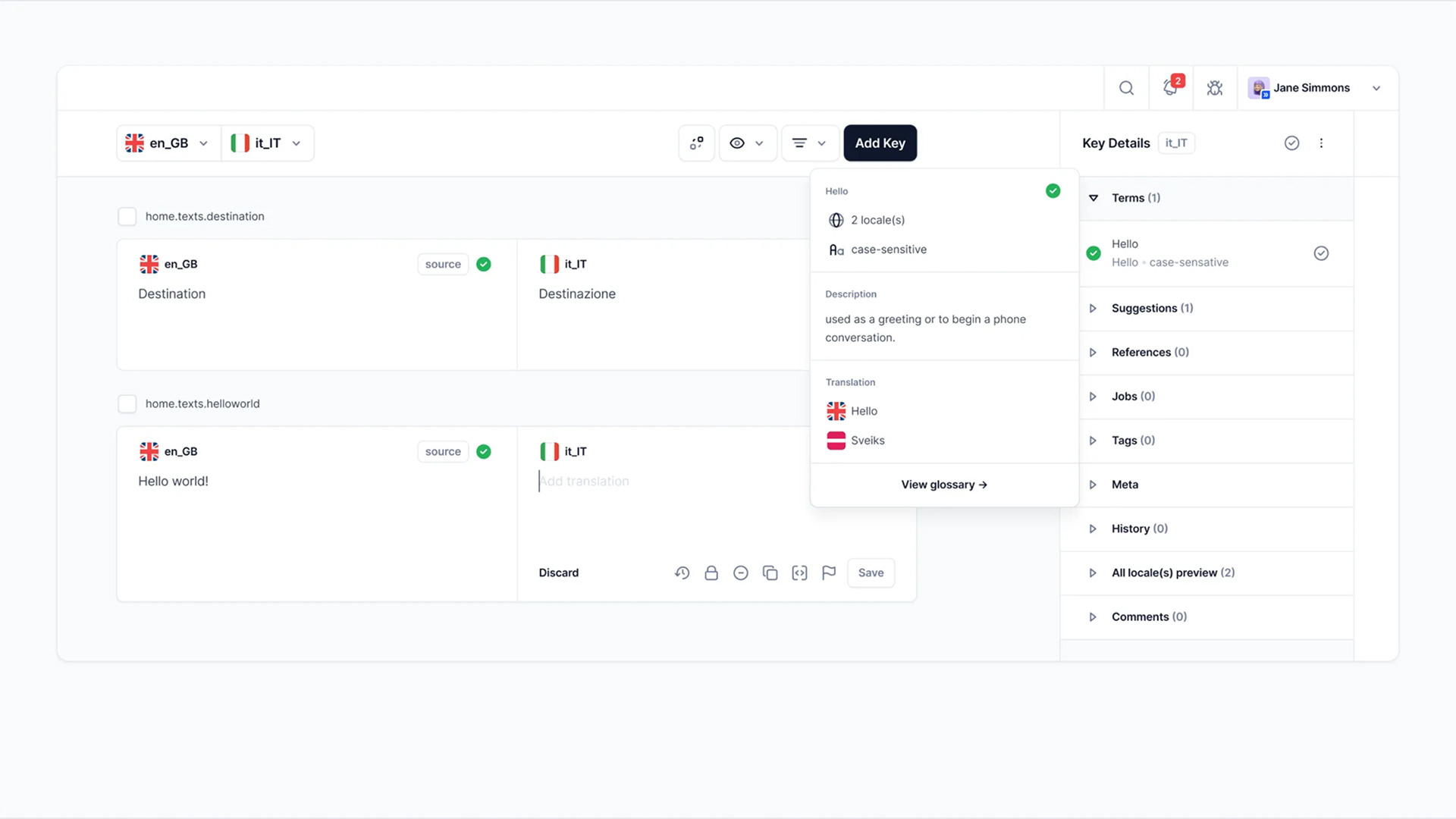
At its core, i18next is a mature, open-source framework built to handle the complexities of internationalisation in JavaScript applications. It manages translations, pluralisation, interpolation (variables inside strings), and namespaces, ensuring developers can maintain consistent multilingual logic across their codebase.
Unlike static translation approaches, i18next is dynamic and scalable. It supports:
- Multiple resource files per language (for modular projects)
- Automatic language detection
- Asynchronous loading of translations
- Extensible plugins for backend and cache management
For enterprises building web or mobile apps in India’s multilingual landscape, i18next offers a foundation that is both technically efficient and localisation-ready, supporting a wide range of scripts and character sets, from Devanagari to Tamil and Malayalam.
The React integration layer
React developers use react-i18next, an official integration layer that connects i18next’s translation engine to React’s component model. This library offers:
- Context-aware updates, ensuring UI text changes instantly when users switch languages
For enterprise React apps, this means teams can separate code from content and update language files without redeploying the app, a major benefit when supporting 10 or more regional languages.
Where next-i18next fits in
For organisations using Next.js, the next-i18next library extends this functionality to server-side rendering (SSR). It allows localisation during page generation, improving both SEO and performance, crucial for content-heavy platforms like eCommerce portals or government websites.
By supporting pre-rendered, localised routes (e.g., /hi/products or /bn/services), enterprises can ensure faster load times and better discoverability in regional-language searches.
Setting up i18next in a React App
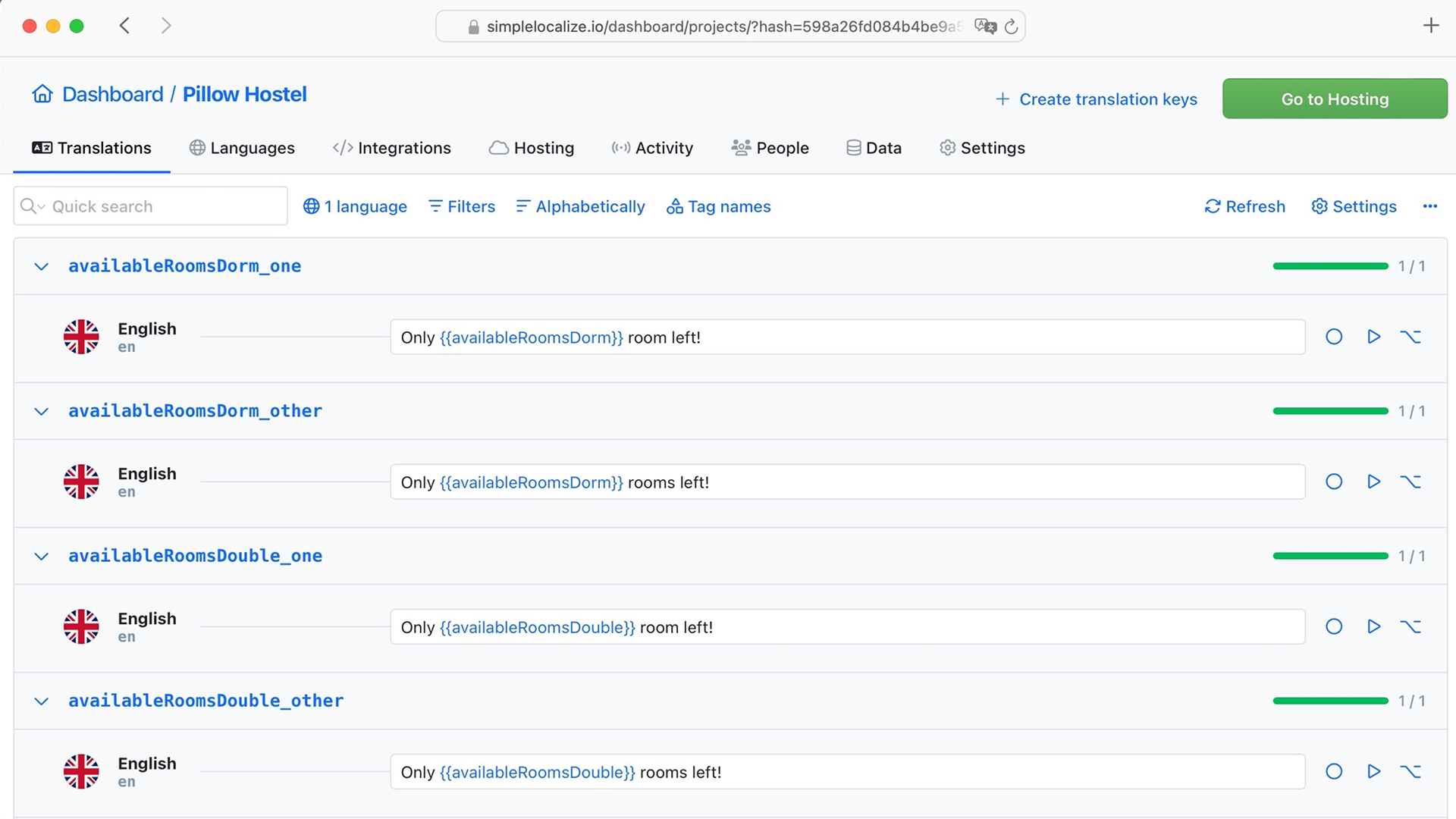
Setting up i18next and react-i18next doesn’t take long, but it’s important to plan your structure upfront, especially when your organisation manages multiple products, teams, or languages.
Installing core packages
To begin, install the essential libraries:
npm install i18next react-i18next i18next-http-backend i18next-browser-languagedetectorThese four packages provide:
- i18next – the core translation framework.
- react-i18next – React bindings for hooks and components.
- HTTP backend – loads translation files hosted remotely (useful for large projects).
- Language detector – automatically detects the user’s language from the browser or URL.
For enterprises managing multilingual content at scale, using external backends (such as S3 or a localisation platform like Anuvadak) allows seamless updates without rebuilding the app.
Initialising i18next
A minimal configuration might look like this (in i18n.js):
import i18n from 'i18next';
import { initReactI18next } from 'react-i18next';
import HttpApi from 'i18next-http-backend';
import LanguageDetector from 'i18next-browser-languagedetector';

i18n
  .use(HttpApi)
  .use(LanguageDetector)
  .use(initReactI18next)
  .init({
    supportedLngs: ['en', 'hi', 'bn'],
    fallbackLng: 'en',
    interpolation: { escapeValue: false },
    backend: { loadPath: '/locales/{{lng}}/{{ns}}.json' },
  });

export default i18n;
This approach:
- Loads translations dynamically from
/locales/[language]/[namespace].json. - Detects and persists user language preferences automatically.
- Prevents escaping to preserve React’s dynamic content rendering.
Enterprises can extend this setup with custom middlewares for analytics tracking, feature toggles, or security logging, ensuring localisation integrates neatly with broader digital operations.
Using translations in components
Developers can access translations directly through the useTranslation() hook:
import { useTranslation } from 'react-i18next';

function Dashboard() {
  const { t } = useTranslation('dashboard');
  return <h1>{t('welcome_message')}</h1>;
}
Translation files are stored as JSON:
{
  "welcome_message": "Welcome to your dashboard"
}
For content containing links or bold text, the <Trans> component handles complex formatting while preserving translation keys.
Structuring translations for scalability
When your app grows, structure your translations by feature or module (namespaces).
Example:
/locales
 ├── en
 │   ├── common.json
 │   ├── dashboard.json
 │   └── settings.json
 ├── hi
 │   ├── common.json
 │   ├── dashboard.json
 │   └── settings.json
This allows teams to work independently, update only relevant sections, and avoid merge conflicts.
Scaling Localisation for Enterprise React Apps

At an enterprise scale, localisation isn’t just a developer task; it becomes an operational system. React applications supporting multiple business units, markets, or languages must handle performance, governance, and inclusion systematically.
Optimising performance
Large multilingual apps can suffer from heavy initial loads if all language bundles are fetched at once.
Use techniques such as:
- Lazy loading translations: load only the active language.
- Code splitting by route or feature.
- Caching frequently used resources to reduce redundant network requests.
This ensures faster load times and better Core Web Vitals, vital for financial or e-commerce applications with high transaction volumes.
Governance and quality management
When multiple teams contribute translations, consistency often erodes.
Best practices include:
- Maintaining a central glossary for product terms and tone consistency.
- Using translation memory tools to reuse existing strings.
- Establishing review workflows before releases.
- Automating language coverage reports to identify missing keys.
Platforms like Anuvadak simplify this governance. They connect directly to your CMS or repository, maintain translation memories, enforce review approvals, and push updates securely via APIs, removing the risk of manual misalignment.
Accessibility and inclusion
True localisation extends beyond words. It involves:
- Script awareness – supporting Indic scripts like Tamil, Bengali, and Gujarati with correct line breaks and ligatures.
- Bidirectional support – ensuring layouts adjust for RTL languages if needed.
- Assistive compatibility – screen reader and ARIA label localisation for inclusive design.
For public-sector portals or education platforms, these aren’t optional; they’re essential for compliance and accessibility mandates.
From Framework to Platform: Managing Localisation at Scale

Setting up i18next helps you localise your React codebase efficiently, but scaling localisation across large enterprises introduces new challenges. Multiple teams, hundreds of pages, and frequent content changes demand more than code-level translation; they require an integrated localisation workflow.
When i18next isn’t enough
While i18next handles the how of multilingual rendering, it doesn’t manage the who, when, and where of localisation. Enterprises often face:
- Fragmented workflows, developers, linguists, and marketers working in silos.
- Inconsistent quality, varying translation standards across teams.
- Manual syncs, frequent file transfers between repositories, and translators.
- Limited governance, no visibility into what’s translated, reviewed, or outdated.
These limitations slow down releases and make it difficult to maintain brand and linguistic consistency, especially for industries like BFSI or government services that need compliant, accurate translations.
How Anuvadak complements i18next
This is where Anuvadak, Reverie’s website and app localisation platform, plays a critical role.
It extends what i18next enables, adding structure, automation, and security to enterprise localisation.
Here’s how Anuvadak fits into the workflow:
| Challenge | i18next covers | Anuvadak enhances |
| Text translation in the app | Framework-level translation | Centralised translation memory and glossary control |
| File management | Local JSON or remote backend | API-based content sync from CMS or repository |
| Quality assurance | Manual or developer-led | Linguist reviews and approval workflows |
| Analytics and tracking | Not available | Dashboard with translation progress, accuracy metrics |
| Security and compliance | Developer-controlled | Enterprise encryption and role-based access |
| Multi-language scalability | Multiple config files | Unified multilingual website and app management |
By integrating i18next at the development layer and Anuvadak at the management layer, organisations gain a complete localisation ecosystem, from code to content delivery.
Industry example: BFSI and multilingual apps
Consider a large private bank rolling out its online banking portal across 12 Indian languages. The frontend runs on React, with i18next managing interface text.
- Without Anuvadak, every update to the site or mobile app requires manual extraction of text, translation, and redeployment, a slow and error-prone process.
- With Anuvadak, the translation memory syncs automatically through APIs. Reviewers validate translations through a secure dashboard, and approved strings are pushed live instantly, with no downtime or manual intervention.
This combination of i18next + Anuvadak enables enterprises to ship faster, maintain quality, and meet compliance standards for multilingual experiences at scale.
Common Pitfalls and How to Avoid Them
Even with robust frameworks, localisation projects can falter due to operational blind spots. Here are some of the most common issues, and how to avoid them:
| Pitfall | Impact | Prevention |
| Hard-coded strings | Blocks automation and translation reuse | Use keys consistently via i18next’s t() function |
| Missing fallback logic | Users see blank or untranslated text | Always configure fallbackLng in setup |
| Loading all locales at once | Increases bundle size and slows the app | Implement lazy loading and code splitting |
| Ignoring plural and gender forms | Creates inaccurate translations | Use i18next’s pluralisation and context features |
| No human validation loop | Mistranslations or cultural errors | Combine i18next with a review workflow via Anuvadak |
| Neglecting accessibility | Fails inclusion and compliance goals | Localise ARIA labels and test with screen readers |
Avoiding these pitfalls ensures your localisation system remains scalable, compliant, and user-friendly across every language your brand serves.
Building a Sustainable Localisation Architecture

As enterprises expand across markets and languages, localisation can no longer be treated as an afterthought. It needs to be part of the digital architecture, designed for scale, governance, and continuous improvement.
A sustainable localisation stack typically has three layers:
1. Framework Layer – Code-level Localisation
This is where libraries like i18next and react-i18next operate. They handle language keys, plural rules, and contextual translation logic inside the application code. This layer ensures that UI text can change dynamically based on the selected locale without modifying the app’s structure.
It’s ideal for developers building modular, multilingual React apps that need high flexibility and low runtime friction.
2. Platform Layer – Workflow and Governance
Once localisation grows beyond a few pages or apps, enterprises need a centralised system to manage the translation process itself. This includes:
- Translation memory and glossary to ensure brand and terminology consistency
- Automated workflows for translation, review, and deployment
- Role-based access for linguists, developers, and compliance teams
- Continuous integration to push updated translations live instantly
This is where a platform like Anuvadak becomes indispensable.
By connecting directly to your CMS, app, or backend through APIs, Anuvadak bridges the gap between technical implementation and linguistic management, enabling multilingual operations at scale while maintaining security and compliance.
3. Analytics and Optimisation Layer
The final layer measures impact. Beyond functional translation, enterprises must understand how localisation drives reach, engagement, and accessibility across regions.
Dashboards tracking language-wise traffic, performance, and completion rates help teams refine priorities, ensuring investments in localisation translate into measurable business outcomes.
Together, these three layers form a future-ready localisation architecture, one where i18next powers the frontend experience, and Anuvadak governs the operational backbone.
Conclusion
React developers have long relied on i18next and react-i18next to build multilingual interfaces efficiently. For enterprises, however, success depends on going beyond translation; it’s about building a system that scales securely, performs consistently, and meets the linguistic diversity of India’s digital audience.
By combining i18next’s technical flexibility with Anuvadak’s centralised governance, organisations can deliver multilingual apps faster, manage quality seamlessly, and ensure every digital experience feels local, accessible, and inclusive.
Explore Anuvadak to learn how your enterprise can manage multilingual delivery across all digital platforms. Sign up today!
FAQs
1. What problem does i18next solve in React?
It simplifies managing translations, pluralisation, and contextual language logic across React components, making localisation scalable and maintainable.
2. Is react-i18next enough for enterprise-scale localisation?
It’s powerful for application logic, but doesn’t manage workflow or quality control. Enterprises need a localisation management platform like Anuvadak to automate translation and maintain consistency.
3. How does Anuvadak integrate with React apps using i18next?
Anuvadak connects through APIs to your CMS or backend, automatically syncing translated content and versioning updates securely.
4. What are common mistakes with i18next in React?
Hard-coding strings, missing fallback languages, loading all locales at once, and skipping review workflows are the most frequent issues.
5. Why is localisation crucial for Indian enterprises?
India’s linguistic diversity demands digital inclusion. Localised interfaces improve adoption, trust, and accessibility across regional markets, especially in BFSI, education, and public services.