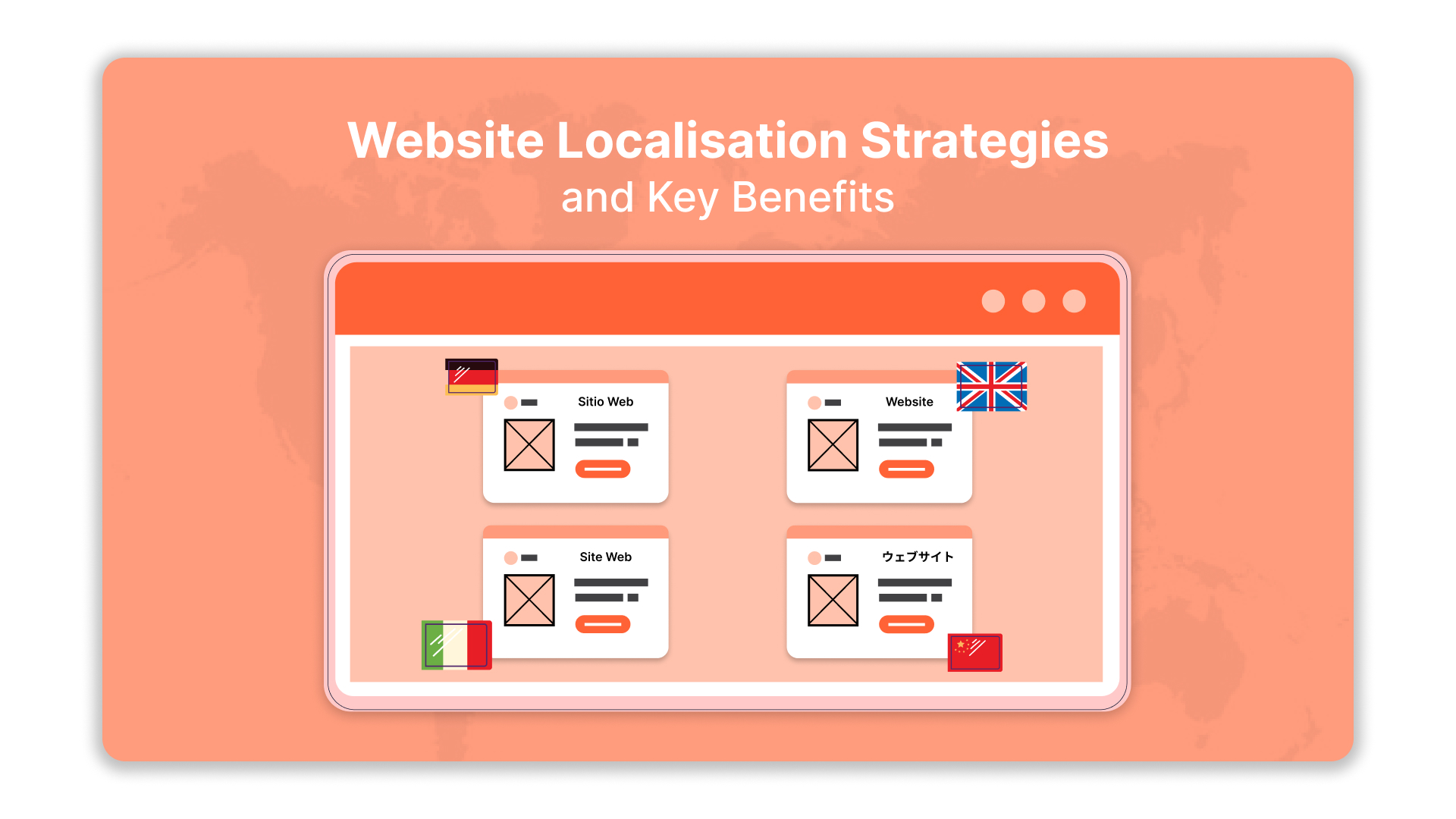
Did you know that over half, 57% of urban internet users, prefer consuming content in regional languages? This clearly shows the rising demand for localised digital experiences across platforms.
Yet many enterprises still struggle to meet this expectation as they expand across India’s diverse linguistic markets. When your website speaks only one language, you risk losing users who are more comfortable in their own language. Website localisation helps close this gap by creating meaningful, language-friendly experiences for every audience segment.
So, if you are also struggling with low engagement, high drop-offs, or inconsistent user experiences across regions, this blog is for you. This website localization services article explains how enterprises can deliver multilingual experiences across India’s diverse markets.
Key Takeaways
- 57% of urban internet users prefer regional languages, making localisation essential for engagement in India.
- Website localisation goes beyond translation; it includes cultural adaptation, compliance, and UX changes for each region.
- Localise when entering new markets, improve trust, user experience, and accessibility, or manage large multilingual content.
- Key benefits include increased user trust, better UX, improved SEO, consistent branding, and stronger market segmentation.
- Effective strategies include conducting market research, building a clear localisation plan, using automation platforms, ensuring QA, and tracking results.
- Top challenges include complex workflows, cultural nuances, and high manual effort without the right tools.
What is Website Localisation?
Website localisation is the process of adapting your website’s language, content, and user experience for specific regions and languages. It goes beyond simple translation to include cultural preferences, user behaviour, regulatory needs, and industry-specific terminology.
When done well, website localisation helps you build trust, improve accessibility, and meet user expectations. For marketing leaders, it supports a scalable multilingual strategy while reducing manual effort. It also strengthens content governance, enabling you to deliver a unified, region-ready brand experience across markets.
Now that you understand what website localisation entails, let’s look at when it becomes essential for your business.
Also Read: 5 Inspiring Website Localisation Examples That Transformed User Engagement
When to Localise Your Website?
You should consider website localisation when your business is expanding into new regions, serving customers who prefer regional languages, or facing lower engagement on your digital platforms. If your teams manage large volumes of content across multiple markets, localisation becomes essential for consistency and governance.
Here are key situations when localisation becomes important for your organisation:
- Entering New Regional Markets: When you want to reach customers in different states or linguistic groups, and need your website to feel local and relatable.
- Scaling Digital Services Across India: When your eCommerce, healthcare, or education platforms must support users in multiple languages.
- Improving User Experience and Trust: When users struggle to understand your website content, it leads to high drop-offs or low conversion rates.
- Meeting Accessibility and Compliance Needs: When your teams must ensure regulatory alignment, language accessibility, or citizen-focused communication.
- Managing Large Multilingual Content Workflows: When your product, marketing, or IT teams spend too much time updating content manually across regions.
Once you identify the right time to localise, it’s important to understand the advantages it brings to your strategy.
The Benefits of Website Localisation

Website localisation delivers measurable value when you operate across multiple regions and need a consistent, multilingual digital experience at scale. It strengthens user trust, improves platform adoption, and supports better governance across your content workflows.
Here are the key benefits for your organisation:
1. Increased User Trust Across Regions
When your website speaks the user’s language, it shows that your brand respects cultural and linguistic differences. Studies show that 75% prefer to buy products in their native language.
This makes localisation essential for sectors such as e-commerce. Localisation helps you improve critical KPIs, such as customer satisfaction, NPS, engagement, and overall digital adoption, across regions.
2. Easier Interaction With Your Digital Platforms
Local-language content makes it simpler for users to navigate services, whether they are opening a bank account, booking a healthcare appointment, or accessing government information. This reduces friction and supports smoother user journeys.
A better user experience leads to higher conversions, stronger engagement, and reduced bounce rates across your website.
3. Better Search Visibility in Regional Markets
Localising keywords, metadata, URLs, and page structure helps search engines match your content to regional user behaviour.
This improves:
- Visibility of regional search results.
- Organic traffic from multilingual users.
- Click-through rates from non-English markets.
For enterprises, this means more discoverability without increasing acquisition costs.
4. Stronger Brand Consistency
Localisation ensures your brand message stays accurate and consistent across languages and regions. This prevents misinterpretation, reduces dependency on local agencies, and helps your teams maintain a unified brand voice.
This is especially important for regulated industries, such as finance, healthcare, government, and legal services.
5. Better Market Segmentation and Personalisation
Localised content enables you to tailor messages for different regions, user groups, and industry-specific needs. This improves relevance and engagement while helping your marketing, product, and CX teams address specific customer expectations in each market.
6. Strong Support for In-Market Teams
Localisation platforms streamline updates by allowing your teams to manage all languages from one place. This reduces manual work, prevents duplication, and ensures faster rollouts when you update product information, service details, or policy changes across regions.
Now that the benefits are clear, let’s explore the most effective strategies to implement website localisation successfully.
Best Strategies for Website Localisation

Expanding into multiple regions presents a common challenge, how to ensure that every user feels equally understood, regardless of their language? Website localisation helps solve this by combining the right planning, technology, and cultural understanding. For enterprises and government organisations, a structured localisation approach ensures consistency, accuracy, and accessibility at scale.
Here are key strategies you should follow:
1. Conduct Market Research
Before you start localising, understand your audience and how they interact with your digital platforms. Here are a few ways to make your research more effective:
- Know your users: Identify the languages, preferences, and behaviours of your target regions. Utilise analytics and feedback tools to gain insight into how users interact with your website.
- Study competitors: Review how local or regional competitors communicate and find gaps your business can fill.
- Monitor trends: Track regional events, seasonal patterns, and local language trends that influence user engagement.
- Do keyword research: Identify search terms in regional languages to improve visibility in local markets.
2. Develop a Localisation Plan
A well-structured plan ensures efficiency and consistency across regions. Here are key elements to include in your localisation plan:
- Set measurable goals: Define what localisation should achieve, such as higher engagement, improved accessibility, or better conversion rates.
- Prioritise content: Start with high-impact sections like your homepage, product pages, and customer support content.
- Include cultural adaptation: Go beyond text, align visuals, tone, and messaging with local context.
- Allocate time and budget: Plan realistic timelines and resources for translation, review, and quality assurance.
3. Choose the Right Partners and Technology
Selecting the right localisation technology and partners can make your process scalable. Here are essential steps to ensure you choose wisely:
- Use reliable localisation platforms: Choose a system that integrates with your CMS, automates updates, and supports API-based translation workflows.
- Engage linguistic experts: Collaborate with professional translators who are familiar with the cultural and regulatory contexts of each region.
- Collaborate with local SEO specialists: Optimise your content for regional search behaviours.
For enterprises operating across industries, including BFSI, eCommerce, healthcare, education, automotive, government, and legal compliance, Anuvadak offers a unified solution tailored for Indian-language localisation. It supports CMS compatibility and provides continuous updates.
4. Ensure Consistency and Quality Assurance
Maintaining consistency across multiple languages is key to trust and brand integrity. Here are practical ways to maintain quality and accuracy:
- Create glossaries and style guides: Define tone, terminology, and preferred translations for your brand.
- Implement review workflows: This includes quality checks for translation accuracy and cultural relevance.
- Set up feedback loops: Encourage feedback from local teams and end-users to continually improve over time.
5. Measure and Refine Continuously
Localisation is an ongoing process that needs regular monitoring. Here are steps to help you track and improve performance:
- Track key metrics: Measure success using KPIs such as user engagement, traffic growth, and conversion rates in each region.
- Use analytics tools: Identify what localised content performs best and where improvements are needed.
- Refine your strategy: Keep updating your localisation plan based on performance data and evolving regional needs.
Website localisation isn’t just about translation, it’s about building authentic, user-friendly experiences for every language community you serve. To simplify the process and manage multilingual websites efficiently, explore how Anuvadak can help your teams automate the translation and management of multilingual websites and apps, ensuring accuracy and cultural relevance.
Even with a clear strategy in place, large organisations often face practical challenges when scaling localisation across regions.
Challenges in Website Localisation

Localising a website for multiple regions is not always straightforward. It involves technical planning, cultural understanding, and coordination between different teams. For enterprises and government organisations managing large digital platforms, localisation can become complex without the right strategy and tools.
Here are some common challenges you may face:
1. Complexity of the Process
Managing multilingual websites requires coordination between IT, product, content, and localisation teams. Handling different scripts, page layouts, and CMS integrations often adds to the technical complexity, especially when updates must be rolled out across multiple languages simultaneously.
2. Understanding Cultural Nuances
Translation alone cannot capture regional context or emotion. Each region has unique preferences, expressions, and sensitivities. Without cultural adaptation, even accurate translations can feel disconnected and may fail to build trust with local users.
3. Cost and Resources
Localising large websites can demand significant time and investment. From translation management to quality checks and technical setup, costs can rise quickly if not automated or centralised. This often challenges teams working with limited budgets or tight timelines.
While these challenges can be complex, the right technology can simplify and streamline the entire localisation process.
Also Read: Website Localisation in 2024 – A Complete Guide
How Anuvadak Simplifies Website Localisation
Anuvadak is an enterprise-grade website localisation platform designed to help organisations translate, manage, and automate multilingual websites at scale. Built with Indian languages in mind, it uses a neural machine translation engine and automation tools to simplify complex localisation workflows.
Whether you manage a government portal, an eCommerce platform, or an enterprise website spanning multiple languages, we enable faster deployment, consistent brand messaging, and compliance-ready multilingual experiences, all without heavy IT dependencies.
Here are the key benefits of choosing Anuvadak for website localisation:
1. Translate; AI-Powered Indian Language Localisation
We use an Indian-language-focused neural translation engine to deliver fast, accurate website localisation. It automatically updates content across websites and sends it for review, ensuring your multilingual website stays consistent and current.
2. Manage; Centralised Control and Cost Efficiency
We streamline the entire localisation process by bringing all workflows under one platform, removing the need for separate infrastructure and tools. It allows you to easily manage projects, add subdomains, adjust settings, and track progress post-deployment with complete version control.
This results in lower costs, simplified operations, and improved control over multilingual content, delivering a smoother and more consistent user experience.
3. Analytics; Data-Driven Insights for Smarter Localisation
Our analytics dashboard gives you clear visibility into your localisation performance. It tracks site visits, language progress, and page views, helping you measure engagement and manage projects efficiently. With these insights, you can make data-driven decisions, optimise content, and drive sustainable business growth.
4. Automation; Continuous Updates With Minimal Manual Effort
Our automation streamlines content management by eliminating manual updates and ensuring continuous localisation across all languages. With auto-updates, real-time progress tracking, and data-driven insights, your website stays current and competitive.
This reduces manual effort, saves time, and provides your teams with greater transparency and control over multilingual projects, resulting in a more efficient workflow and a stronger online presence.
Also Read: Anuvadak – Website Localisation and Translation Tool
Conclusion
Website localisation helps you deliver consistent, multilingual digital experiences across India’s diverse markets. It builds user trust, improves engagement, supports compliance, and boosts discoverability in regional searches. With the right strategy, tools, and planning, you can reduce manual effort and scale localisation across multiple languages and regions.
If you need an enterprise-grade solution to manage localisation efficiently, Anuvadak offers everything you need. Designed for Indian enterprises and government platforms, we offer AI-powered Indian-language translation, automated content updates, real-time progress tracking, and centralised control, all in one platform. We help your teams streamline operations while ensuring cultural and linguistic accuracy across your digital properties.
So, why wait? Contact us to see how Anuvadak can support your multilingual expansion!
FAQs
1. Which metrics should enterprises monitor to assess localisation success?
Key metrics include regional conversion rates, bounce rates on localised pages, organic traffic from local search terms, user engagement in native languages, and time-to-market for content updates.
2. What are the typical obstacles to scaling localisation across multiple markets?
Common obstacles include the technical complexity of multi‑language support (scripts, layouts, CMS integrations), ensuring consistent brand tone across languages, and allocating sufficient resources and budget for ongoing updates.
3. Can localisation improve search engine visibility in regional markets?
Yes. By localising metadata, keywords, URL structures, and supporting hreflang tags, your website can rank better in regional search results, attract multilingual organic traffic, and improve click‑through rates.