India’s internet growth is increasingly shaped by users who browse, search, and transact in regional languages. As digital adoption expands beyond metro cities, businesses are encountering audiences whose expectations of online communication are fundamentally different from earlier English-first users.
This shift is captured in the IAMAI–Kantar ICUBE 2025 report, which shows that Indian language internet users now make up over 57% of India’s total internet population.
For businesses, this reality changes how websites function as growth assets. A website is no longer just an information layer. It is often the first and most influential touchpoint in the customer journey. When that touchpoint does not align with the user’s language preference, discovery, engagement, and decision-making are all affected.
Website translation services address this gap by enabling businesses to deliver content that users can easily understand and navigate.
Key Takeaways
- Website translation services are a business growth lever, not just a language exercise. They directly influence how effectively a website supports discovery, engagement, and decision-making across diverse audiences.
- Language impacts the entire digital funnel, from how users interpret value propositions to how confidently they complete high-intent actions such as sign-ups, applications, or purchases.
- Translation enables faster and more cost-efficient market expansion by allowing businesses to enter new regions and language segments without rebuilding existing digital assets.
- High-impact pages benefit the most from translation, including product pages, onboarding flows, forms, and support content, where clarity directly affects outcomes.
- Scalable website translation requires the right execution model, combining automation with human review, seamless CMS integration, cultural localisation, and technical SEO best practices.
- Measuring translation impact is essential. Engagement metrics, conversion performance, regional traffic growth, and operational efficiency indicators help quantify ROI and guide optimisation.
- Platform-led localisation makes multilingual scale sustainable. Centralised control, governance, and workflow automation are critical for managing multiple languages as content volumes grow.
- The benefits of website translation services compound over time, helping organisations build resilient, inclusive, and future-ready digital platforms aligned with long-term business goals.
How Language Influences User Behaviour on Websites
Language affects user behaviour in multiple, distinct ways across the digital journey. Rather than influencing a single outcome, it shapes how users process information, evaluate credibility, and interact with website elements.
Cognitive Ease and Decision-Making
Users make decisions faster when content is presented in a language they are comfortable with. Clear language reduces cognitive load, helping users understand value propositions, pricing, policies, and instructions without mental effort. This ease of comprehension allows users to focus on the offering itself rather than interpreting the content.
Trust and Perceived Credibility
Language familiarity also plays a critical role in building trust. Users subconsciously associate local-language content with legitimacy, effort, and reliability. When a website communicates clearly in the user’s preferred language, it signals that the business understands its audience, which is especially important in high-trust industries such as BFSI, healthcare, education, and government services.
Engagement and Performance Outcomes
These cognitive and trust-related factors translate into measurable performance improvements. Users are more likely to explore content, complete key actions, and progress through journeys when they understand what is being presented. As a result, translated websites often see improvements across engagement metrics, reduced drop-offs, and stronger overall funnel performance.
For businesses focused on sustainable growth, website translation is not a cosmetic enhancement. It is a structural improvement that allows digital platforms to function effectively across diverse user bases. This is why understanding the benefits of website translation services is essential before making decisions about expansion, localisation strategy, or long-term digital investments.
Key Business Benefits of Website Translation Services
Beyond improving readability, translation directly influences how efficiently a business acquires customers, competes in new markets, and scales digital operations.
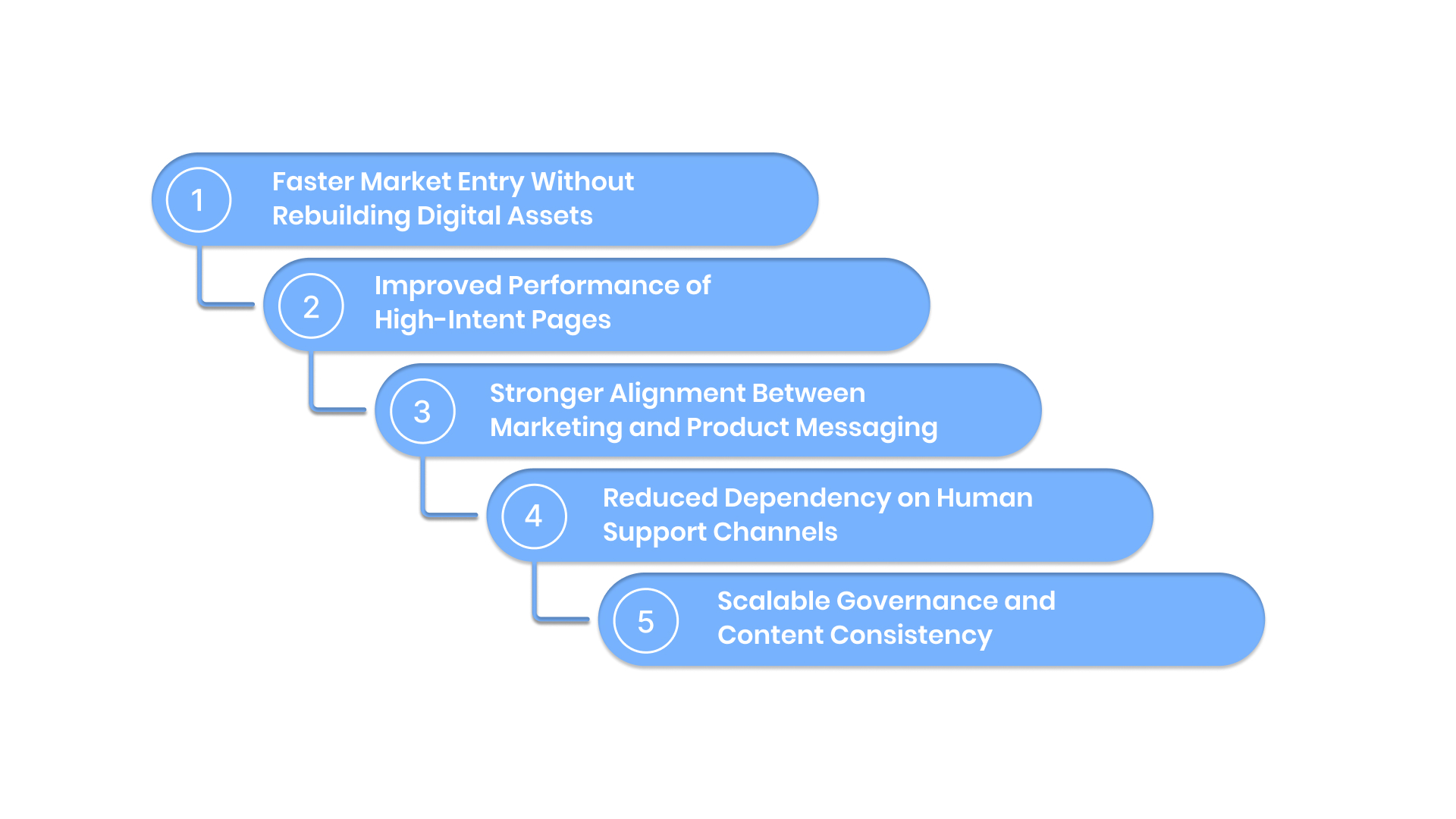
Faster Market Entry Without Rebuilding Digital Assets
Launching in new regions often requires changes across marketing, sales, and support functions. Website translation allows businesses to enter new language markets without redesigning or rebuilding their existing digital infrastructure. By reusing the same website architecture while adapting content linguistically, organizations can validate new markets faster and at significantly lower cost.
Improved Performance of High-Intent Pages
Not all pages contribute equally to business outcomes. Product pages, onboarding flows, application forms, and support journeys are especially sensitive to language clarity. Translating these high-intent touchpoints reduces drop-offs caused by misunderstanding and improves the effectiveness of the website as a conversion engine.
Stronger Alignment Between Marketing and Product Messaging
Marketing campaigns increasingly drive users to owned digital properties. When ad creatives or outreach campaigns are localised but landing pages are not, the user experience breaks. Website translation ensures continuity between acquisition channels and on-site messaging, helping marketing investments deliver better returns.
Reduced Dependency on Human Support Channels
When users clearly understand website content, they rely less on call centres, email support, or in-person assistance. Translated FAQs, policy pages, and help content allow users to self-serve more effectively, lowering operational load while improving customer satisfaction.
Scalable Governance and Content Consistency
As businesses grow, managing content across languages becomes complex. Professional website translation services introduce structure, version control, and consistency across languages. This ensures that updates, regulatory changes, and product revisions are reflected uniformly, reducing risk and manual effort.
Taken together, these benefits show why website translation services function as a structured, ongoing growth enabler that improves speed, efficiency, and resilience across digital operations. Understanding the benefits of website translation services through this lens helps businesses make informed decisions about how and where to invest in multilingual capabilities.
How to Implement Website Translation Services Effectively
The impact of website translation depends less on intent and more on execution. Without the right approach, translation can create operational complexity instead of reducing it. These considerations help businesses implement translation in a way that is scalable, consistent, and aligned with business goals.
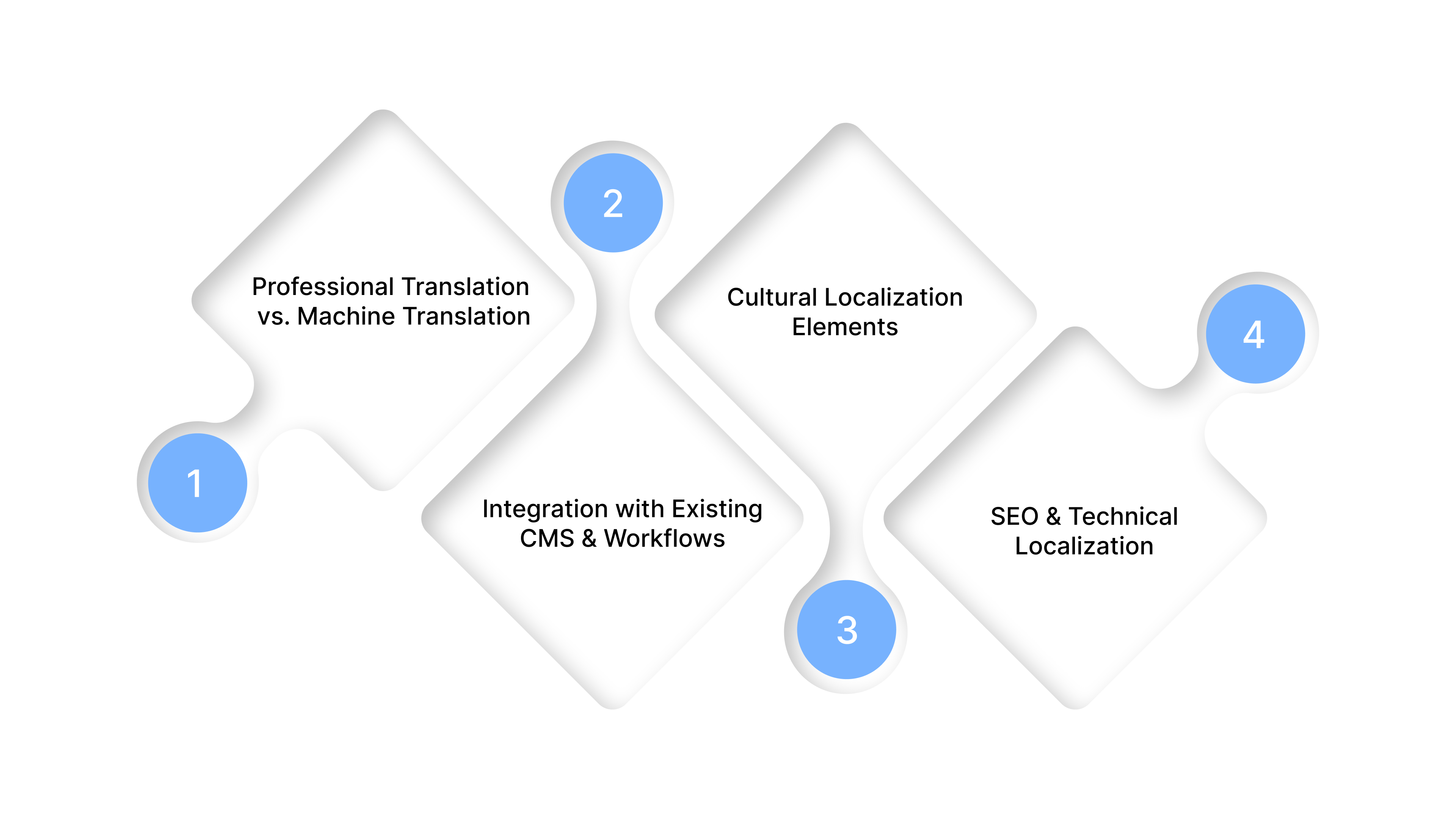
Professional Translation vs. Machine Translation
Choosing the right translation approach starts with understanding content risk and purpose.
Machine translation is effective when:
- Content volume is high and time sensitivity is critical
- The material is informational or low-risk
- Speed matters more than stylistic precision
Professional human translation is essential when:
- Content influences trust or purchasing decisions
- Legal, financial, or regulatory accuracy is required
- Brand tone and clarity must be preserved
Most enterprises adopt a hybrid model, using automation for scale while applying human review to high-impact content. The goal is to balance efficiency with quality, not to treat translation as a one-size-fits-all decision.
Integration with Existing CMS and Workflows
Translation should fit into existing content processes, not sit outside them.
Key implementation considerations include:
- Direct integration with CMS and web platforms
- Automated detection of new or updated content
- Version control across source and translated pages
When translation is embedded into workflows, teams avoid manual handoffs, reduce errors, and ensure that updates in the source language are reflected consistently across all languages.
Cultural Localization Elements
Effective translation goes beyond words and addresses how users interpret and interact with content.
This includes:
- Adapting imagery, icons, and visual cues
- Localising date formats, numbers, and currencies
- Aligning tone and messaging with regional expectations
Ignoring cultural context can make content feel generic or unfamiliar, even if the language itself is correct. Localization ensures that translated websites feel intentional and user-centric.
SEO and Technical Localization
Multilingual websites must be structured so search engines can correctly understand and rank them.
Technical best practices include:
- Language-specific URL structures
- Correct use of hreflang annotations
- Translated metadata for each language version
- Clear relationships between source and translated pages
Proper technical localization prevents indexing issues and allows translated content to perform effectively in regional search results.
When these considerations are addressed upfront, website translation becomes a sustainable capability rather than an operational burden. Businesses that plan for quality, workflow integration, cultural relevance, and technical accuracy are far more likely to realise the long-term benefits of website translation services.
How to Measure the ROI of Website Translation Services
After implementation, the key question for any business is whether website translation is delivering tangible results. Measuring impact helps organisations move translation from a perceived cost centre to a clearly evaluated business investment.
Rather than relying on broad assumptions, impact should be assessed through specific performance indicators tied to business goals.
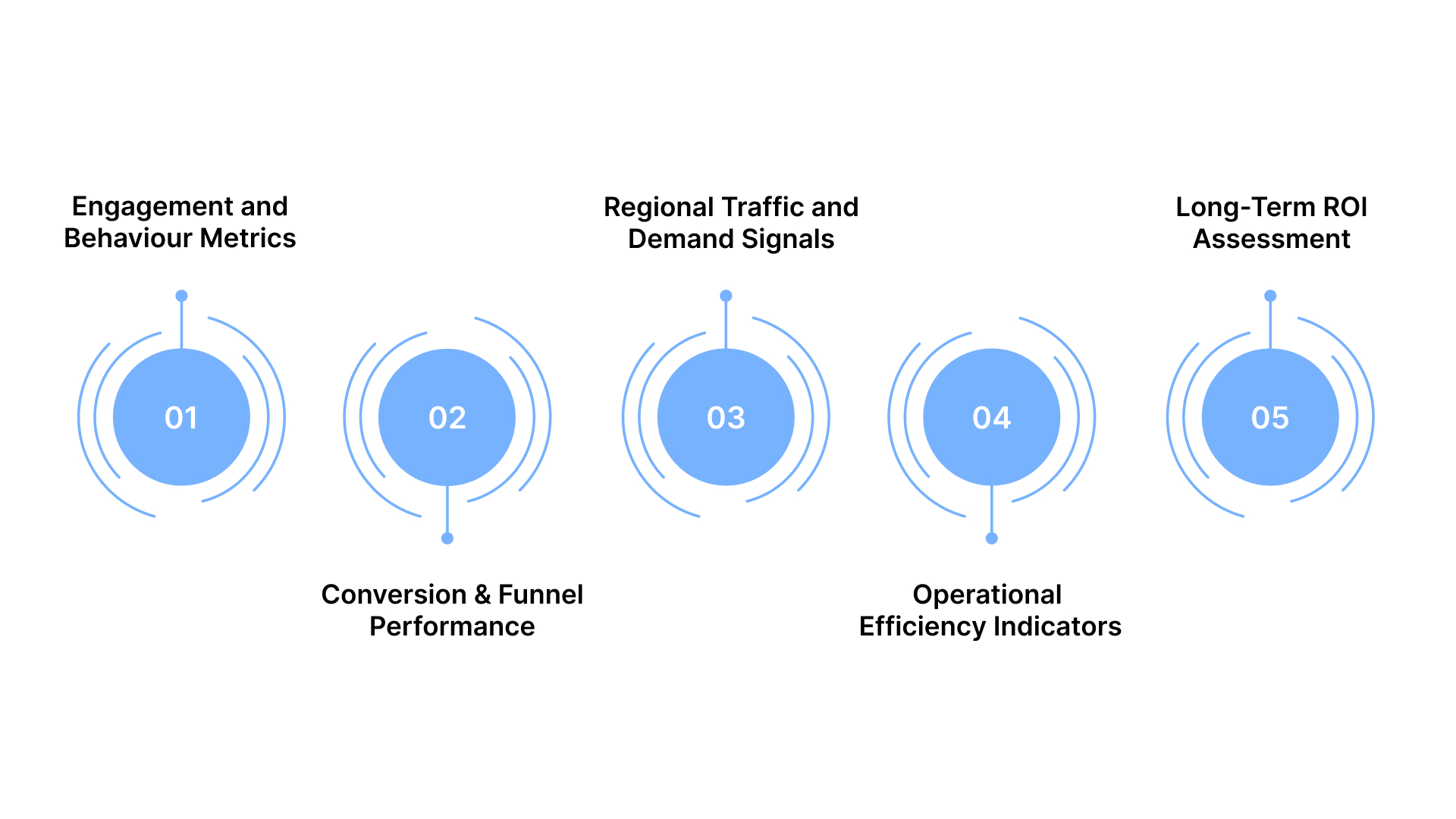
Engagement and Behaviour Metrics
Translated content often changes how users interact with a website.
Key indicators to track include:
- Time spent on translated pages
- Bounce rates across language versions
- Navigation depth and page flow completion
Improved engagement signals that users are able to understand and interact with content more effectively in their preferred language.
Conversion and Funnel Performance
Website translation influences how smoothly users move through high-intent journeys.
Metrics to monitor include:
- Form completion rates
- Checkout or application success rates
- Drop-offs at critical decision points
Comparing performance between source-language and translated journeys helps identify where translation is contributing directly to business outcomes.
Regional Traffic and Demand Signals
Translation often unlocks demand that was previously invisible.
Relevant indicators include:
- Organic traffic growth from specific regions
- Language-specific landing page performance
- Search impressions for regional-language queries
These signals help businesses understand which markets are responding most strongly and where to prioritise further localisation.
Operational Efficiency Indicators
Beyond user-facing metrics, translation also affects internal efficiency.
Useful measures include:
- Reduction in support queries related to comprehension
- Faster content update cycles across languages
- Lower dependency on manual translation workflows
Operational improvements often compound over time, contributing to long-term cost control and scalability.
Long-Term ROI Assessment
Translation impact should be evaluated over time rather than immediately after launch.
Effective ROI assessment considers:
- Cumulative traffic and conversion gains
- Cost savings from automation and reduced rework
- Market expansion achieved without rebuilding digital assets
By tying translation performance to measurable outcomes, businesses gain clarity on where translation delivers the most value and how to optimise it further.
When measured systematically, website translation services become easier to justify, optimise, and scale. This visibility is what allows organisations to treat multilingual capability as a long-term digital asset rather than a one-time initiative.
Scaling Multilingual Websites with Anuvadak
As multilingual requirements grow, the challenge for most organisations is not translation itself but managing scale without losing control. Multiple languages, frequent content updates, regulatory sensitivity, and distributed teams can quickly turn localisation into a fragmented and error-prone process. This is where a purpose-built platform becomes essential.
Anuvadak is designed to help enterprises and government organisations operationalise website translation as a long-term capability rather than a series of ad hoc projects.
Centralised Control Across Languages
Anuvadak enables teams to manage all language versions of a website from a single interface. Content updates in the source language can be tracked, translated, and published systematically, reducing the risk of outdated or inconsistent information across languages.
This centralisation is especially important for organisations operating in regulated sectors, where accuracy and consistency are critical.
Automation Without Losing Oversight
Scaling multilingual websites requires automation, but not at the cost of quality. Anuvadak supports automated translation workflows while allowing businesses to define where human review is required. This ensures that high-impact content receives appropriate attention, while routine updates move quickly.
Automation here is used to reduce manual effort, not to remove governance.
Seamless Integration with Existing Systems
Anuvadak is built to integrate with existing CMS platforms, web stacks, and digital workflows. This allows translation to function as an extension of current publishing processes rather than a parallel system.
For product, content, and engineering teams, this means:
- Fewer manual handoffs
- Faster update cycles across languages
- Better alignment between source and translated content
Enterprise-Grade Security and Compliance
For organisations handling sensitive information, multilingual scale must not introduce security risks. Anuvadak is designed with enterprise-grade security controls and compliance considerations, making it suitable for BFSI, healthcare, government, and legal use cases.
This ensures that localisation efforts remain aligned with internal policies and regulatory requirements.
Designed for India’s Linguistic Diversity
Anuvadak is purpose-built for India’s multilingual reality, supporting multiple Indian languages while accounting for linguistic, cultural, and script-level complexity. This allows organisations to expand language coverage confidently without compromising user experience or operational efficiency.
By combining automation, governance, and integration, Anuvadak helps organisations move from isolated translation efforts to a scalable, platform-led multilingual strategy that enables sustainable growth.
Conclusion
Website translation has moved beyond being a tactical enhancement to becoming a foundational element of digital strategy. As businesses expand their reach, refine customer journeys, and optimise digital performance, language increasingly determines how effectively a website supports growth, trust, and operational efficiency.
Organisations that approach website translation as a structured, scalable capability are better positioned to adapt to evolving markets, manage complexity, and deliver consistent experiences across languages. The real advantage lies not just in translating content, but in building systems that allow multilingual websites to evolve alongside business needs.
Platforms like Anuvadak enable this shift by bringing together automation, governance, and integration in a way that supports long-term multilingual scale. For businesses looking to unlock the full benefits of website translation services, the next step is to move from fragmented efforts to a unified localisation strategy designed for growth.
Exploring how your digital platforms can scale across languages today is a practical way to prepare for the opportunities of tomorrow.
FAQs
Q: What are the benefits of website translation services for businesses?
A: Website translation services help businesses reach wider audiences, improve user understanding, and support growth in new markets. They also enable better content consistency and scalability compared to ad hoc or manual translation efforts.
Q: Why is website translation important for business success?
A: Website translation is important because it allows businesses to communicate clearly with users who prefer content in their native language. Clear communication improves engagement, supports decision-making, and strengthens the overall effectiveness of digital platforms.
Q: How does website translation impact conversions and sales?
A: When users understand content without effort, they are more likely to complete key actions such as sign-ups, inquiries, or purchases. Translation reduces confusion at critical touchpoints, helping websites perform more effectively as conversion channels.
Q: Is website translation only useful for global businesses?
A: No, website translation is equally valuable for businesses operating within multilingual countries like India. Even domestic audiences often prefer regional languages, making translation relevant for both local and international growth.
Q: How do businesses choose the right website translation service?
A: Businesses should look for services that support automation, workflow integration, quality control, and scalability. The right solution should align with existing systems and long-term multilingual requirements, not just immediate translation needs.