
Did you know that over 1 billion voice searches are conducted each month globally? This rapid adoption highlights the growing need for accurate, real-time voice solutions in enterprise operations.
For Indian B2B enterprises managing large volumes of data, multilingual teams, and role-specific workflows, traditional text-based systems can slow decisions and reduce productivity. Voice search offers hands-free interaction, real-time transcription, and context-aware insights to address these challenges efficiently.
In this blog, you’ll discover how voice search can optimise workflows in India and learn practical strategies for implementing scalable, reliable, and multilingual voice solutions.
At a Glance
- Faster Workflows: Voice search reduces manual entry, enables hands-free operation, and ensures real-time transcription for accurate enterprise processes.
- Language Coverage: Supports multiple Indian languages, code-switching, regional accents, and domain-specific terms for consistent communication.
- Instant Insights: Integration with BI tools enables professionals to access filtered metrics and reports instantly, enabling quicker decision-making.
- Automated Operations: Predictive workflows anticipate needs, trigger processes, flag anomalies, and free teams for strategic tasks.
- Secure & Compliant: Role-based access, encryption, and privacy measures protect sensitive data while supporting real-time voice operations.
Why Voice Search Matters for Enterprises in India?
Many Indian enterprises operate in complex, high-volume environments where speed, accuracy, and accessibility directly affect business outcomes. Voice search addresses these challenges by streamlining how information is captured, accessed, and acted upon across enterprise systems.
- Reduced Reliance on Manual Data Entry: Voice search enables professionals to record information verbally, reducing time spent on typing and minimising documentation errors in operational workflows.
- Real-Time Transcription for Time-Critical Operations: In fast-paced environments, voice-driven transcription ensures that data is captured and processed instantly, supporting timely decisions and compliance.
- Multilingual Communication at Enterprise Scale: Voice systems support regional languages and mixed-language interactions, allowing teams across India to work efficiently without compromising transcription accuracy.
- Improved Accessibility Across Diverse Roles: Voice search allows hands-free interaction with systems, making digital tools accessible to field staff, clinicians, technicians, and supervisors.
- Enterprise-Grade Reliability and Compliance Support: Accurate voice-driven documentation supports audit readiness and regulatory requirements in sectors where precision and traceability are mandatory.
To achieve this reliability, voice search systems rely on advanced technologies that enable their accuracy and scalability. Let’s take a closer look at these technologies driving the future of voice search.
4 Key Technologies Powering Voice Search
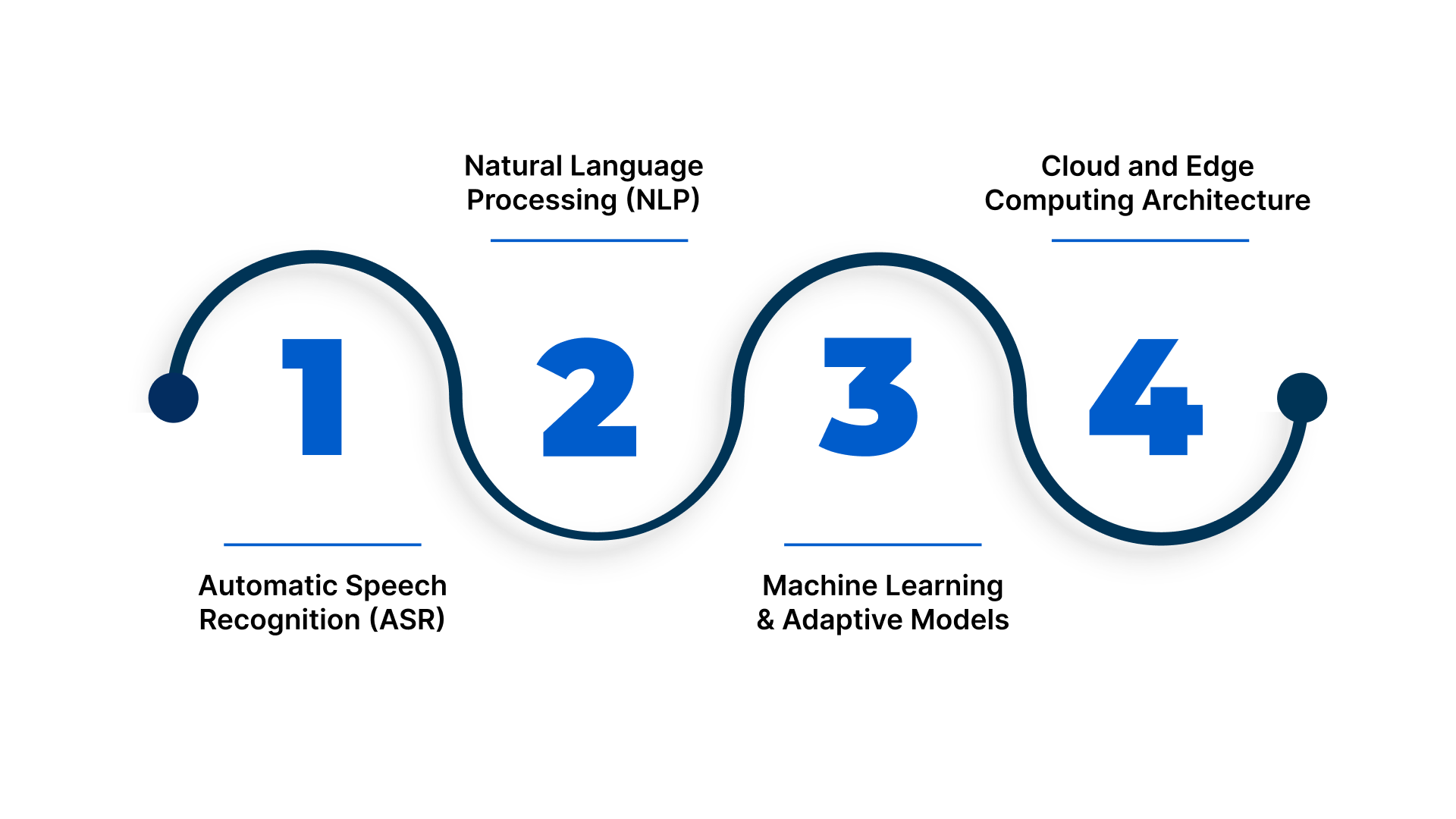
Modern voice search systems rely on multiple integrated technologies to deliver accurate, scalable, and real-time performance. In B2B environments, these technologies must handle linguistic diversity, technical vocabulary, and high-volume operational demands with consistent reliability.
1. Automatic Speech Recognition (ASR)
ASR forms the foundation of voice search by converting spoken language into text that enterprise systems can process.
- Recognises regional accents and pronunciation variations common in Indian workplaces.
- Maintains transcription accuracy in noisy environments such as factories or hospitals.
- Supports domain-specific terminology used in healthcare, legal, and industrial settings.
- Enables low-latency, real-time transcription for time-sensitive workflows.
2. Natural Language Processing (NLP)
NLP interprets the meaning and intent behind transcribed speech, ensuring that voice inputs lead to relevant outcomes.
- Identifies user intent beyond literal phrasing.
- Applies contextual understanding based on role and workflow.
- Converts unstructured voice input into structured enterprise data.
- Handles conversational and incomplete language accurately.
3. Machine Learning and Adaptive Models
Machine learning allows voice systems to improve continuously as they are used across the organisation.
- Refines accuracy through ongoing interaction with data.
- Adapts to individual speaking styles without losing consistency.
- Reduces recurring errors through pattern recognition.
- Scales efficiently across departments and use cases.
4. Cloud and Edge Computing Architecture
Infrastructure choices determine how well voice search performs at scale.
- Cloud platforms enable centralised processing and high-volume scalability.
- Edge computing supports low-latency processing in critical environments.
- Hybrid models balance security, performance, and compliance needs.
- Flexible architecture enables integration with existing enterprise systems.
Also Read: Power of Speech to Text API: A Game Changer for Content Creation
Together, these technologies enable enterprise-grade voice search that supports real-time transcription, multilingual interaction, and scalable deployment. However, even with strong technical foundations, organisations must address adoption challenges to realise the full potential of voice search.
Sector‑Specific Impact: Voice Search in Practice
Voice search is moving beyond a supporting role to become a core operational capability. By enabling hands-free interaction, real-time transcription, and context-aware data access, it addresses a key enterprise challenge: scalable, accurate communication. Here’s how different sectors are applying it to transform workflows:
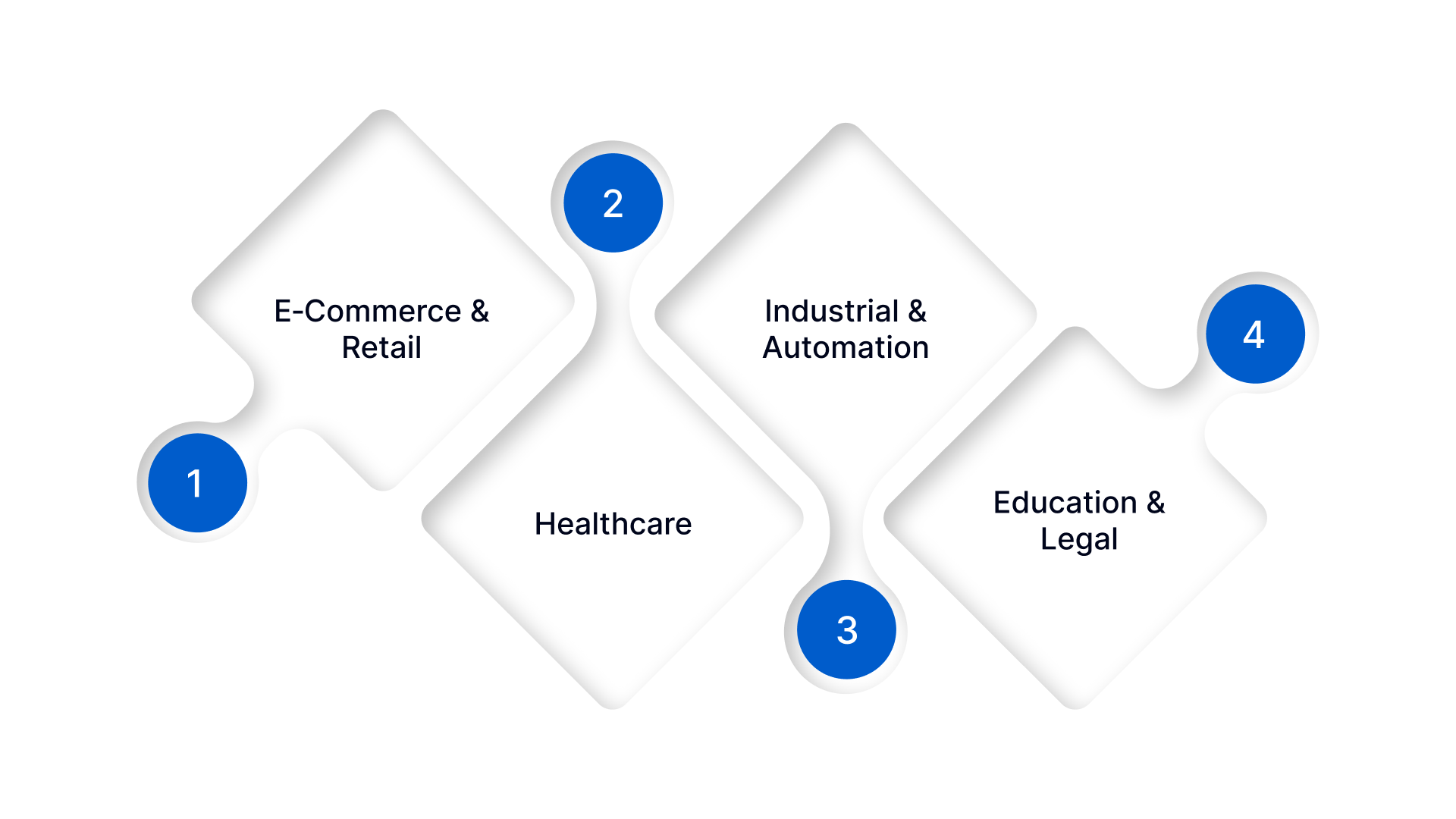
- E‑Commerce & Retail: Voice search can enhance catalogue search, order placement, and supplier interactions by reducing reliance on typed queries. Voice‑driven product discovery also enables better user engagement across languages.
- Healthcare: Clinicians can use voice commands for real‑time charting, clinical transcription, and case retrieval, dramatically reducing documentation burden and improving patient outcomes.
- Industrial & Automation: Operators can interact with control systems hands‑free, receiving status updates, maintenance alerts, and diagnostic reports through voice interfaces that integrate with existing SCADA/IoT systems.
- Education & Legal: Teachers and legal professionals benefit from voice‑based research queries, document summarisation, and automated transcription, improving efficiency and accessibility.
Looking to build context-aware, multilingual voice solutions? The Reverie Speech-to-Text API can enhance transcription accuracy, streamline operations, and support real-time decision-making. Schedule a call today to see how it can optimise your workflow.
While the potential is compelling, realising this future requires addressing specific challenges unique to Indian enterprises.
Common Challenges in Voice Search Adoption
While interest in voice search is growing rapidly, enterprises still face significant obstacles when deploying it at scale. These challenges are especially pronounced in the Indian context, where linguistic diversity, complex workflows, and regulatory requirements add layers of complexity. Key challenges include:
- Linguistic diversity: Regional languages, accents, and dialects can reduce transcription accuracy if systems are not adequately trained to handle them.
- Industry-specific terminology: Generic models often struggle to recognise technical terms used in healthcare, legal, automation, and other specialised sectors.
- System integration hurdles: Connecting voice platforms with legacy ERP, CRM, and operational systems can be complex and resource-intensive.
- Data security and privacy: Sensitive voice data must comply with industry regulations, creating challenges around storage, access, and governance.
- Performance at scale: High volumes of real-time voice interactions can strain processing systems, potentially affecting speed and accuracy.
Also Read: How Reverie’s Speech-to-Text API is Reshaping Businesses in India
These challenges explain why many organisations remain cautious about moving beyond pilot projects. Addressing these limitations is central to defining the future of voice search in enterprises.
What the Future Holds for Voice Search?
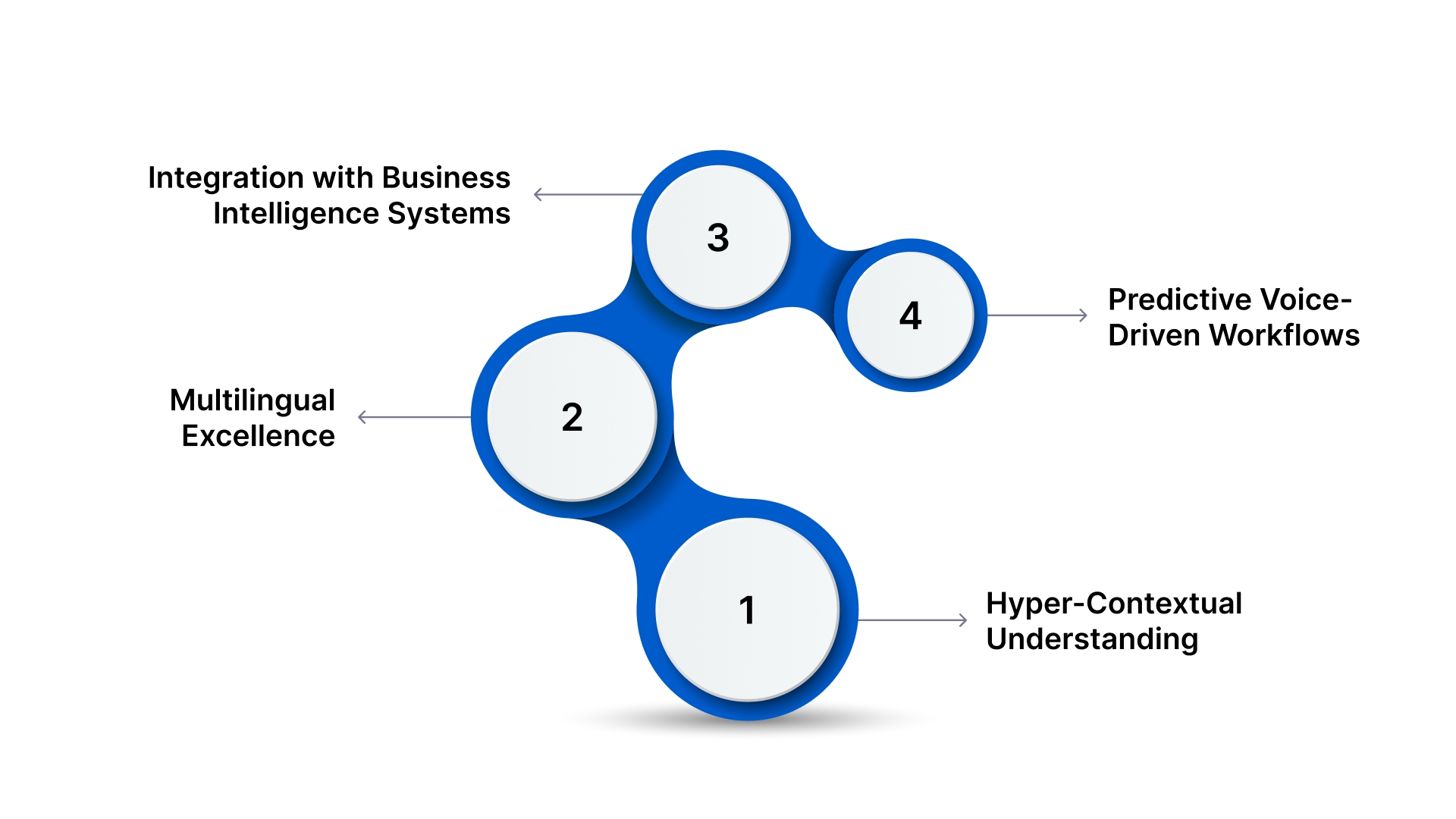
The future of voice search will be defined by intelligence, integration, and proactive operational capabilities. These advancements will help Indian enterprises improve efficiency and transform how professionals interact with data. Here are a few key capabilities set to drive this transformation:
1. Hyper-Contextual Understanding
Future voice systems will interpret more than spoken words. By understanding business context, user roles, urgency, and historical interactions, these systems deliver precise, relevant, and actionable outputs.
- Role-aware responses: Voice recognition adapts to whether the speaker is a technician, clinician, manager, or legal professional.
- Contextual transcription: Captured speech reflects intended meaning rather than literal word-for-word conversion.
- Priority recognition: Systems identify urgency and automatically prioritise tasks.
- Continuity across interactions: Ongoing workflows are maintained seamlessly across multiple voice interactions.
Building on contextual awareness, multilingual support ensures enterprises can scale voice search across diverse teams and regions.
Real-world Example: In 2025, Digital India’s Bhashini Division and CRIS partnered to integrate multilingual ASR into Indian Railways platforms like RailMadad and the National Train Enquiry System, enabling services in 22 languages and advancing enterprise-level, inclusive voice interfaces.
2. Multilingual Excellence
Multilingual capability will be foundational for voice search in India. Enterprises require consistent accuracy across languages without compromising operational efficiency.
- Regional language support: Native handling of languages used across day-to-day operations.
- Code-switching: Accurate interpretation even when multiple languages are used within a single interaction.
- Accent adaptation: Continuous learning to recognise regional accents and pronunciation patterns.
- Standardised outputs: Ensures reporting, analytics, and compliance remain consistent across languages.
Beyond language, integration with business intelligence systems enables actionable insights directly via voice commands.
Real-world Example: AI4Bharat’s foundational language models, adopted by Bhashini’s national language platform, support speech recognition, translation, and language understanding across India’s official languages, powering services in government, healthcare, education, and agriculture.
3. Integration with Business Intelligence Systems
Voice search will increasingly serve as a natural interface for enterprise data. Professionals will access operational metrics, performance insights, and compliance records using simple voice queries.
- Conversational queries: Retrieve sales figures, production data, and other key metrics without manual searches.
- Contextual filtering: Data is automatically filtered based on role, department, and workflow context.
- Secure access: Authentication ensures that sensitive information is available only to authorised personnel.
- Faster decision-making: Voice-enabled access reduces dependency on dashboards and accelerates business insights.
While integration with BI systems provides actionable insights, predictive workflows will enable enterprises to act proactively rather than reactively.
Real-world Example: Apollo Hospitals and other major healthcare providers in India are using automated speech transcription for clinical documentation and consultation recording. These systems convert spoken interactions into structured text for patient records in multiple Indian languages and mixed speech.
4. Predictive Voice-Driven Workflows
The future of voice search lies in anticipation. Advanced systems will analyse behavioural patterns and operational data to predict needs and automate routine processes.
- Behavioural analysis: Systems learn from repeated interactions to anticipate user requirements.
- Proactive alerts: Flag anomalies, compliance risks, or urgent tasks automatically.
- Workflow automation: Voice commands can trigger multi-step processes without manual intervention.
- Focus on high-value work: Reduces repetitive tasks, allowing teams to concentrate on strategic activities.
Predictive workflows transform voice search from a passive input tool into an active operational partner for enterprises.
Real-world Reference: In 2026, enterprises are adopting autonomous, multi‑agent AI systems that anticipate tasks, automate workflows, and support predictive, voice-driven operations across business processes.
Conclusion
B2B enterprises in India face challenges managing large volumes of data, multilingual teams, and role-specific workflows. Traditional systems can slow decision-making and reduce productivity. Voice search addresses this by enabling hands-free interaction, real-time transcription, and context-aware insights.
To realise these benefits, you can utilise platforms like Reverie, which enable enterprises to implement scalable, context-aware voice search with multilingual transcription across 11 Indian languages, flexible processing, and voice-driven workflows. These capabilities allow businesses to capture and act on voice data efficiently, while maintaining secure, compliant operations.
Discover how the Reverie Speech‑to‑Text API can power accurate transcription in your voice search and workflow systems. Sign up now to explore multilingual voice solutions built for Indian enterprises.
FAQs
1. How can voice search enhance enterprise workflows in India?
Voice search reduces manual data entry, enables instant access to business metrics, and supports hands-free operations. In healthcare, manufacturing, and legal environments, it accelerates task execution and improves response times for critical workflows.
2. Can voice search handle India’s language diversity?
Yes. Modern systems support regional languages, code-switching, and accent variation, ensuring accurate transcription and consistent communication across multilingual teams without impacting performance or compliance.
3. How does voice search support faster decision-making?
Integrated with enterprise data platforms, voice search enables on-demand access to reports and KPIs via simple voice commands, eliminating the need for dashboard access and speeding up operational decision-making.
4. What benefits do predictive voice workflows offer?
Predictive systems anticipate user needs, automate routine processes, flag risks, and reduce repetitive work, allowing teams to focus on high-value operational and strategic tasks.
5. What are the key security considerations for enterprise voice search?
Enterprise platforms require encryption, role-based access, secure authentication, and compliant data storage to protect sensitive information while supporting real-time voice operations.