
Have you ever wondered why your digital platforms perform well in some regions but fail to connect in others?
Many enterprises across sectors like banking, healthcare, governance, and e-commerce face this gap when their content, interfaces, and customer journeys are not aligned with the language and cultural expectations of diverse Indian users. In a country where people prefer to engage, read, and transact in their own language, ignoring localisation can limit reach, reduce trust, and slow down digital adoption.
Are you also dealing with issues such as a poor user experience across languages? This blog explores why localisation is essential for business success in India and how it helps enterprises deliver inclusive, accurate, and seamless digital experiences at scale.
Key Takeaways
- Localisation helps you deliver clear, trustworthy, and culturally relevant digital experiences that match the language preferences of diverse Indian users.
- It improves engagement, reduces miscommunication, strengthens customer trust, and supports compliance across sectors such as BFSI, healthcare, eCommerce, government, and legal services.
- A well-localised platform boosts adoption, increases conversions, and enhances overall user satisfaction across regions.
- Enterprises often struggle to scale multilingual content, maintain accuracy, manage workflows, and ensure consistency without the right tools.
- Using an advanced localisation platform like Anuvadak streamlines translation, automation, and management, helping you deliver multilingual digital experiences efficiently and at scale.
What is Localisation?
Localisation is the process of adapting your digital platforms, content, and user journeys to the language and cultural context of each region you serve. It is more than translation. You modify text, design elements, visuals, and functional components to help users interact with your service naturally in their preferred language.
For medium to large enterprises, localisation ensures clear communication, regulatory accuracy, and a smoother user experience across diverse Indian markets. It helps you deliver consistent, high-quality engagement to customers, regardless of the language they use.
Now that you understand what localisation means, it’s important to explore why it matters for your business.
Also Read: 5 Inspiring Website Localisation Examples That Transformed User Engagement
Why Localisation Matters for Your Business
Suppose you are still wondering why localization is important for businesses operating in India’s diverse markets. In that case, the following sections will help you understand its impact across user trust, compliance, and overall digital adoption.
When you communicate in the language people prefer, you remove barriers that often slow down adoption, reduce engagement, and affect overall business performance. It also helps your teams maintain consistency, accuracy, and control across multiple regions at scale.
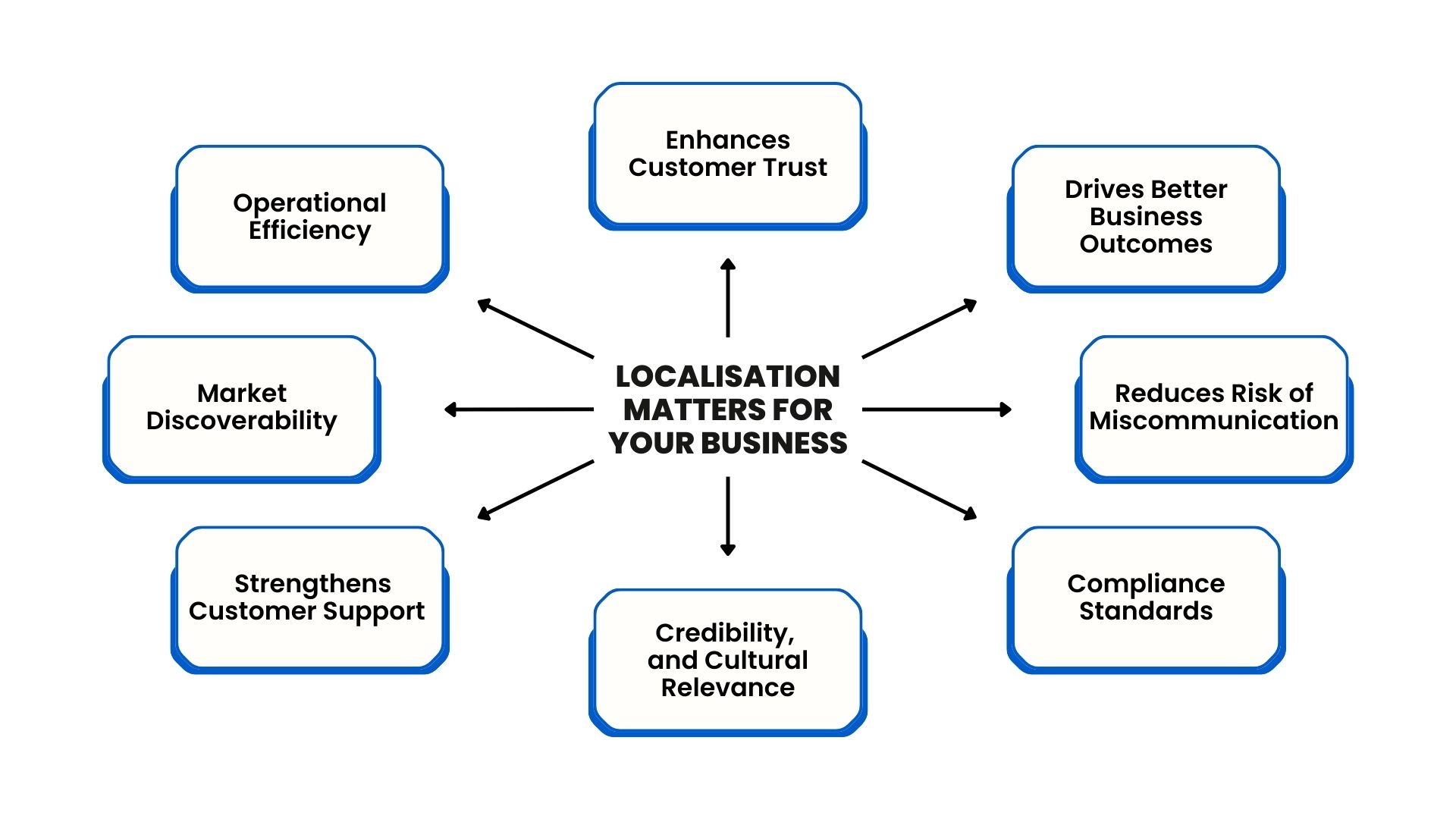
Here are the key reasons why localisation matters for your business:
1. Enhances Customer Trust and Experience
When users see information, labels, and instructions in their own language, they feel more confident navigating your website, app, or service. This reduces confusion, lowers drop-offs, and improves satisfaction.
For sectors where accuracy and clarity are essential, a well-localised interface strengthens trust and reduces risks.
2. Drives Better Business Outcomes
Localisation directly impacts performance metrics such as engagement, adoption, and retention. When you offer information in languages your customers understand, they spend more time on your platform and complete more actions.
This leads to better onboarding, stronger customer relationships, and improved digital uptake across regional markets.
3. Reduces Risk of Miscommunication
Communicating in the wrong language or using inaccurate translations can lead to errors, delays, and customer dissatisfaction. In regulated sectors such as finance, healthcare, and legal services, even minor misunderstandings can create serious issues.
Localisation helps you deliver precise, context-aware information that users can trust, reducing the risk of misinterpretation.
4. Supports Legal and Compliance Standards
Many government and industry regulations require information to be available in local languages. Localisation helps you meet these standards and avoid compliance risks.
It ensures your content is accurate, consistent, and aligned with regional guidelines, which is critical for sectors that handle sensitive data or citizen information.
5. Increases Brand Trust, Credibility, and Cultural Relevance
When your platform reflects the audience’s language and culture, your brand feels more familiar and reliable. This strengthens your reputation as a customer-first organisation.
For enterprises expanding across India, culturally relevant localisation helps you build long-term loyalty and stand out in competitive markets.
6. Strengthens Customer Support and Service Efficiency
When your support channels, FAQs, chatbots, and help content are localised, users can resolve issues faster without depending on call centres or manual escalation. Localised communication also reduces misunderstanding during service interactions, lowering operational pressure on your support teams.
For industries such as BFSI, eCommerce, Healthcare, and Government, clear multilingual support helps you handle high-volume queries efficiently and improves customer satisfaction.
7. Better SEO and Market Discoverability
Localising your content with region-specific keywords helps your platform appear in local search results. Users searching in their native language are more likely to find your business.
This increases your visibility in regional markets and strengthens your presence across multiple states and languages.
8. Scalability & Operational Efficiency
Managing multilingual content manually is slow and expensive for large organisations. With proper localisation workflows, you can update content faster, maintain consistency across languages, and reduce operational workload.
This is especially valuable for enterprises handling frequent updates, large content volumes, or multi-region communication.
If you are searching for a reliable way to localise your digital presence, an enterprise localisation platform such as Anuvadak simplifies the process by automating translations, maintaining version control, and ensuring every language version stays accurate and up to date.
To put these advantages into perspective, here’s how localisation creates measurable value across various industries.
Specific Use Cases: Where Localisation Matters Most
Each business sector has its own risks and expectations, and a single-language digital experience often falls short. When customers, patients, students, or citizens cannot clearly understand your content, the chances of drop-offs, errors, and mistrust increase.
Here are the key use cases where localisation delivers the highest value:
1. BFSI & Financial Services
In banking and financial services, users must understand every instruction clearly. Localisation helps you present account details, onboarding steps, loan information, and payment flows in a language users trust. This reduces service errors, supports regulatory requirements, and strengthens customer confidence.
2. eCommerce
For eCommerce brands, localised product descriptions, filters, checkout steps, and support pages help customers make confident buying decisions. When buyers read product details in their own language, they convert faster and show higher repeat-purchase behaviour.
3. Healthcare & Telehealth
In healthcare, even a small misunderstanding can lead to serious issues. Localisation ensures patients can read diagnoses, prescriptions, instructions, and consent forms without confusion. It also improves the accessibility of telehealth platforms for non-English-speaking users.
4. Education & eLearning
Educational platforms need to reach learners across states with different language preferences. Localised lessons, assessments, dashboards, and support material help you deliver equal learning opportunities and improve course completion rates.
5. Government & Public Sector
Government portals must be accessible to every citizen, regardless of language. Localised websites and mobile apps help you share information about schemes, registrations, grievances, and public services in languages that people use daily.
6. Legal & Compliance Portals
Legal content demands precision. Localisation ensures contracts, policies, case details, and compliance documents are translated accurately and adapted to regional legal contexts. This prevents misinterpretations and supports secure, compliant communication across regions.
Even with clear benefits, businesses often struggle with localisation challenges across regions.
Also Read: E-commerce Localisation: A Comprehensive Guide for Seamless Expansion
Common Challenges You Face During Localisation
Localisation becomes challenging when your business operates across multiple regions and serves users with different language needs. As your digital platforms grow, the pressure to maintain accuracy, speed, and consistency increases. Without the right tools and processes, even small gaps in localisation can impact user experience and compliance.
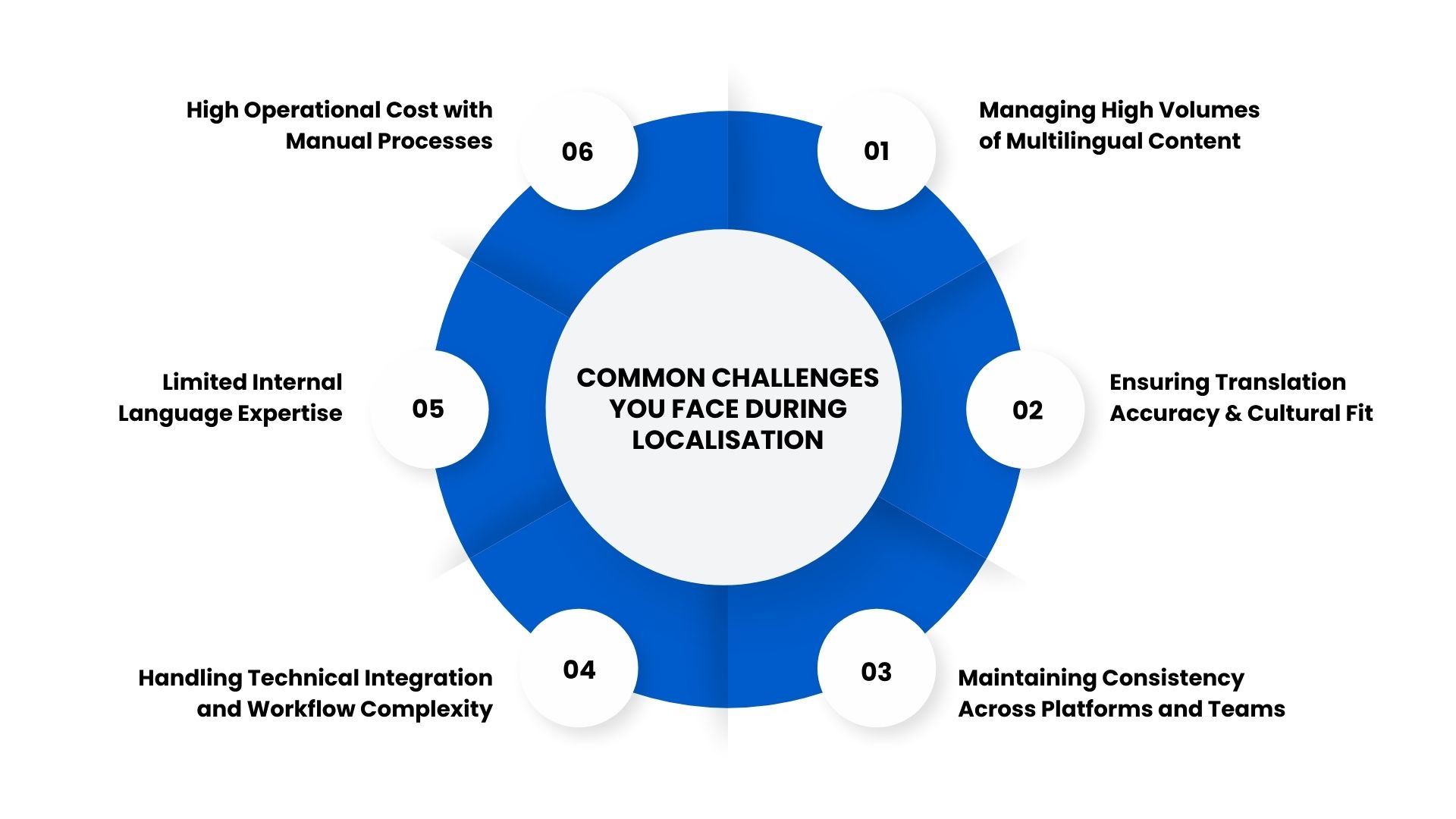
Here are the most common localisation challenges you may face:
1. Managing High Volumes of Multilingual Content
When you handle websites, apps, product catalogues, service pages, or citizen portals, keeping every language version updated becomes difficult. Without a central system, content quickly becomes outdated or inconsistent.
2. Ensuring Translation Accuracy and Cultural Fit
Direct or literal translation often fails to reflect context. This leads to confusing or incorrect messaging, which is risky in sectors such as BFSI, healthcare, legal, and government services, where accuracy is critical.
3. Maintaining Consistency Across Platforms and Teams
Different teams may use different terms, styles, or translation sources. This causes mismatches in language across your website, mobile app, chatbot, IVR flows, marketing materials, and documentation.
4. Handling Technical Integration and Workflow Complexity
Integrating localisation into CMS systems, mobile apps, internal tools, or citizen service portals can be challenging. Manual workflows slow down releases and create errors during updates.
5. Limited Internal Language Expertise
Many organisations do not have in-house reviewers or language specialists for every region. This affects quality checks, glossary control, and overall governance.
6. High Operational Cost with Manual Processes
Manual translation, uploading, formatting, and version management increase cost and effort. This becomes unsustainable when you scale across many languages and touchpoints.
To overcome these challenges, it is essential to adopt the right practices to strengthen your localisation process.
Best Practices for Effective Localisation Strategy
Building a strong localisation strategy is essential when you operate across multiple regions and manage complex digital platforms. Without the right practices in place, your teams may struggle to maintain quality, meet compliance needs, and scale efficiently.
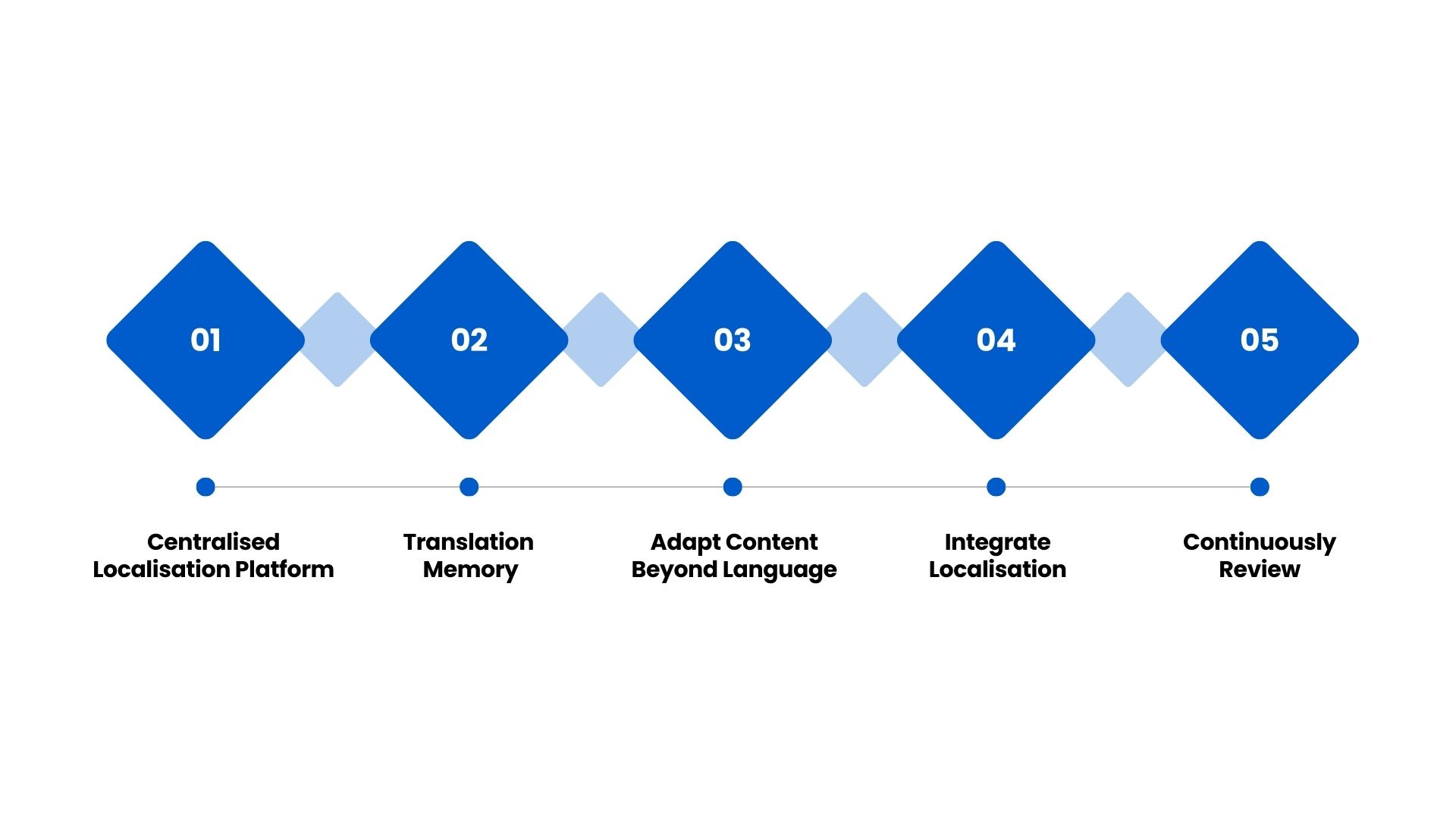
Here are the best practices that help you build an effective localisation strategy:
1. Use a Centralised Localisation Platform
Managing content through different tools or teams leads to delays and inconsistencies. A central platform helps you streamline translation, review, update, and quality-check processes in one place. It also makes it easier to manage websites and apps.
2. Maintain Translation Memory and a Controlled Glossary
A translation memory ensures that key terms, product names, financial terms, medical phrases, and regulatory language stay consistent across every channel. A glossary helps your teams avoid confusion and maintain the same terminology across all languages.
3. Adapt Content Beyond Language
Localisation should include cultural, visual, and functional adjustments. This means adapting design layouts for Indian scripts, updating images for regional relevance, and ensuring your workflows match local user behaviour. This creates a more natural and trustworthy user experience.
4. Integrate Localisation into Your Development and Content Workflows
Localisation should not be an afterthought. Integrating it directly into your CMS, product development cycles, and app release workflows helps you launch updates faster. This prevents delays and ensures every language version is released on time.
5. Continuously Review, Test, and Optimise
Localisation is not a one-time activity. You should regularly test language versions, review user feedback, and track performance across regions. This helps you catch errors early, improve clarity, and deliver a consistent experience as your platform evolves.
Adopting a robust localisation solution like Anuvadak allows your teams to put these best practices into action, ensuring your multilingual ecosystem stays accurate, consistent, and easy to manage.
With the best practices in place, the next step is to use the right platform to implement them efficiently at scale. If you are searching for a seamless way to implement these best practices at scale, Anuvadak makes enterprise localisation faster, more accurate, and easier to manage.
How Anuvadak Simplifies Enterprise-Scale Localisation
Anuvadak is a cloud-based localisation platform that simplifies and streamlines the delivery of multilingual digital experiences at scale. It helps you reach diverse Indian audiences by automatically translating, managing, and publishing your website or application in multiple languages without the typical overhead, delay, or complexity.
Here is how Anuvadak enables localisation for your digital platforms:
1. Automated Website Translation
Anuvadak uses an Indian-language neural machine translation engine to quickly and accurately translate your website. It continuously detects new English content and automatically updates all language versions, ensuring regional users always see the latest information.
2. Continuous Localisation with Zero Downtime
The platform supports continuous localisation without interrupting your live website. Based on your sitemap, Anuvadak maps all URLs, prepares language versions, and keeps your site updated with no downtime during setup or publishing.
3. Centralised Project and Content Management
Anuvadak consolidates subdomains, reviews, and version control into one dashboard. This helps your teams manage multilingual content more efficiently, reduce manual work, and maintain complete oversight across all localisation projects.
4. 90% Reduction in Manual Workload
The system automates content syncing, translation updates, and formatting. Your teams only need to review or edit language outputs instead of doing repetitive manual tasks. This significantly reduces operational workload and accelerates your localisation cycles.
5. Real-Time Language Progress Tracking
Real-time progress tracking of translation services adds transparency, empowering businesses to monitor and manage projects effectively, resulting in time savings, reduced manual effort, and an enhanced online presence.
Also Read: Anuvadak – Website Localisation and Translation Tool
Conclusion
Localisation has become essential for enterprises operating across India’s diverse languages. It improves user experience, reduces miscommunication, supports compliance, and strengthens your brand’s presence across regions. Whether you work in BFSI, healthcare, eCommerce, education, governance, or legal services, it helps you reach more people, increase adoption, and build a strong digital presence across regions.
If you are looking to simplify and scale your multilingual operations, Anuvadak, a website and app localisation platform, automates workflows, reduces manual effort, and ensures accurate, culturally aligned communication across all your digital channels. With features like continuous localisation, centralised control, and real-time tracking, Anuvadak helps your teams deliver consistent regional experiences across India.
So, why wait? Contact us to explore how Anuvadak can support your localisation goals!
FAQs
1. Can localisation really improve business outcomes like sales or engagement?
Yes. Studies show that localised platforms tend to see higher engagement, better user trust and satisfaction, and increased conversions because users interact more easily when content speaks their language and culture.
2. What risks does a business face if it ignores localisation when scaling to multiple regions?
Without proper localisation, you risk miscommunication, poor user experience, low engagement, compliance gaps (especially in regulated sectors), and reduced competitive edge, all of which can limit growth and damage brand reputation.
3. Can localisation really impact SEO and discoverability in regional markets?
Yes. Localised websites with content, metadata, URLs, and keywords tailored to local languages tend to perform better in search results for those languages. This improves visibility and organic traffic in target regional markets.