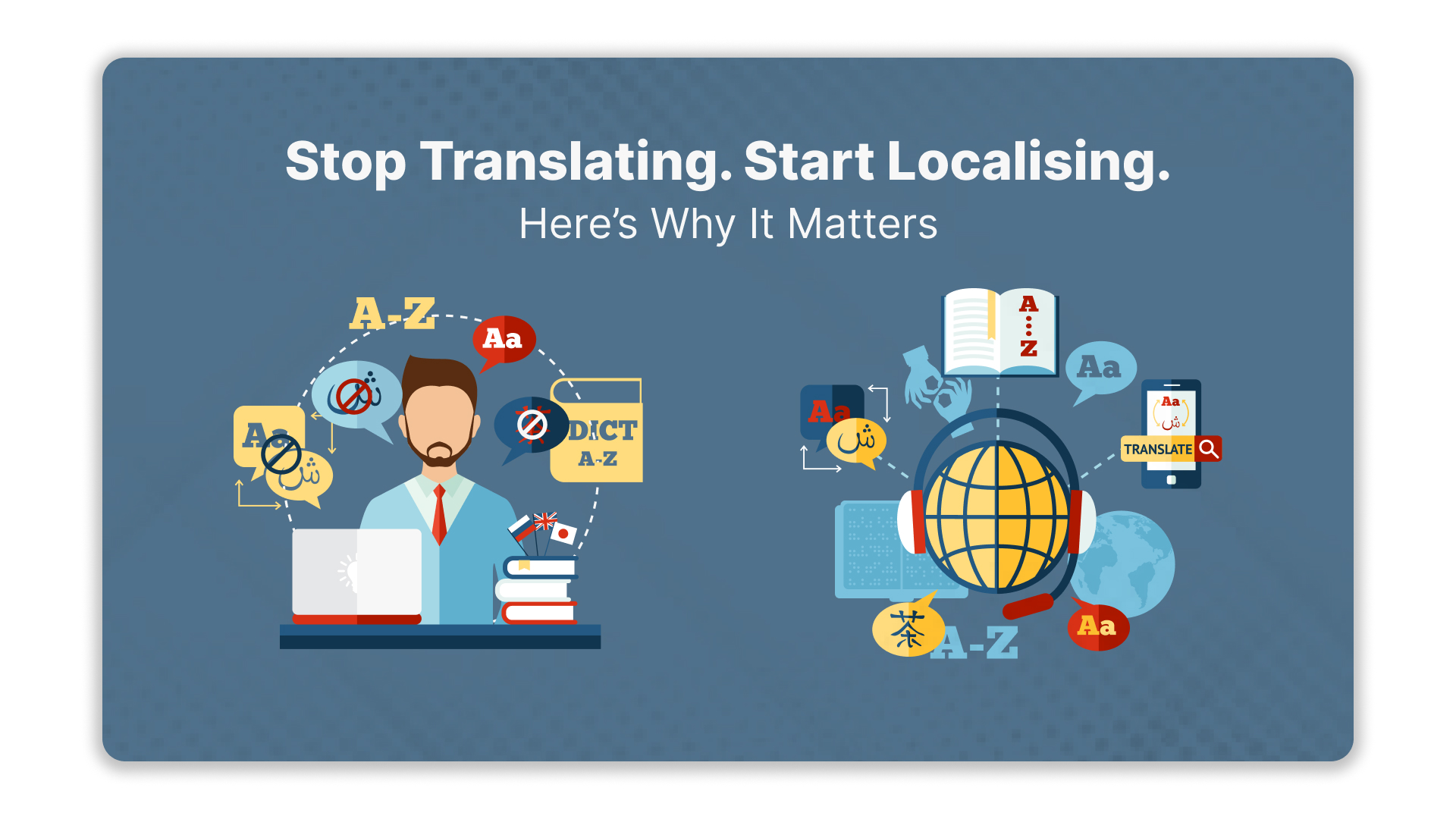
In an era where enterprises deliver digital experiences to audiences spanning languages, cultures, and regions, effective communication is no longer about whether you translate; it’s about how you localize.
The terms localization and translation are often used interchangeably, yet they represent fundamentally different goals.
Translation focuses on accuracy, ensuring your message is understood.
Localization focuses on experience, ensuring your message feels native, relevant, and trustworthy.
For global and multilingual businesses, understanding this difference is more than a linguistic exercise; it’s a strategic advantage.
When done right, localization turns translation from a task into a system, one that drives engagement, compliance, and consistency across every market.
Key Takeaways
- Translation focuses on converting text between languages, while localisation adapts content, tone, and design to fit local culture and context.
- For enterprises, localisation ensures every user experience feels native, improving engagement, compliance, and trust.
- Technology enables scalable localisation by automating translation, syncing updates, and maintaining brand consistency across markets.
- Common challenges include fragmented workflows, manual processes, and inconsistent tone, all solvable through structured governance and automation.
- Platforms like Anuvadak bridge the gap between translation and localisation, turning multilingual management into a seamless, data-driven enterprise function.
What Is Translation?
Translation is the linguistic process of converting content from one language (the source) into another (the target) while retaining its intended meaning. It’s the foundation of multilingual communication, the step that makes your content accessible across languages.
In enterprise settings, translation applies to:
- Product documentation and technical guides,
- Legal, financial, and policy documents,
- Software interfaces, menus, and support text, and
- Marketing and customer communication assets.
Its purpose is fidelity, ensuring that information is accurate, readable, and aligned with the source text. But translation alone doesn’t account for tone, emotion, or cultural nuance, the elements that shape user trust and engagement.
For example:
- A direct translation of “Sign up for free” might sound unnatural or overly formal in certain languages.
- Translating product names or slogans literally can distort meaning or even offend another market.
Translation ensures your content is understood; localisation ensures it is accepted.
What Is Localization (and Why It Goes Beyond Translation)

Localization is the process of adapting content, products, and experiences to align with the language, culture, and expectations of a specific audience. While translation converts words, localization transforms meaning, ensuring that tone, design, and functionality feel entirely native to the target market.
For enterprises, localization means rethinking how communication works across regions. It’s not only about changing language; it’s about contextual accuracy, ensuring that your product, website, or service reflects local customs, compliance requirements, and user preferences.
A truly localised experience might include:
- Adjusting date, time, and currency formats to regional conventions,
- Adapting imagery, colour schemes, and iconography to cultural context,
- Modifying user interfaces for right-to-left scripts or longer word structures,
- Ensuring legal and accessibility compliance in local languages, and
- Rewriting marketing copy to reflect tone, humour, or emotion that resonates locally.
For example, a multilingual government portal in India may use the same technical structure but serve different linguistic and cultural contexts, from English in Delhi to Marathi in Pune. Each version must feel tailored, not translated.
Localization transforms digital communication from a mechanical conversion to a cultural experience.
This distinction becomes critical as organisations scale across multilingual markets, where subtle differences in tone or phrasing can determine trust, adoption, and engagement.
Localization ensures that every user, regardless of their language, experiences the same clarity, credibility, and brand intent.
Localization vs Translation: Key Differences for Enterprises
While translation and localization work hand in hand, they serve different purposes within an enterprise communication strategy.
Here’s how they differ across key dimensions:
| Aspect | Translation | Localization |
|---|---|---|
| Primary Goal | Converts text from one language to another accurately. | Adapts content and experience to fit cultural, regional, and linguistic nuances. |
| Focus Area | Linguistic precision and meaning. | Cultural relevance, usability, and emotional resonance. |
| Scope | Text, phrases, and syntax. | Design, imagery, tone, UI, regulatory requirements, and local preferences. |
| Process Ownership | Usually managed by translators or language service providers. | Managed by localisation teams, product owners, and UX/content strategists. |
| Tools & Technology | Translation Memory (TM), machine translation, glossaries. | CMS integration, localisation platforms, automation, and cultural QA systems. |
| Output | A linguistically correct translation. | A regionally adapted experience that feels built for the local audience. |
| Business Impact | Makes content accessible to new audiences. | Builds brand trust, compliance, and deeper market penetration. |
In essence, translation communicates, while localization connects.
For enterprises, this difference defines whether a multilingual strategy delivers surface-level reach or meaningful engagement.
Why Localization Matters More Than Translation for Enterprises

For global and multilingual enterprises, translation is no longer enough. It ensures accuracy, but not alignment and in diverse markets, accuracy without cultural alignment rarely builds trust.
Localization goes a step further, transforming communication into a unified, market-specific experience that strengthens brand connection and operational efficiency.
1. It Builds Trust and Market Relevance
A translated product or website might convey the right words, but a localised one speaks the customer’s language of trust.
By adapting tone, phrasing, imagery, and even layout to local expectations, enterprises show genuine understanding, a key factor in markets where brand credibility depends on cultural fluency.
2. It Ensures Compliance and Accessibility
In regulated industries such as banking, healthcare, or public services, communication isn’t optional; it’s a compliance requirement.
Localization ensures that legal notices, policies, and public content meet regional standards for language accessibility and inclusivity.
This not only reduces risk but also demonstrates ethical and social responsibility in digital communication.
3. It Protects Brand Consistency Across Markets
Without localisation governance, each market interprets the brand differently, leading to tone drift, fragmented messaging, and reduced impact.
Localisation standardises this process, ensuring every audience experiences the same brand voice, quality, and trustworthiness, regardless of language.
4. It Optimises Efficiency and Speed to Market
When localisation is embedded into digital workflows, enterprises can launch updates across all regions simultaneously.
Rather than translating each asset manually, teams rely on automation and translation memory to keep all local versions aligned with the source.
The result: faster releases, lower costs, and consistent global experiences.
5. It Converts Users Into Advocates
A user who feels understood is far more likely to stay engaged.
Localization personalises content for emotional and contextual relevance, turning functional understanding into loyalty and communication into connection.
In short:
Translation gives enterprises reach; localization gives them resonance.
It turns language from a technical layer into a business advantage, one that drives customer trust, compliance, and long-term market growth.
Common Enterprise Challenges in Localization and Translation

For large organisations managing multilingual ecosystems, localisation and translation often evolve into complex, multi-stakeholder operations.
While the goal is seamless communication across markets, most enterprises face structural, technical, and process-related barriers that slow them down.
Here are the most common challenges and why they persist even in mature digital environments:
1. Fragmented Ownership
Different teams often handle different parts of the localisation process — product teams translate interfaces, marketing teams manage campaigns, and compliance teams review legal content.
Without a central governance model, these silos create duplicate work, inconsistent messaging, and unclear accountability.
2. Manual and Disconnected Workflows
Many enterprises still rely on outdated, spreadsheet-based translation processes.
When content is updated in the source language, corresponding target versions lag, creating version mismatches and release delays.
This manual coordination increases costs, slows time-to-market, and exposes gaps in quality control.
3. Lack of Integration Across Systems
Translation and localisation tools often operate independently of content management systems (CMS), CRMs, or analytics platforms.
This disconnect means teams must manually move content between systems — a process prone to human error and inefficiency.
4. Inconsistent Tone, Quality, and Brand Voice
When multiple translation vendors or regional teams manage localisation independently, the brand voice can drift.
Without shared glossaries, terminology databases, or linguistic QA frameworks, enterprises lose the consistency that defines credibility and trust.
5. Compliance and Security Risks
In regulated industries, content must meet strict language accessibility and data protection standards.
Unstructured localisation workflows can lead to non-compliance with government or sectoral language mandates or, worse, expose sensitive data during translation transfers.
The challenge for enterprises isn’t the lack of translation capacity; it’s the lack of structured governance.
To scale localisation effectively, organisations need integrated systems that automate translation, maintain version parity, and uphold linguistic and regulatory standards across every channel.
Let us see how technology and governance resolve these barriers.
How Technology Bridges the Gap Between Localization and Translation

As enterprises expand across regions and digital channels, manual translation workflows can’t keep up with the scale, speed, or complexity required. Technology bridges this gap, transforming localisation and translation from disconnected, manual tasks into continuous, data-driven systems.
Modern localisation technology goes far beyond word conversion. It integrates translation into the very fabric of digital operations, enabling content updates, quality checks, and multilingual publishing to happen in real time.
Here’s how it changes the game for enterprises:
1. Automation for Scale and Speed
Automated translation workflows connect directly with content management systems (CMS) and publishing platforms.
When content is updated in the source language, all corresponding target versions are automatically detected, queued, and translated, drastically reducing time-to-market.
This ensures every language version remains synchronised without manual coordination.
2. AI-Powered Translation and Quality Control
Neural machine translation (NMT) systems now deliver context-aware, domain-trained translations that balance speed with accuracy.
Combined with AI-driven linguistic QA, enterprises can maintain tone, terminology, and style across markets while human reviewers handle nuance and creative interpretation where needed.
3. Centralised Governance Platforms
Instead of fragmented ownership, modern localisation platforms provide a single dashboard where teams can manage translations, approvals, and analytics.
This central control ensures every asset, from web pages to product labels, aligns with brand voice, compliance standards, and quality benchmarks.
4. Translation Memory and Reuse
Intelligent translation memory (TM) systems store approved phrases, terms, and stylistic rules.
When similar content appears again, the system reuses these assets, improving consistency and cutting translation costs significantly.
For enterprises producing recurring content, this can reduce localisation effort by up to 50%.
5. Real-Time Analytics and Reporting
Visibility is critical for governance.
With analytics dashboards, localisation managers can monitor translation progress, quality scores, turnaround time, and engagement metrics, turning language operations into measurable business functions.
The result:
Technology doesn’t just translate faster, it makes localisation governable.
Enterprises gain visibility, consistency, and scalability across every market they serve, ensuring that every message, no matter the language, aligns with the brand’s intent and audience expectations.
Where Anuvadak Bridges the Enterprise Localisation Gap
For most enterprises, the real challenge isn’t translating content; it’s ensuring that every version remains accurate, updated, and consistent across markets.
Anuvadak is designed to solve exactly that problem, helping organisations manage multilingual content with structure, control, and speed.
1. Centralised Control Across Teams
Anuvadak brings marketing, product, and compliance teams onto one platform.
Every stage of localisation, translation, review, approval, and publishing happens in a single workspace.
This removes confusion around ownership, reduces rework, and ensures that every published version carries the same message and tone, regardless of language.
2. Real-Time Multilingual Updates
Anuvadak connects directly with a company’s CMS. When the original content changes, translations across all languages are updated automatically.
This keeps multilingual websites and applications current without manual uploads or delays, a key advantage for enterprises managing frequent content changes.
3. Translation Quality That Reflects Local Context
Anuvadak uses a neural machine translation engine, trained on Indian and global languages.
It’s built to understand cultural nuance and domain-specific terms, delivering translations that sound natural to readers, not machine-made.
This balance of automation and contextual accuracy helps brands sound genuine in every market.
4. Visibility, Compliance, and Security
Enterprises need oversight at scale, and Anuvadak delivers that through detailed analytics on translation quality, progress, and engagement.
Built-in access controls, encryption, and audit trails ensure that multilingual workflows meet the highest data protection and localisation standards.
5. Proven Results in Action
Organisations using Anuvadak have reduced manual effort by nearly 90% while speeding up multilingual publishing by up to five times.
In essence, Anuvadak simplifies how large organisations handle multilingual content.
With Anuvadak, enterprises can manage every translation, update, and review from one place, ensuring their communication stays accurate, consistent, and relevant across every language.
Explore how Anuvadak can help your enterprise scale localisation with precision and purpose
The Future of Localisation and Translation in the Enterprise

As global operations grow more complex, the future of localisation and translation will hinge on how intelligently enterprises integrate language into their core systems, transforming it from a support function into a strategic capability.
Enterprises are already moving beyond static translation cycles toward continuous, data-driven localisation, where content adapts in real time to audience context and cultural nuance.
AI models will enhance accuracy and tone, while human expertise will continue to refine meaning and intent, especially in sensitive, high-impact industries.
Ethical, inclusive language will also take centre stage, with enterprises ensuring fairness, accessibility, and representation across every translated interaction.
Ultimately, localisation will evolve into a strategic growth driver shaping how brands build trust, meet compliance, and scale globally.
The organisations that treat language as infrastructure, not an afterthought, will define the next era of digital connection.
Conclusion
In today’s borderless digital economy, language is more than a communication tool; it’s the foundation of trust, access, and growth.
Enterprises that build localisation into their core strategy don’t just reach new markets; they resonate within them.
By combining automation, governance, and linguistic intelligence, platforms like Anuvadak empower organisations to deliver experiences that feel local everywhere, clear, compliant, and culturally authentic.
Because in the end, true global success isn’t about speaking every language, it’s about being understood in every one of them.
Contact Anuvadak to start your localisation journey today.
FAQs
1. What is the difference between localisation and translation?
Translation converts text from one language to another, focusing on accuracy and meaning.
Localisation goes further, adapting content, tone, visuals, and user experience to suit cultural and regional preferences, ensuring it feels natural and relevant to local audiences.
2. Why is localisation important for enterprises?
For global and multilingual businesses, localisation ensures products, websites, and communication resonate with local users. It improves engagement, compliance, and brand trust by delivering experiences that align with cultural expectations — not just linguistic accuracy.
3. How does technology improve localisation and translation?
Modern localisation platforms use AI-powered translation, automation, and integrated workflows to manage updates at scale. Tools like Anuvadak synchronise translations across websites and apps in real time, reducing errors and ensuring consistency across all languages.
4. What are common challenges in enterprise localisation?
Enterprises often face fragmented workflows, inconsistent terminology, manual processes, and a lack of governance. These challenges make it difficult to maintain quality and brand consistency across multiple target languages and regions.
5. How can enterprises choose the right localisation solution?
Look for platforms that combine automation, analytics, and linguistic intelligence with strong governance. The right solution should integrate with your CMS, support continuous updates, ensure compliance, and scale effortlessly across markets — like Anuvadak.
6. Is localisation the same as cultural adaptation?
Not exactly. Cultural adaptation is a part of localisation. While localisation covers translation, formatting, and technical adjustments, cultural adaptation ensures that tone, imagery, and references resonate emotionally with the audience in each region.