Did you know that India’s linguistic diversity spans 22 official languages and over 453 living languages and dialects? In a country where language changes every few hundred kilometres, voice naturally becomes the most intuitive way for people to interact with digital systems. This is why speech-to-text has moved beyond transcription.
In 2026, it serves as the foundation for digital interactions across banking, commerce, healthcare, education, media, and public services. As users shift between voice, text, and video, STT enables natural and inclusive experiences. In India, where typing in local languages is constrained by keyboards but speaking is effortless, voice has emerged as the preferred input.
In this blog, you’ll explore speech-to-text trends for 2026, how STT is transforming Indian enterprise voice experiences, and practical strategies to scale its adoption effectively.
At a Glance
- Multilingual Readiness: Supporting code-mixed speech is critical for accurate transcription and user adoption across India’s linguistic diversity.
- Hybrid Deployment: Edge-cloud STT models balance speed, privacy, and scalability for enterprise use cases in real-time and batch modes.
- Data Compliance: Privacy-by-design and adherence to DPDPA are now essential for STT platforms to protect sensitive voice data.
- Business Impact: STT goes beyond transcription, powering analytics, automation, and workflow integration for measurable enterprise outcomes.
- Accessibility and Inclusion: Real-time captions and multilingual transcription enable broader access across content platforms, education, and corporate applications.
Why Speech to Text is Becoming a Mainstream Enabler
Earlier, speech-to-text was mainly used for tasks such as call recording and meeting transcription. Today, it plays a central role in how digital platforms handle voice-led interactions at scale.
Indian users increasingly expect systems to understand them in their own language, accent, and speaking style. They speak informally, mix languages, and communicate through short voice notes and videos rather than long written text. STT enables platforms to meet users where they are, without forcing them into rigid interaction patterns.
Let’s move to the Indian market context, where these voice-led interaction patterns place unique demands on speech-to-text systems.
Speech-to-Text in India: Three Defining Market Dynamics
India presents one of the most demanding environments for speech-to-text adoption. Its digital ecosystem offers massive reach, but it also introduces linguistic and behavioural complexities that STT systems must handle reliably at scale.
Below are three core dynamics that define how speech-to-text works in the Indian context:
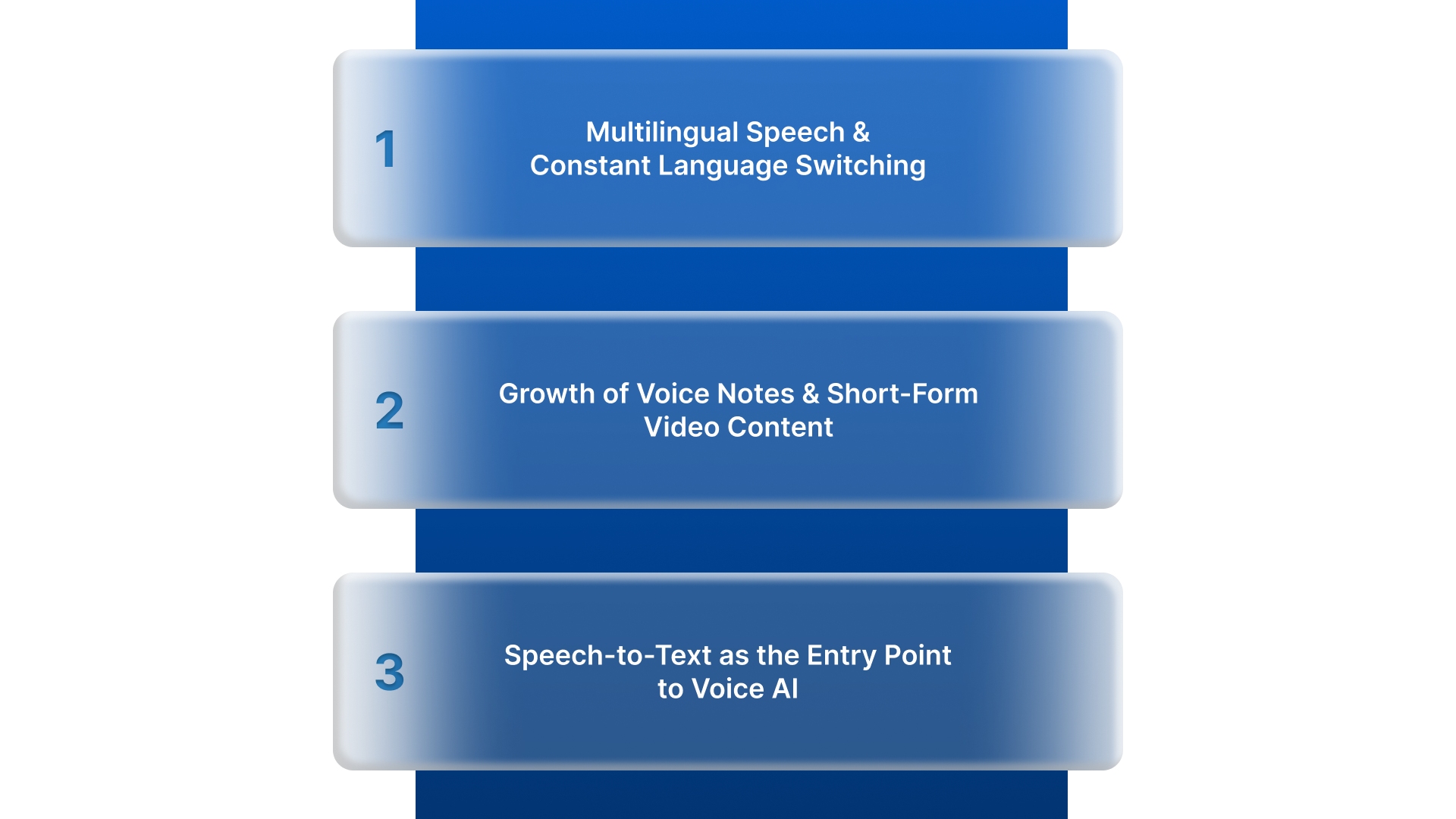
1. Multilingual Speech and Constant Language Switching
Indian speech commonly blends English with regional languages within the same sentence, with frequent switching during a single conversation. For speech-to-text systems, this requires preserving sentence structure and intent while handling continuous language shifts, not just detecting languages.
Key implications for enterprises include:
- Support for mixed-language speech within a single utterance
- Consistent transcription without fragmenting sentences by language
- Reliable intent capture despite informal grammar and phrasing
- Better user experiences that feel native, not translated
Enterprises that handle this well deliver interactions that match how Indians actually speak.
2. Growth of Voice Notes and Short-Form Video Content
Voice and video have become primary communication formats for Indian users. Short audio messages, regional videos, and spoken content now dominate engagement across consumer and enterprise platforms. This shift has created a large volume of unstructured voice data that needs to be processed, indexed, and analysed.
Speech-to-text enables enterprises to:
- Make spoken content searchable and discoverable
- Apply moderation and policy checks at scale
- Extract insights from user engagement and interactions
- Support localisation and captioning across Indian languages
The scale of regional language usage and accent diversity makes this trend particularly significant in India.
3. Speech-to-Text as the Entry Point to Voice AI
As Indian enterprises adopt conversational AI for customer support, commerce, and public services, speech-to-text becomes the first and most critical layer in the system. A typical voice interaction follows a clear sequence:
- Speech input
- Speech-to-text conversion
- Language understanding
- Dialogue handling
- Action or response
If transcription accuracy or latency breaks at the first step, the entire interaction fails. Voice bots, IVR systems, and assistants are only as effective as the STT layer that powers them.
Turn Voice Queries into Searchable Data.
Achieve up to 37% sales improvement using Reverie’s Speech-to-Text API.
These patterns shape how speech-to-text is used across India today. Let’s now look at the trends that are defining its future in 2026.
Future of Speech-to-Text in India: 5 Key 2026 Trends
Speech-to-text in India is advancing beyond model accuracy into a system-level capability. In 2026, adoption is shaped by deployment architecture, regulatory readiness, real-world reliability, and the ability to convert voice data into outcomes.
The following trends define how STT is being implemented at scale:
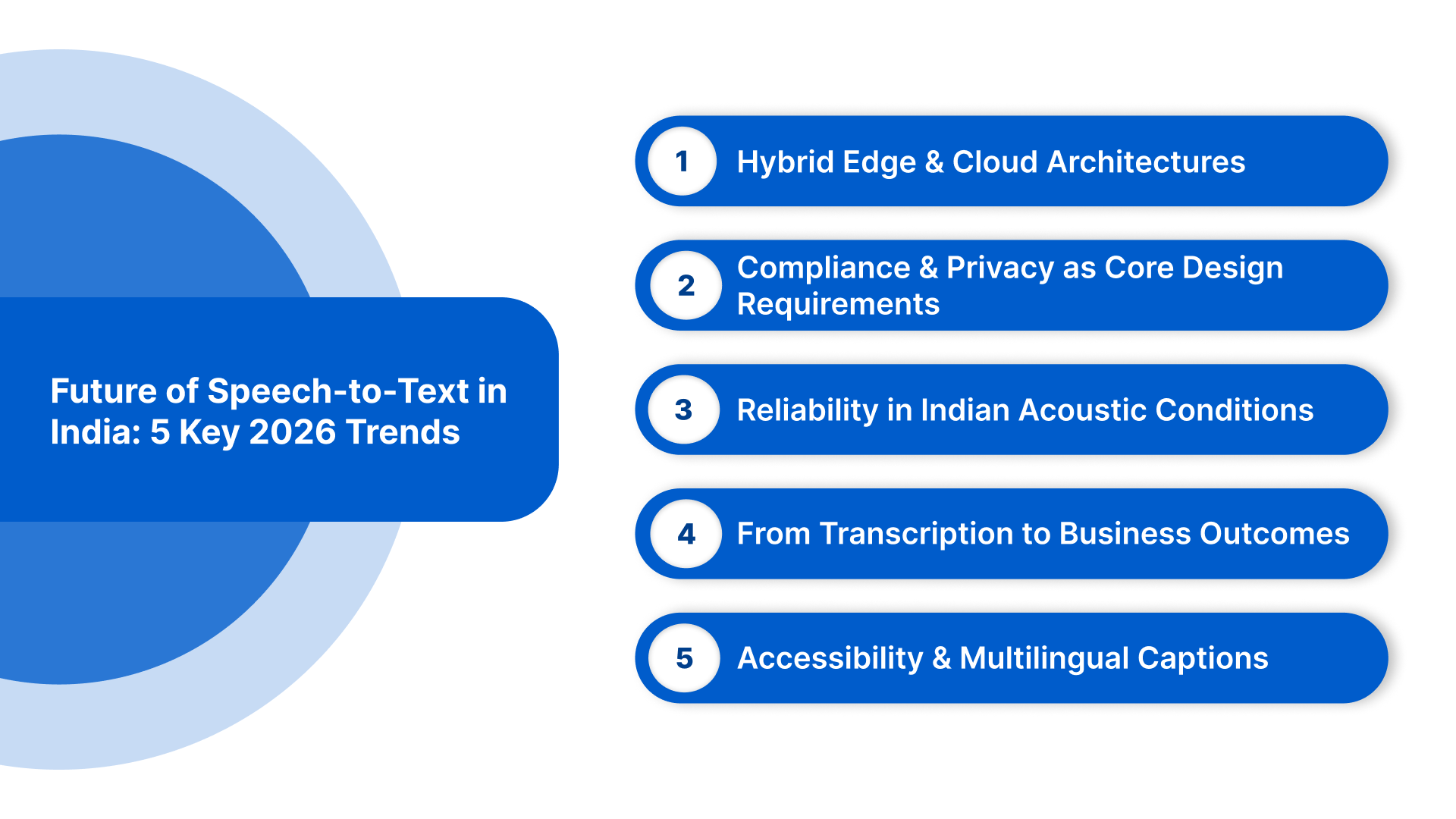
1. Hybrid Edge and Cloud Architectures
Enterprises are increasingly adopting hybrid STT setups where speech processing is split between devices and the cloud. On-device or edge models handle immediate transcription needs, while cloud systems support advanced processing and scaling.
Key implications include:
- Faster response times for real-time interactions
- Reduced exposure of sensitive voice data
- Support for use cases requiring low latency
- Flexibility to deploy across mobile, web, and telephony environments
This approach is especially relevant for banking, healthcare, and government services, where performance and data control carry equal weight.
2. Compliance and Privacy as Core Design Requirements
Voice data frequently contains personally identifiable and sensitive information. With the Digital Personal Data Protection Act in force, speech data governance has become a primary evaluation factor for STT platforms.
Enterprises now expect:
- Data minimisation across capture and storage
- Configurable retention and deletion policies
- Secure, auditable processing environments
- Privacy-by-default system design
Compliance readiness is no longer a differentiator; it is a baseline requirement.
3. Reliability in Indian Acoustic Conditions
Unlike controlled lab environments, Indian speech data often comes from noisy and unpredictable settings. STT systems must perform consistently across these conditions to be usable at scale.
Critical performance requirements include:
- Accurate transcription of telephony audio
- Stability in crowded or outdoor environments
- Support for diverse accents and dialects
- Tolerance to inconsistent microphones and audio quality
For enterprises, dependable performance in these conditions matters more than peak accuracy on clean samples.
4. From Transcription to Business Outcomes
STT is no longer treated as an end output. Enterprises are embedding speech data directly into operational and analytical workflows.
Common integrations include:
- Feeding transcripts into CRM and support systems
- Automating compliance and quality checks
- Extracting insights from customer interactions
- Identifying operational risks and trends through analytics
This shift positions STT as an input layer for automation and decision-making rather than a standalone tool.
5. Accessibility and Multilingual Captions
As digital content consumption grows across OTT platforms, education, and virtual events, real-time captions and transcription have become standard expectations.
STT supports:
- Inclusive access for users with hearing impairments
- Content consumption across multiple Indian languages
- Regulatory and accessibility compliance for platforms
- Broader reach without duplicating content creation efforts
Accessibility is now a structural requirement shaping STT adoption decisions in India.
As these trends drive the adoption of STT at scale in India, a reliable platform is key to turning voice data into actionable insights. The Reverie Speech-to-Text API enhances transcription accuracy, streamlines operations, and enables real-time decision-making. Schedule a call today to see how it can optimise your workflow.
Also Read: How Reverie’s Speech-to-Text API is Reshaping Businesses in India
To convert STT potential into real business value, enterprises must adopt disciplined practices across data management, testing, and multilingual design. Here’s a closer look.
Speech-to-Text Adoption Strategies for Indian Businesses
As voice becomes a dominant communication medium, success depends on execution discipline rather than experimental deployments.
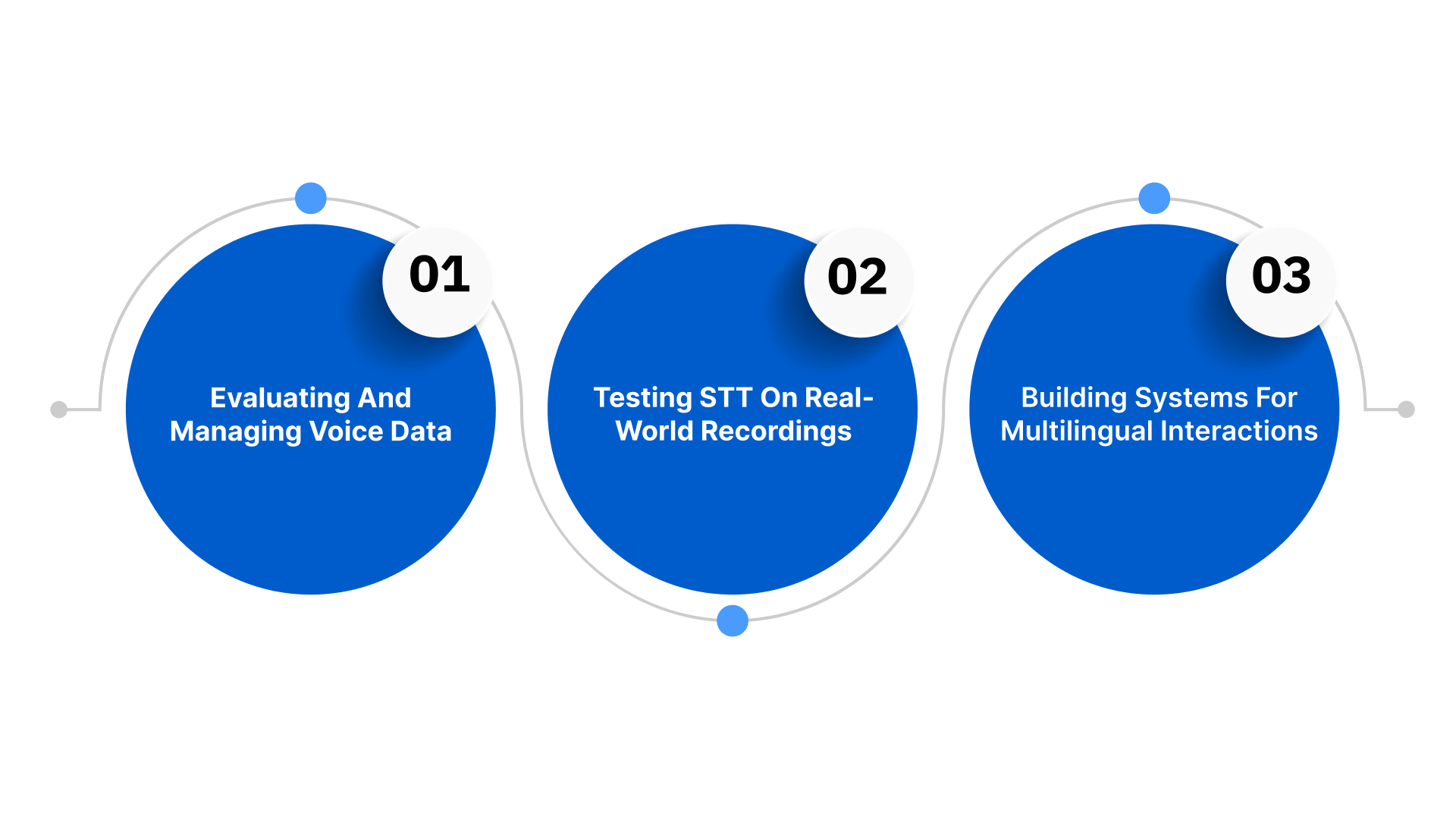
1. Evaluating and Managing Voice Data
Enterprises generate vast amounts of audio data, yet it often remains fragmented across systems:
- Calls in BFSI for verification, grievance resolution, and compliance are frequently stored without a unified governance framework.
- After-sales and installation calls in consumer durables generate daily voice data that is rarely systematically analysed.
A thorough voice data audit helps organisations understand where audio resides, how it moves, and what controls are required for responsible and effective use.
Real-world example: Bharti Airtel deployed AI-powered speech analytics with NVIDIA to analyse high volumes of contact center calls. The system extracts insights that improve agent performance and user experience across multiple languages.
2. Testing STT on Real-World Recordings
Testing STT on clean, lab-grade samples gives a false sense of accuracy. Pilots must use actual field data to reflect Indian conditions:
- Contact centers must handle noise, call drops, and overlapping speech.
- Service engineers collect feedback in uncontrolled, multilingual environments.
Piloting with real-world audio exposes accuracy gaps early and prevents failures during large-scale rollouts.
Real-world example: Flipkart integrates voice interfaces across customer support and seller platforms. Regional language queries are processed directly into backend order management and CRM systems, ensuring STT works under real operational conditions.
3. Building Systems for Multilingual Interactions
India’s linguistic diversity directly impacts STT adoption:
- Retail, e-commerce, and service interactions often switch between English and regional languages.
- Without multilingual readiness, critical information can be misinterpreted or lost.
Enterprises that design STT systems for multilingual workflows are better positioned to serve diverse user bases, as over half of Indian internet users prefer local language content.
Real-world example: IRCTC’s AskDISHA 2.0 AI assistant supports voice and text in Hindi, Hinglish, and English. Users can book tickets, check PNR status, cancel bookings, and track refunds, enabling smooth access across India’s linguistic diversity.
Build Accurate Voice Search with Reverie Speech-to-Text
Get real-time transcription in 11 Indian languages with Reverie’s STT.
Also Read: Power of Speech to Text API: A Game Changer for Content Creation
Now, let’s explore how Reverie’s speech-to-text API transforms enterprise voice data into accurate transcripts in Indian languages, enabling actionable insights and smarter operations.
Reverie’s Automatic Speech-to-Text Recognition Model Simplified
As STT evolves from a backend utility to a frontline enabler, the real value lies in what enterprises build on top of it. Reverie’s Speech-to-Text platform ASR model converts enterprise voice data into accurate text across Indian languages, enabling real-time transcription of calls, meetings, and recordings for meaningful analysis.
Here’s how it enhances workflow:
- Transcription in 11 Indian Languages: Seamlessly convert conversations, including regional or mixed-language content, into correctly punctuated text.
- Real-time and Batch Processing: Monitor calls live or process large volumes of audio later, giving you flexibility in how you analyse voice data.
- Voice Typing and Command Support: Enable users to create text by speaking or to invoke actions via voice commands.
- Smooth Integration and Developer Support: Use APIs or SDKs with clear documentation and a testing playground to integrate speech transcription into your CRM, contact center, or internal systems.
- Data Security & Privacy Compliance: Reverie encrypts data and adheres to strong privacy standards, essential for sectors such as legal, healthcare, and finance.
Ready to turn calls into actionable insights? Instantly transcribe customer interactions across Indian languages with Reverie’s ASR, enabling precise analysis and smarter business decisions. Contact us to learn more!
Conclusion
Speech-to-text trends 2026, such as hybrid edge-cloud deployments, multilingual support, handling diverse Indian accents, and compliance-focused design, are enabling businesses to process and act on voice data effectively.
Platforms like Reverie enable scalable, context-aware workflows across 11 Indian languages, turning voice interactions into actionable insights. These capabilities allow enterprises to capture, interpret, and act on voice data effectively, transforming voice interactions into measurable business outcomes.
Explore the Reverie Speech-to-Text API to power accurate, enterprise-ready transcription and multilingual voice solutions for India’s diverse digital ecosystem. Sign up today to get started.
FAQs
1. How can enterprises measure the ROI of STT implementations?
ROI can be measured through improved agent efficiency, faster query resolution, reduced manual transcription costs, enhanced customer engagement, and actionable insights derived from voice data integration into workflows and analytics systems.
2. What makes STT adoption challenging in rural Indian contexts?
Rural deployment challenges include poor network connectivity, diverse dialects, background noise, low-quality microphones, and code-mixed speech, all of which require robust, offline-capable STT models with adaptive learning.
3. How does STT improve multilingual customer support?
STT enables automatic transcription across multiple Indian languages, accurately captures intent in code-mixed speech, and integrates seamlessly with chatbots, IVR systems, and CRMs, enabling support teams to respond faster and reduce miscommunication.
4. Can STT assist Indian enterprises with regulatory compliance?
Yes, STT captures voice data systematically, timestamps conversations, and integrates with compliance workflows, ensuring adherence to data retention, audit, and privacy standards mandated by the Digital Personal Data Protection Act.
5. How does STT contribute to business intelligence beyond transcription?
Transcripts feed into analytics engines, enabling sentiment analysis, operational trend identification, voice-of-customer insights, and predictive decision-making, transforming raw voice data into actionable, measurable business outcomes.