What if you could instantly understand what every customer truly feels?
Every word, tone, or pause in a conversation carries meaning, but most businesses miss it. With conversations happening across calls, chats, and social platforms in multiple Indian languages, understanding customer emotions isn’t easy. That’s where sentiment analysis becomes a game-changer, helping you decode intent, tone, and satisfaction in real time.
Are your teams struggling to turn spoken insights into data-driven actions? This blog explores the top sentiment analysis applications for businesses in India, from healthcare to e-commerce, and shows how you can use them to improve engagement, boost conversions, and scale your business.
At a Glance
- Sentiment analysis decodes emotional tone from voice, chat, and multilingual feedback to help you make faster, more informed business decisions.
- Common applications include IVR analytics, customer support prioritisation, healthcare feedback, market research, and education engagement.
- Choose from graded, emotion-detection, fine-grained, aspect-based, or intent analysis based on your business need and data complexity.
- You gain sharper customer insights, improve product development, track brand perception, personalise content, and react before issues escalate.
- Start by defining objectives, collecting and preparing data, selecting the appropriate method, and sharing insights with stakeholders to inform action.
What is Sentiment Analysis?

Sentiment analysis is the process of using AI to automatically understand the emotion and attitude behind what your customers say or write. Instead of just converting speech or text into words, it tells you how the customer feels. For example, positive, negative, or neutral, and in many cases, how intense that emotion is.
When you deal with thousands of calls, chats, or emails a day across multiple Indian languages, sentiment analysis helps you quickly see where customers are happy, frustrated, or at risk of churn without manual review.
As a Business Head, sentiment analysis becomes a practical tool that enables you to make faster, more informed decisions based on customer conversations. You can:
- Monitor customer mood at scale across IVR, contact centres, and chatbots.
- Prioritise critical interactions, such as angry banking customers, dissatisfied e-commerce buyers, or confused patients in healthcare.
- Track trends over time, such as declining satisfaction after a policy change.
Depending on your goals and the nature of your data, there are various types of sentiment analysis.
Also Read: Top IVR Features and Benefits for Modern Businesses
What are the Different Types of Sentiment Analysis?
Not all sentiments are expressed in the same way, and not every analysis method captures them equally. The type of sentiment analysis you choose depends on your business goals and the complexity of your customer data.
Here are the main types commonly used across enterprise applications:
- Graded analysis: In this simpler form, sentiment is captured via predefined scales such as a 5‑star rating or choices like “excellent”, “satisfactory”, or “below average”.
- Emotion-detection analysis: This type assigns specific emotions, such as anger, frustration, happiness, or sadness, to customer interactions, helping you identify tone beyond simple positive or negative sentiment.
- Fine‑grained analysis: Here, you break down sentences into feature‑level components and assess sentiment at a more precise level (for example: “The wipers on my car snapped off after three years”).
- Aspect‑based analysis: You focus on specific components or features of your product or service (e.g., “battery life” in a device, “report delivery” in a hospital) and determine sentiment for each attribute.
- Intent analysis: This detects the type of communication the user is making (a question, complaint, suggestion, or praise) and helps you understand the purpose behind the sentiment.
Each of these types offers distinct value depending on whether you’re dealing with multilingual voice calls, chat logs, IVR interactions, or product reviews, so you’ll want to choose the type that aligns with your objective and the data you’re working with.
With the right type of sentiment analysis in place, you can unlock several benefits across teams and customer touchpoints.
Benefits of Sentiment Analysis for Businesses
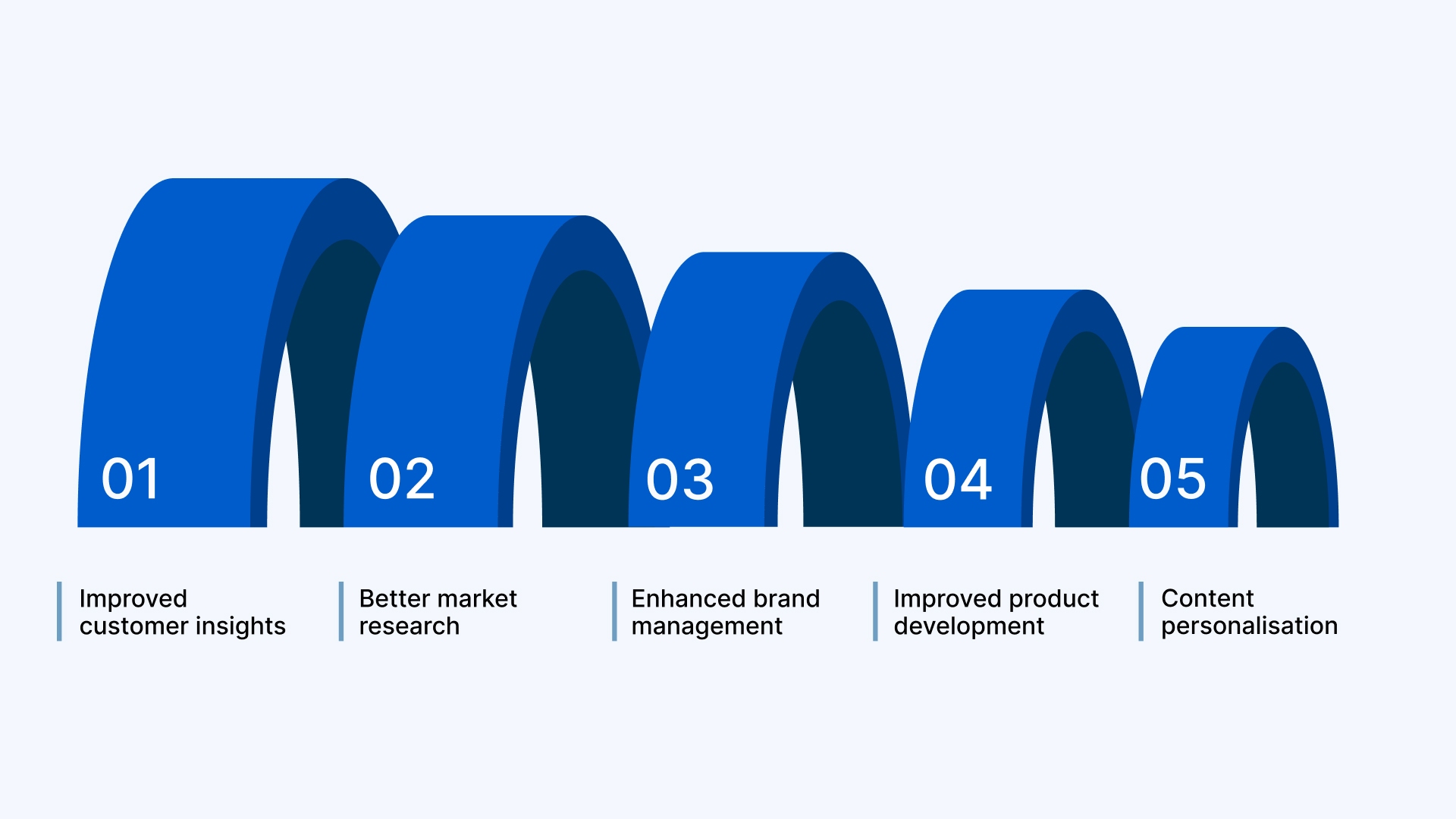
Understanding how your customers feel is no longer optional; it’s essential for scaling trust, engagement, and revenue. Here are some key benefits of using sentiment analysis across different business functions and sectors:
1. Improved customer insights
You can gain a deeper understanding of how your customers feel. Sentiment analysis helps you see patterns in voice calls, chat transcripts, and multilingual feedback across Indian languages, so you know which interactions are positive, which are negative , and why. With this clarity, you can prioritise which touch‑points need urgent attention and which are performing well.
2. Better market research
Instead of relying only on surveys, you can tap into real‑time conversations across channels and languages to identify emerging trends. Organisations use sentiment-analysis tools to monitor how audiences perceive their products, campaigns, and competitors, giving them the agility to adjust their strategy based on what their users actually care about.
3. Enhanced brand management
Your brand reputation is being shaped every minute. Sentiment analysis provides early warning signs of negative sentiment, allowing you to act quickly and protect your trust. By continuously monitoring how your audience feels across channels and languages, you stay ahead of issues rather than simply reacting to them.
4. Improved product development
Feedback hidden in conversations often tells you more than structured surveys. Sentiment analysis helps you spot recurring customer complaints, feature requests, or language‑specific issues, which are valuable for your product roadmap. For example, in healthcare, if doctor-patient consultations in Tamil or Hindi reveal frustration due to a language mismatch, you can prioritise multilingual support in your next release.
5. Content personalisation
When you understand the tone and emotion of your audience, you can tailor content in a way that resonates. Sentiment analysis enables you to serve content that adapts to user sentiment, and this level of personalisation can significantly boost engagement and conversions.
While the benefits are clear, putting sentiment analysis into action is where its true value unfolds.
Top Applications of Sentiment Analysis in Business
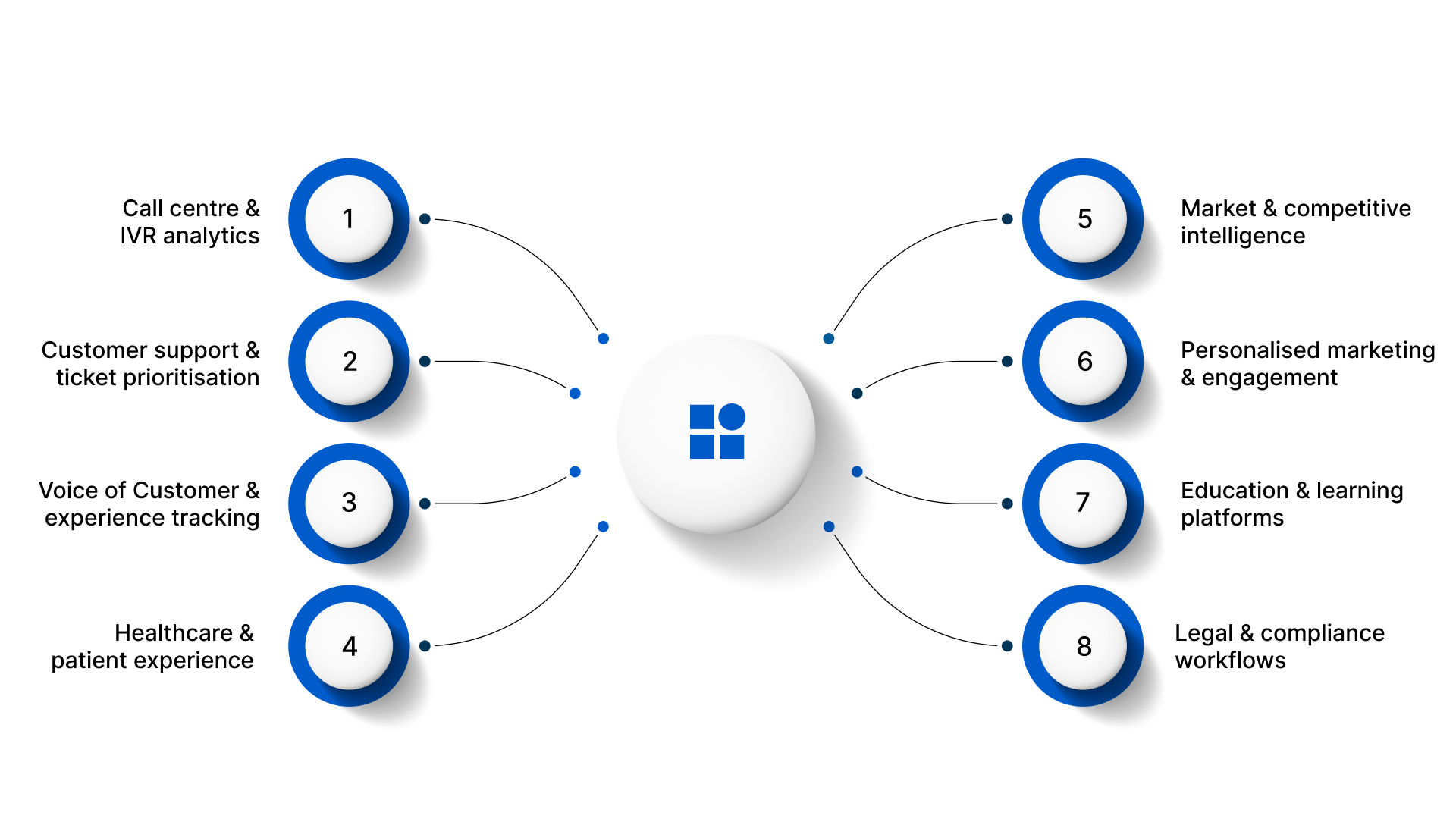
Sentiment analysis isn’t just about tracking emotions; it’s about making smarter decisions from everyday customer interactions. Whether you’re handling voice, chat, or multilingual feedback, it helps you act where it matters most.
Here are some of the most effective applications of sentiment analysis across key business functions:
1. Call centre and IVR analytics
You can use sentiment analysis on call recordings and IVR interactions to understand whether customers sound satisfied, confused, or frustrated. This goes beyond basic metrics, such as handle time, and helps you identify process gaps, agent performance issues, and high-risk interactions that require intervention.
For example, a telecom company notices repeated negative sentiment during IVR calls about a “recharge failed” message. They update the IVR script and proactive SMS alerts, reducing repeat calls.
2. Customer support and ticket prioritisation
By running sentiment analysis on emails, chat logs, and support tickets, you can automatically flag negative sentiment and prioritise those cases for faster resolution. This is especially useful for banking, e-commerce, and telecom, where a delay can directly lead to churn or public complaints.
For example, after releasing a new credit card, a bank tracks comments and finds that users are unhappy about the clarity of reward points. They push a short explainer video through app notifications and customer care calls.
3. Voice of Customer (VoC) and experience tracking
You can analyse feedback from surveys, app reviews, and social channels to see how sentiment shifts after a new feature, pricing change, or campaign. This helps you make data-driven decisions instead of relying only on anecdotal feedback, and is now a core part of modern VoC programmes.
For example, a mobile wallet app reads app-store sentiment after adding a new UPI flow. Users show mixed reactions to extra steps, so the company releases a quicker 2-tap payment option and announces it in-app.
4. Healthcare and patient experience
Hospitals and telehealth platforms can apply sentiment analysis on consultation transcripts, feedback forms, and call recordings to understand patient satisfaction and areas of friction. This allows you to identify issues such as poor communication, long wait times, or language barriers and address them before they affect trust.
For example, a diagnostics chain reviews call sentiment and notices frustration around report delivery timelines. They launch SMS alerts with a live tracking link to indicate when reports will arrive, thereby reducing support calls.
5. Market and competitive intelligence
You can track sentiment around your brand, competitors, and key topics across public data sources, including reviews and social media. This provides an early view of changing expectations, emerging risks, and new product opportunities without requiring large, manual research exercises.
For example, a streaming app is identifying growing complaints online about the limited regional-language content on rival platforms. They release new shows in those languages and promote them with targeted push notifications.
6. Personalised marketing and engagement
Marketing teams can use sentiment signals to adjust messaging, offers, and channels based on how different segments respond over time.
For example, if sentiment drops after a campaign in a particular region or language, you can quickly refine creatives, copy, or targeting instead of waiting for revenue impact.
7. Education and learning platforms
You can apply sentiment analysis on student feedback, course reviews, and support chats to understand where learners feel confused, disengaged, or satisfied. This helps you refine course content, improve teacher–student communication, and reduce drop-offs in online or hybrid learning environments.
For example, an ed-tech platform finds frustration spikes in comments around a math chapter. They add extra practice sessions and revision videos, reducing dropout rates for that topic.
8. Legal and compliance workflows
In legal services, you can use sentiment analysis on client communications, case discussions, and feedback to gauge confidence, stress, or dissatisfaction levels. This provides an early warning signal on relationship risks, helps you prioritise sensitive matters, and supports better client management at scale.
For example, a loan advisory service detects stress signals in client conversations related to paperwork. They assign a document-support executive to walk customers through each step on a screen-share call.
Sentiment analysis helps you turn everyday voice and text interactions into clear, actionable insights. In such cases, Reverie’s Speech-to-Text API helps by transcribing regional-language calls and consultations in real time, enabling sentiment engines to capture tone and emotion with greater accuracy. By applying it across business functions, you can enhance the customer experience, reduce churn, and respond more effectively to what truly matters.
To turn these applications into real outcomes, it’s important to follow a structured approach to sentiment analysis.
Also Read: How to Translate Chat Messages in Native Languages: A Guide for Indian Industries
How to Conduct a Sentiment Analysis
Sentiment analysis can be a powerful tool for businesses, enabling them to understand customer emotions and make informed decisions. However, it’s a multi-step process that requires structure and accuracy. To achieve meaningful results, you must follow each step in the correct order. Here are the key steps:
- Define your objectives: Start by clarifying exactly what you want to measure, such as sentiment about a product launch or brand perception. Next, decide which channels (social media, chat logs, voice transcripts) you’ll analyse so your effort aligns with your objective.
- Collect the data: Gather relevant datasets, such as transcripts, emails, chat logs, or social media posts, tied to your target audience. Ensure the data collection method (APIs, scraping, interviews) supports the channels you defined.
- Prepare the data: Clean and organise your raw data by removing noise, normalising text, and converting audio to text so that the analysis model can process it. Using transcription tools like Reverie’s Speech-to-Text API, which accurately converts voice interactions in multiple Indian languages into analysable text, ensures consistent and reliable data for sentiment detection.
- Choose the analysis method: Decide whether you will use rules‑based sentiment detection or a machine‑learning model, depending on the depth and complexity needed. Additionally, match the method to your objective. A simple rating scale may suffice for basic trend monitoring, while a full NLP approach may be necessary for in-depth insights.
- Evaluate the results: Check if the analytical output aligns with business needs, review accuracy, examine human-judged samples, and assess whether the sentiment aligns with expectations. If the results don’t align, revisit earlier steps (data quality, method) rather than blindly trusting the numbers.
- Interpret and share the results: Once validated, present the insights to stakeholders (product, marketing, and customer experience teams) in a clear and actionable manner to drive informed action. Use the findings to recommend changes and ensure follow-up ownership of those actions.
Conclusion
Sentiment analysis helps you turn large volumes of voice and text interactions into clear, actionable insights. From identifying customer frustration in IVR calls to improving feedback handling in healthcare and education, it enables you to respond faster, personalise better, and build trust across touchpoints. When applied correctly, it enhances the customer experience and informs smarter business decisions across various industries.
To unlock these insights effectively, you need reliable transcription as the first step. This is where Reverie’s Speech-to-Text API comes in. We enable sentiment analysis by converting multilingual voice interactions into accurate, structured text. This allows you to analyse emotional tone across calls, IVR logs, or recordings that were previously difficult to process at scale.
The Speech-to-Text API supports over 11 Indian languages, keyword spotting, and domain-specific vocabulary customisation. By transforming unstructured audio into actionable data, we help you uncover patterns in customer emotions, reduce churn, and enhance the experience across digital touchpoints.
Sign up with Reverie to power your sentiment analysis workflows with accurate, secure, and language-smart transcription tailored for Indian business needs.
FAQs
1. What are the typical limits or risks businesses must consider when using sentiment analysis?
Common challenges include handling sarcasm, mixed emotions, domain‑specific terminology, and multilingual data. These can reduce accuracy and lead to misleading insights if not addressed.
2. Is sentiment analysis only useful for marketing and brand monitoring?
Not at all. While brand reputation is a strong use case, sentiment analysis also supports product development, customer support prioritisation, risk monitoring, and multilingual engagement across diverse sectors.
3. Does sentiment analysis require a lot of technical resources to implement?
You will need some technical integration (APIs, data pipelines, dashboards), but many platforms offer out‑of‑the‑box models and connectors, reducing the setup burden.
4. Can sentiment analysis support product development?
Yes, companies aggregate reviews, support tickets, and forum posts to identify recurring complaints, feature requests, and pain points. That insight helps prioritise roadmap items and improve UX.
5. How do you handle mixed sentiment in a single message?
Use sentence or clause-level analysis and topic classification to assign sentiment per topic or aspect, rather than a single label for the whole message.