Text-to-speech (TTS) is no longer a niche feature. It is now a core layer in modern digital experiences.
The global TTS market, valued at $4 billion in 2024, is projected to cross $7.6 billion by 2029, driven by rapid adoption across apps, IVR systems, education platforms, and enterprise workflows.
As users increasingly prefer listening over reading, businesses need scalable ways to deliver content, instructions, and support in natural-sounding voices.
TTS solves this by converting text into clear, human-like audio across multiple languages without relying on manual recordings.
This guide breaks down the key advantages of text-to-speech converters and why modern organisations are adopting TTS as a foundational part of their digital strategy.
At a Glance
- Text-to-speech converters make digital content accessible, interactive, and multilingual.
- TTS improves customer engagement across apps, IVRs, automotive systems, and conversational bots.
- For enterprises, TTS reduces operational overhead by automating announcements, instructions, alerts, and communication workflows.
- India-first TTS engines support regional languages and natural intonation that reflects local speech patterns.
- TTS is a foundational technology for voice-led products, accessibility compliance, and future-ready AI experiences.
What Is a Text-to-Speech Converter?
A text-to-speech (TTS) converter transforms written text into spoken audio using machine learning models. It takes any input — app content, notifications, documents, support responses, or learning material — and turns it into clear, natural-sounding speech.
Modern TTS systems do more than read text aloud. They understand punctuation, context, pauses and emphasis, making the output sound smooth and human-like. Businesses use TTS to power voice assistants, IVR systems, customer support automation, accessibility features and multilingual digital experiences.
Types of Text-to-Speech systems:
- Neural TTS: Uses deep learning models to generate lifelike voices with natural flow, better pronunciation and fewer robotic artefacts. This is now the industry standard.
- Multilingual TTS: Supports multiple languages and accents, allowing companies to deliver voice experiences across diverse user groups without maintaining separate recordings.
- Expressive or Natural-Sounding TTS: Provides voices with emotional tone, intonation and variation. This enhances user experience in learning platforms, customer support and conversational interfaces.
Together, these systems allow businesses to deliver consistent, scalable and human-like voice experiences without relying on manual audio production.
How a Text-to-Speech Converter Works
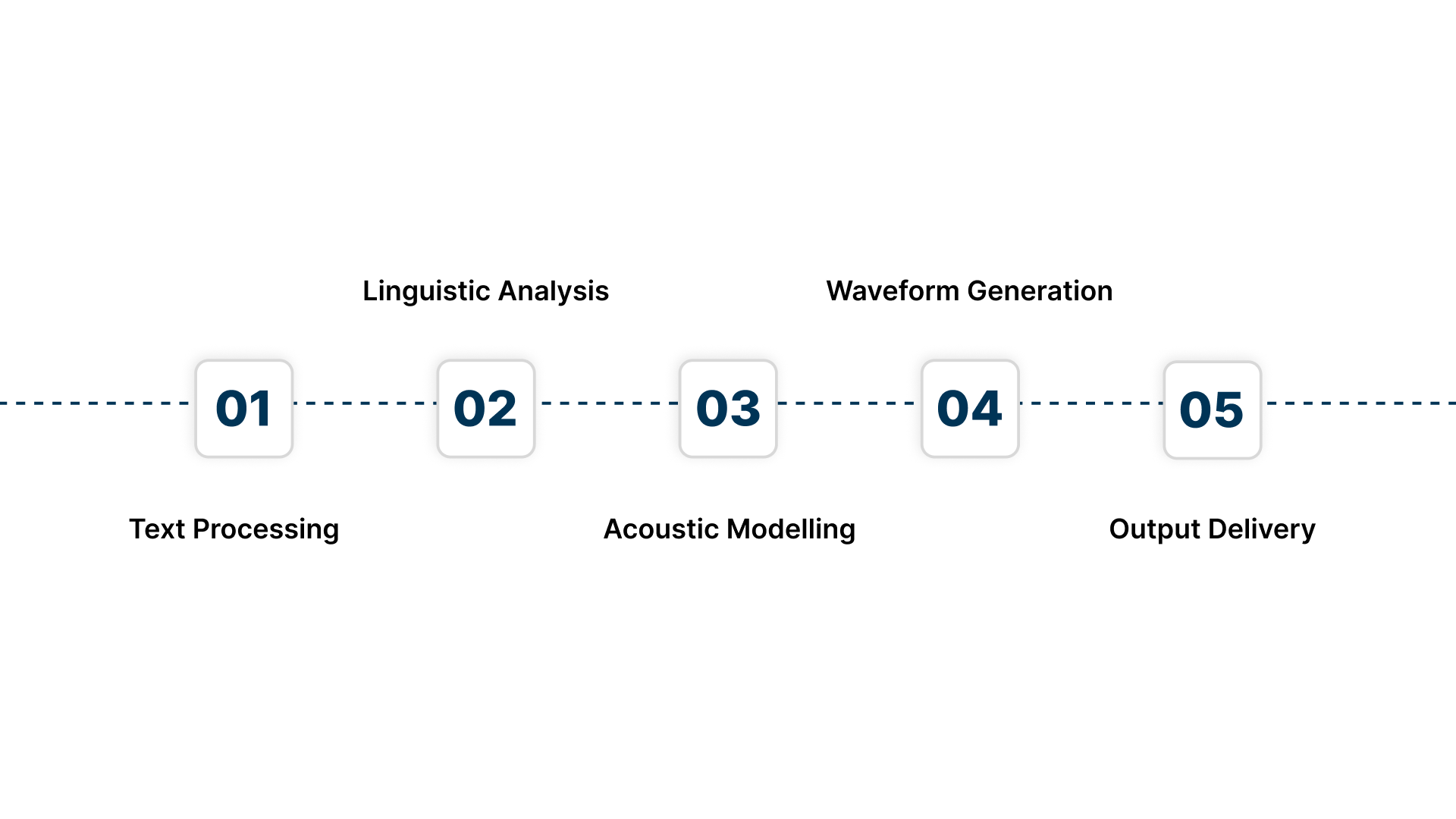
A modern TTS system follows a structured pipeline to convert written text into natural-sounding speech. Here’s how the process works:
1. Text Processing
The system analyses the raw text, interprets punctuation and expands items like dates, abbreviations and numbers. This ensures the model reads text in a form that sounds natural instead of literal or fragmented.
2. Linguistic Analysis
The engine identifies phonemes, syllable stress and intonation patterns to understand how each word should be pronounced. This step helps decide the right rhythm, emphasis and pronunciation for fluent speech delivery.
3. Acoustic Modelling
Neural models generate the acoustic blueprint for speech: tone, pitch, speed and emotional cues. This is what makes TTS voices sound smooth and human-like instead of flat or robotic.
4. Waveform Generation
A vocoder converts the acoustic blueprint into an actual audio waveform. It stitches together the sound in real time, producing clear and natural audio output.
5. Output Delivery
The final audio is returned instantly as a file or spoken live through your app, device or IVR system. This allows businesses to integrate voice output into any workflow without manual recording or editing.
Also read: What is Text-to-Speech API and How Does it Help Grow Your Business?
The Major Advantages of Text-to-Speech Converters
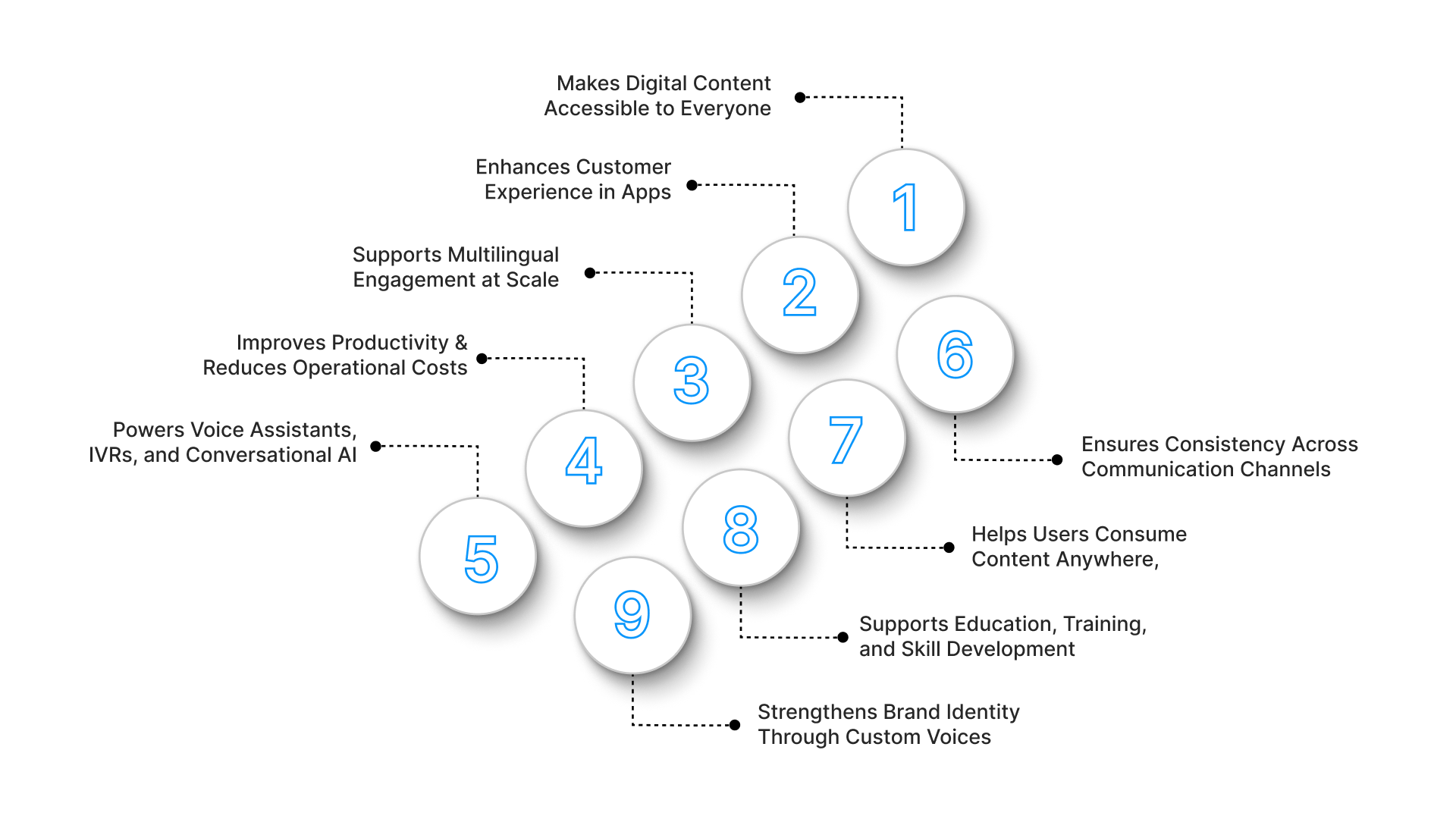
Below are the most meaningful benefits of TTS — especially for Indian enterprises, digital platforms, and voice-enabled applications.
1. Makes Digital Content Accessible to Everyone
TTS is one of the strongest enablers of digital accessibility. It helps users who struggle with reading due to low literacy, visual impairments, cognitive load or language unfamiliarity.
This matters because many users:
- Prefer listening over reading, especially on mobile
- Consume long content more comfortably as audio
- Need hands-free access in daily scenarios
TTS allows organisations to offer spoken access to app content, instructions, public information, documents and essential services. It ensures inclusivity and helps companies meet growing accessibility expectations across sectors like finance, healthcare, education and e-governance.
2. Enhances Customer Experience in Apps and Digital Workflows
Spoken guidance is easier to follow than long text, especially during complex tasks. TTS gives users real-time clarity, reducing friction and boosting completion rates.
It’s widely used for:
- Step-by-step onboarding flows
- Form-filling assistance
- Navigation inside apps and devices
- Voice confirmations and proactive alerts
- Tutorials and support journeys
By reducing cognitive load and providing timely audio support, TTS shortens learning curves and improves usability. Customers using Reverie’s Text-to-Speech API have even reported a 52% increase in customer satisfaction after enabling multilingual voice experiences.
This demonstrates how strongly voice impacts user comfort, trust and follow-through within digital workflows.
3. Supports Multilingual Engagement at Scale
Building engaging experiences for multilingual audiences is expensive and slow if done manually. TTS solves this with instant, consistent voice outputs in multiple languages.
This helps teams:
- Launch features faster across several languages
- Keep tone and clarity uniform across regions
- Reduce reliance on voice artists and manual recordings
- Offer language-inclusive experiences without scaling teams
With natural-sounding multilingual TTS, enterprises can quickly localise support journeys, content, instructions and app experiences across Hindi, Bengali, Tamil, Marathi, Kannada, Telugu and more.
4. Improves Productivity and Reduces Operational Costs
TTS automates recurring communication tasks that would otherwise require human voice recording, editing or explanation.
It delivers efficiency gains such as:
- Automated announcements in apps and IVRs
- Self-service prompts that reduce agent workload
- Voice alerts for logistics, banking, healthcare and field teams
- Audio responses inside chatbots or conversational interfaces
By removing the need for studio recordings, reshoots and manual revisions, TTS significantly reduces operational overhead.
Organisations using enterprise-grade engines like Reverie’s TTS API report strong impact, including up to a 62% reduction in operational costs after automating voice workflows.
5. Powers Voice Assistants, IVRs, and Conversational AI
Every voice-enabled system needs a TTS engine to deliver natural, human-like responses. Without it, voice assistants can listen but cannot speak back.
TTS plays a critical role in:
- Smart home devices and appliances
- In-car infotainment and navigation systems
- Banking and insurance IVR flows
- Customer support bots and AI agents
- Virtual training and helpdesk automation
As conversational interfaces become standard across consumer apps, enterprise platforms and embedded devices, TTS provides the scalable voice layer that makes these interactions feel smooth, clear and human.
6. Ensures Consistency Across Communication Channels
Manual voice recordings are time-consuming and costly to update. Every change in script often requires new recordings, edits and quality checks, which slows down production.
TTS eliminates this overhead by generating:
- Uniform, on-brand voice output
- Consistent tone across all channels
- Instant updates when content changes
- Scalable audio production without human effort
Instead of days of re-recording, teams can update scripts and regenerate high-quality audio in seconds. This keeps communication accurate, timely and aligned with brand standards across apps, support systems, IVRs and learning platforms.
7. Helps Users Consume Content Anywhere, Hands-Free
Text-to-Speech makes digital content usable even when users can’t look at a screen. It gives people the flexibility to listen to articles, emails, documents and instructions while multitasking.
This matters in scenarios like:
- Driving or commuting
- Field operations or on-site work
- Workouts or hands-busy environments
- Accessibility needs for low-vision users
With TTS, content becomes portable, convenient and effortless to consume. This leads to longer engagement times and higher completion rates across apps, learning tools and productivity platforms.
8. Supports Education, Training, and Skill Development
TTS strengthens learning experiences by delivering content in both visual and auditory formats. This supports different learning styles and makes complex material easier to follow.
It powers:
- Language learning and pronunciation support
- Inclusive learning for special-needs students
- Interactive study materials and read-aloud features
- Audio lessons, summaries and flashcards
- Exam prep modules that combine text + audio
Listening while reading improves comprehension, retention and focus. This makes TTS an essential tool for education, online learning and workforce training.
Also read: How can the eBooks Industry benefit from Text-to-Speech API?
9. Strengthens Brand Identity Through Custom Voices
Modern TTS systems allow brands to create custom voices that reflect their personality, whether friendly, professional or conversational. This gives companies a distinct audio identity across channels.
Custom voices enhance brand consistency in:
- IVR and customer support systems
- Voice assistants and chatbots
- Learning and training platforms
- Product tutorials and onboarding journeys
A recognisable voice builds familiarity, trust and emotional connection, making interactions feel more personalised and memorable.
These advantages become even more meaningful when you see how TTS transforms outcomes across different industries.
Where Text-to-Speech Delivers the Highest Business Impact
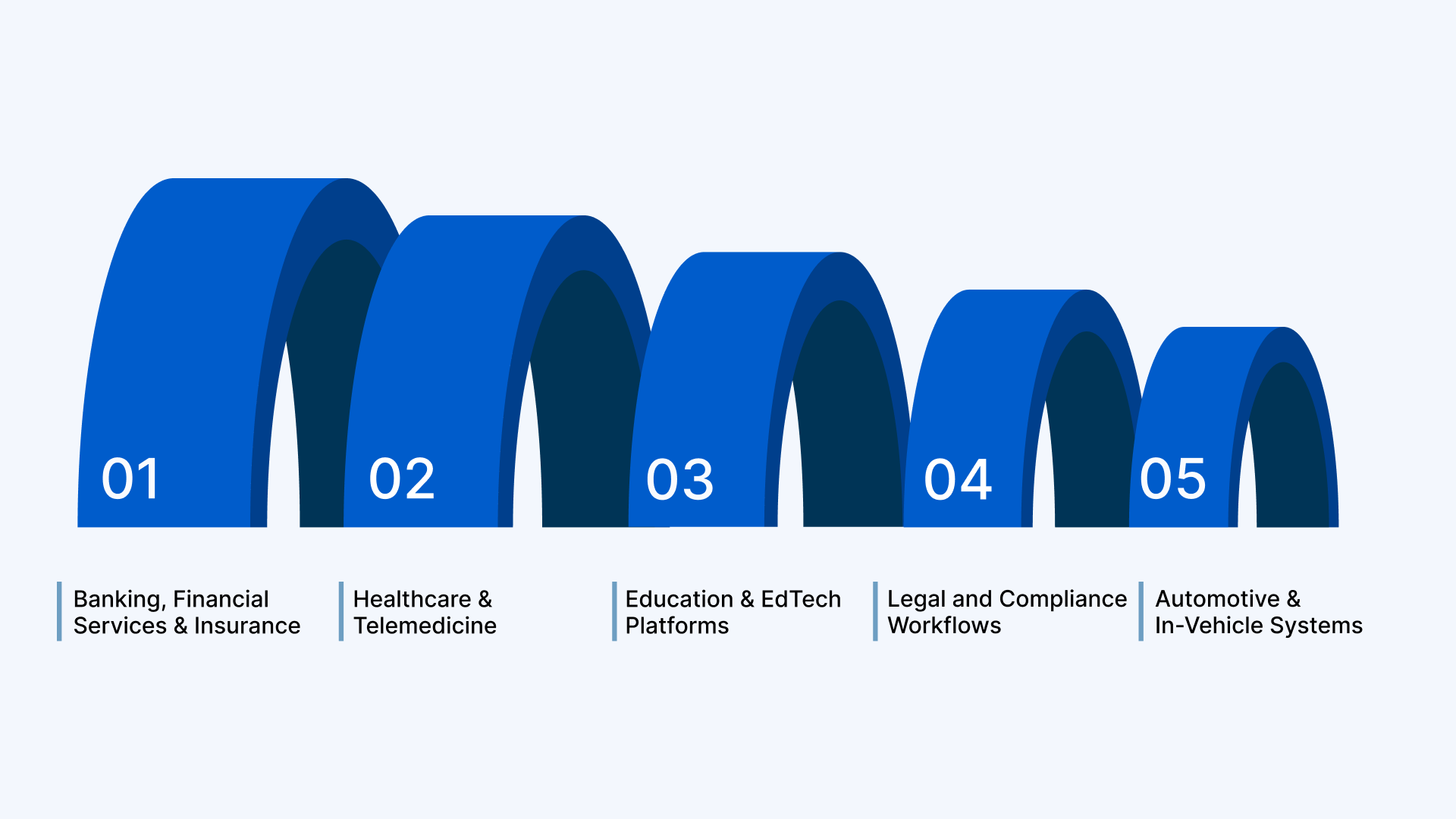
TTS is no longer a general-purpose tool. It is becoming a strategic capability in sectors that depend on clarity, scale and multilingual access.
Here’s where Text-to-Speech is creating the most significant business value today.
1. Banking, Financial Services and Insurance (BFSI)
TTS helps financial institutions simplify complex communication and support customers more efficiently. It enables:
- Clear voice instructions in onboarding and KYC journeys
- Automated reminders for due payments, policy renewals and EMIs
- Multilingual IVR prompts that reduce agent load
- Voice guidance inside mobile banking apps
This creates a more accessible and secure customer experience while lowering support costs.
2. Healthcare and Telemedicine
Healthcare platforms use TTS to deliver critical information accurately and quickly. It supports:
- Read-aloud prescriptions and medical instructions
- Voice-based patient education and follow-up alerts
- Multilingual guidance in teleconsultation apps
- Hands-free content consumption for clinicians during rounds
This reduces miscommunication and improves treatment adherence.
3. Education and EdTech Platforms
TTS strengthens digital learning experiences for diverse learner groups. It helps with:
- Read-aloud lessons for early learners
- Support for students with reading or visual challenges
- Audio versions of textbooks, summaries and test prep
- Pronunciation support in language-learning apps
Students learn faster and retain more when content is available in both text and audio formats.
4. Legal and Compliance Workflows
Legal teams process large volumes of text-heavy documentation. TTS makes content easy to review and understand. It is useful for:
- Listening to long case documents
- Reviewing contracts and compliance material
- Audio briefings for lawyers on the move
- Making legal information more accessible to citizens
This saves time, reduces fatigue and helps professionals stay updated while multitasking.
5. Automotive and In-Vehicle Systems
Automotive brands use TTS to build safer, hands-free driving experiences. It powers:
- Real-time navigation instructions
- Read-aloud notifications and alerts
- Voice-guided infotainment and controls
- Driver assistance systems
Drivers stay informed without taking their eyes off the road, improving safety and convenience.
Reverie’s Text-to-Speech API: Built for Multilingual, Enterprise-Ready Voice Experiences
Reverie’s Text-to-Speech API converts written text into natural, human-like speech across 11 Indian languages and accents. It’s engineered for enterprises that need scalable, brand-aligned voice output for IVRs, bots, apps and content workflows.
With fast onboarding, custom pronunciation control and deployment flexibility, Reverie makes it easy to deliver multilingual voice experiences at scale.
Key features:
- Multilingual, Natural-Sounding Voices: High-quality neural voices optimised for Indian accents and real user speech patterns.
- Precise Pronunciation & Voice Control: Customizable pronunciation, pause/break management, and SSML-style controls for on-brand delivery.
- Flexible Audio Output Formats: Supports multiple formats suitable for IVR systems, apps, content platforms and automation pipelines.
- High-Volume, Low-Latency Synthesis: Generates audio instantly for large workloads like customer notifications, support flows and content localisation.
- Cloud or On-Prem Deployment: Available as SaaS, VPC or full on-prem for regulated sectors like BFSI, government and healthcare.
- Developer-Ready Integration: SDKs for Android, iOS, Web, NodeJS and Python, plus an API Playground for instant testing.
- Analytics & Monitoring: Real-time dashboards for usage tracking, optimisation and quality validation.
With this combination of accuracy, scale and deployment flexibility, Reverie gives enterprises a future-proof way to deliver voice experiences across all digital touchpoints.
Final Words
Text-to-Speech technology is a proven way for businesses to improve accessibility, scale multilingual engagement, reduce operational effort and deliver smoother customer experiences across apps, IVRs, devices and support channels.
As voice-first interactions continue to grow, choosing a reliable TTS engine becomes a direct advantage in user satisfaction and operational efficiency.
If you want natural-sounding, multilingual audio at scale, Reverie’s Text-to-Speech API offers the accuracy, flexibility and enterprise readiness needed for real-world deployments. Sign up now to get started.
FAQs
1. What are the advantages of text-to-speech?
Text-to-speech makes digital content accessible, improves user experience, supports multilingual engagement, reduces operational costs and powers voice assistants, IVRs and automated communication workflows at scale.
2. What are the benefits of using STT?
Speech-to-text helps convert voice data into searchable, analysable text. It improves productivity, enables automation, supports compliance workflows and unlocks insights from calls, meetings and customer interactions.
3. What is a text-to-speech converter?
A text-to-speech converter is a tool that transforms written text into spoken audio using AI voice models. It helps deliver natural, multilingual voice output across apps, IVRs, bots and digital products.
5. How does text-to-speech improve accessibility?
TTS helps users with visual impairments, reading difficulties, or language barriers consume content easily by listening instead of reading.
6. Is text-to-speech suitable for enterprise workflows?
Yes. Modern TTS engines support multilingual output, scalable automation, custom voices and integration with IVR, apps, bots and CX platforms.