Is your team spending too much time fixing translation errors instead of improving your digital platform?
For large enterprises and government bodies, a single localisation mistake can break user trust, distort important information, or even create compliance risks. When your services reach millions across diverse linguistic markets, even small errors can reduce adoption and weaken engagement.
Are you dealing with issues such as inconsistent terminology, culturally inappropriate phrasing, or localisation workflows that fail at scale? This blog explores the major localisation errors enterprises commonly face and explains how they impact user experience, brand reliability, regulatory compliance, and multilingual growth across India’s diverse markets.
Key Takeaways
- Localisation errors, such as inaccurate translations or cultural mismatches, can break trust, disrupt user journeys, and cause compliance issues across sectors such as BFSI, Healthcare, Government, and eCommerce.
- Common errors include translating without localising, ignoring regional design needs, skipping SEO, and using machine translation without review.
- These errors lead to user drop-offs, legal risks, costly rework, and reduced adoption in India’s multilingual markets.
- Tools like Anuvadak enable enterprises to manage localisation at scale through automation, AI-driven translation, and centralised control.
What a Localisation Error Really Means?
A localisation error is any mistake that changes the meaning, accuracy, or usability of your content when it is adapted for regional languages. This could be an incorrect translation, inconsistent terminology, or a cultural mismatch that affects users understanding of critical information.
In sectors such as BFSI, Healthcare, or Government, even a single localisation error can lead to confusion, compliance issues, or disrupted user journeys across your digital platforms.
Once you understand what a localisation error is, the next step is recognising why catching it early matters.
Why Detecting Localisation Errors Early Matters
Finding a localisation error early is essential because even a small mistake can affect how users understand your services, complete transactions, or trust your platform. For enterprises and government bodies operating at scale, these errors can weaken the overall user experience.
Here are the key reasons why detecting localisation errors matters:
- It prevents misinformation in critical areas such as BFSI, healthcare, and government services.
- It protects your brand from inconsistent or unclear communication across regions.
- It reduces rework, delays, and operational costs caused by fixing errors after launch.
- It ensures your multilingual platforms remain compliant, accessible, and dependable for all users.
If you are searching for a way to catch and resolve localisation issues before they disrupt user experience, Anuvadak’s centralised dashboard and continuous localisation features allow teams to detect and correct issues quickly, avoiding rework and delays.
By now, it’s clear that detecting localisation errors early can prevent costly setbacks and protect brand trust. But to fix them effectively, you need to understand the various types of errors occur.
Also Read: How Can Localisation of Your eCommerce Website Reduce Bounce Rates?
What are the Common Localisation Errors?
When you manage multilingual platforms across India’s diverse markets, localisation mistakes can occur at many levels, from translation to design, testing, or even process planning. These errors can slow your digital adoption, confuse users, or risk compliance if not identified early.
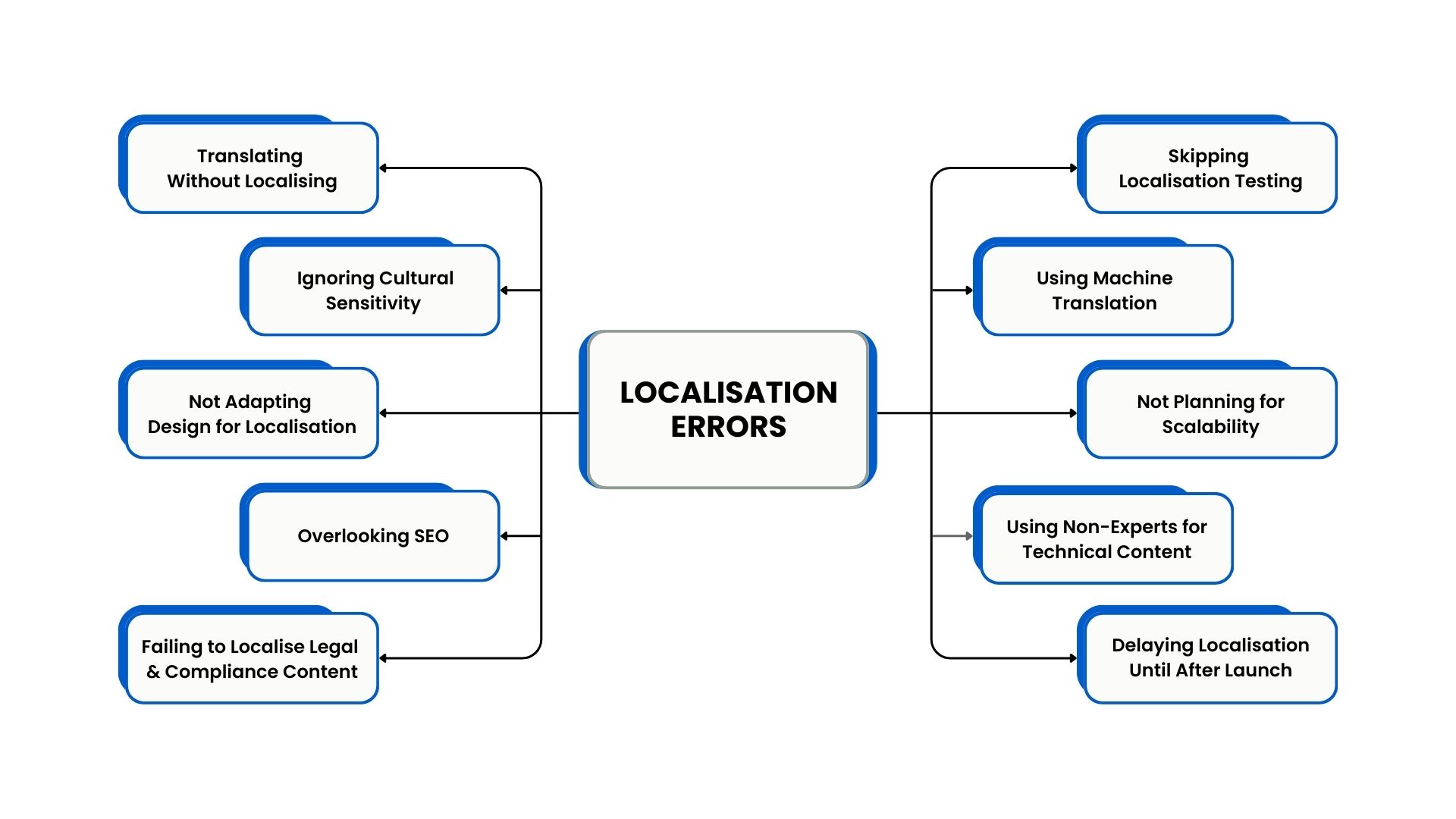
Here are the most common localisation errors enterprises and government teams often face:
1. Translating Without Localising
This happens when you translate words but do not adapt the message for local context, user behaviour, or regional expectations. You may keep the meaning technically correct, but the content still feels foreign, unclear, or disconnected for users in different Indian languages.
For example, a BFSI website translates “Apply for a Loan” word-for-word into regional languages, but the phrasing sounds unnatural for customers used to simpler, conversational terms.
2. Ignoring Cultural Sensitivity
Some phrases, examples, colours, images, or tone may not fit cultural norms in specific regions. When you skip cultural checks, your content may sound inappropriate or uncomfortable for users who expect communication aligned with their local practices and values.
For example, an automotive brand using a colour associated with mourning in certain Indian states for a festival campaign may unintentionally create a negative impression.
3. Not Adapting Design for Localisation
Many languages expand or contract when translated. If your design does not support flexible layouts, you may see cut-off text, overlapping elements, or broken screens. This usually happens when UI components are fixed or not prepared for multilingual adjustments.
For example, a bank app designed in English breaks when converted to Tamil or Marathi, and the translated button text overlaps with icons, making navigation confusing for users.
4. Overlooking SEO
When you translate content but skip localising meta titles, descriptions, and alt tags along with keywords, your multilingual pages may still remain invisible to local users searching in their language.
For example, an education platform translates “online classes” into Gujarati literally but misses the local phrase students actually search for, losing organic traffic from that region.
5. Failing to Localise Legal and Compliance Content
Legal terms, financial instructions, health information, and policy details require precise language. Using direct translations without domain expertise often leads to unclear or incomplete content, especially for industries with strict regulatory requirements.
For example, a financial institution translates its loan agreement into Bengali using general wording. The translated text misses critical clauses around interest calculations, making the document legally inconsistent.
6. Skipping Localisation Testing
When you do not test the localised version of your website or app, you may miss functional issues, broken layouts, untranslated strings, or formatting errors. This usually happens when testing focuses solely on the source-language version.
For example, a government e-service app launches its Gujarati version without QA testing and later finds English menu items appearing within Gujarati pages, confusing users.
7. Using Machine Translation Without Human Review
Machine translation can speed up your workflow, but it often produces literal or inaccurate results without proper context. When you skip human validation, domain-specific terminology, tone, and nuances are easily lost.
For example, a hospital’s chatbot automatically translates medical instructions into Hindi without review. The translation uses casual language rather than medical terms, which can lead to misunderstandings in patient communication.
8. Not Planning for Scalability
If your localisation process is not designed to handle frequent updates, multiple languages, or large content volumes, you may face constant backlogs. This error occurs when workflows depend on manual steps or disconnected tools that cannot grow with your platform.
For example, an automotive company launches a multilingual website but updates only the English version with new model details. The regional versions stay outdated because there is no central system for synchronised updates.
9. Using Non-Experts for Technical Content
Highly technical content in BFSI, healthcare, automotive, legal, or compliance sectors needs writers with domain knowledge. When general translators handle technical material, important details may be misunderstood or simplified incorrectly.
For example, a legal portal assigns general translators to localise compliance documents and ends up with misinterpreted clauses that change the meaning of critical regulations.
10. Delaying Localisation Until After Launch
When you start localisation late, you often rush translations, revisions, and testing. This leads to inconsistent quality and additional rework because the multilingual versions are treated as last-minute add-ons rather than part of the core release cycle.
For example, an education platform launches its English website first and begins localisation later. By then, the platform will have new content updates, causing delays and a mismatch between English and regional versions.
Now that you know the most common localisation errors, it’s important to understand how they affect your users, brand reputation, and overall digital growth.
What Is the Impact of These Localisation Errors?
Localisation errors may look small at first, but for large organisations operating across India’s diverse markets, they can quickly create serious business and operational challenges. These mistakes affect how users understand your message, how much they trust your brand, and how smoothly your multilingual systems run.
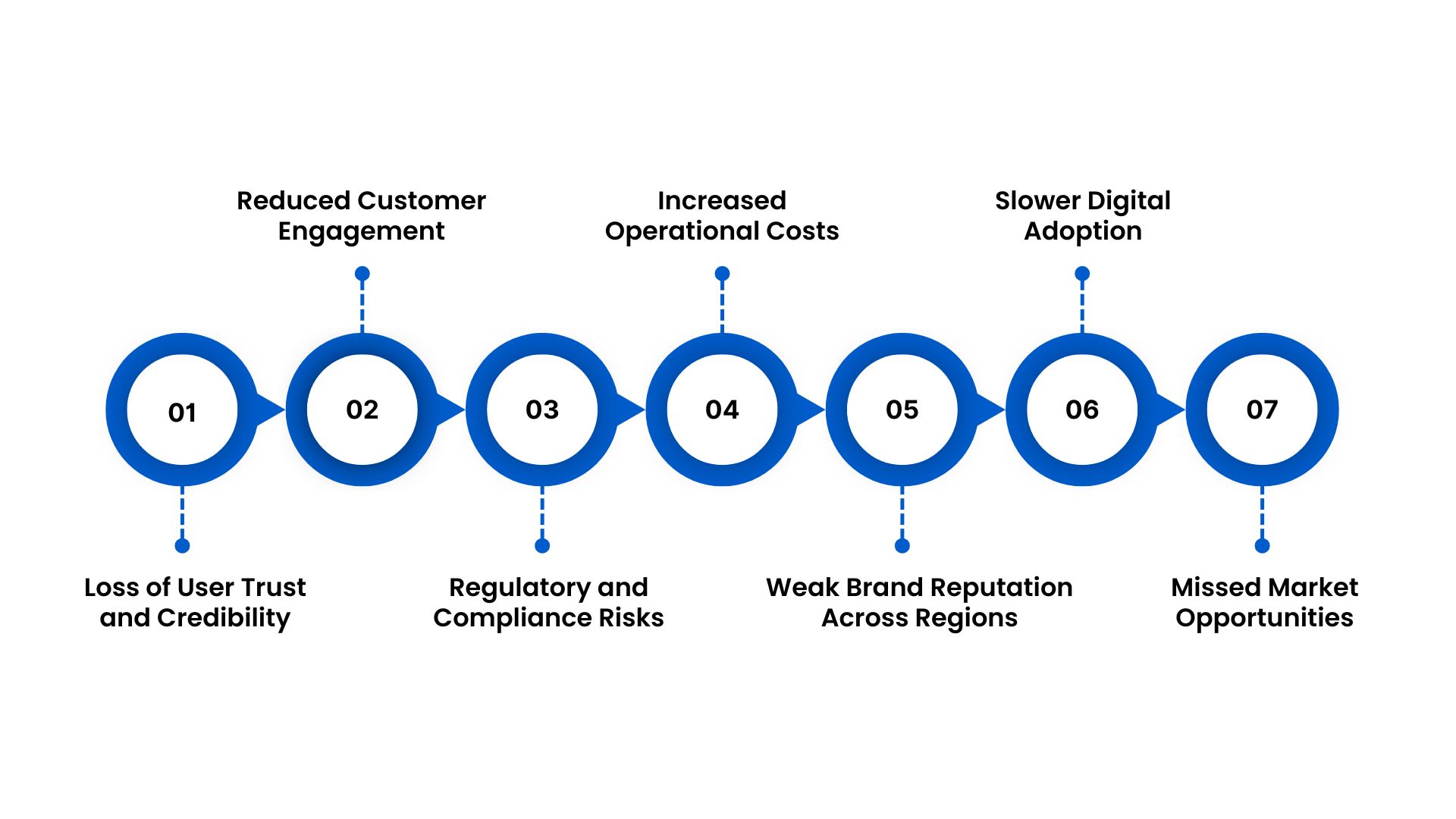
Here are the key impacts you should be aware of:
1. Loss of User Trust and Credibility
When users see incorrect or confusing language, they immediately doubt the accuracy of your service. In sectors like BFSI or healthcare, even one poorly translated message can damage customer confidence and make users question your reliability.
2. Reduced Customer Engagement and Conversions
Poorly localised websites or apps fail to connect with regional users. This leads to higher bounce rates, lower sign-ups, and missed opportunities to convert new customers, especially in competitive eCommerce and education markets.
3. Regulatory and Compliance Risks
In industries such as legal, banking, or government, mistranslated policies or forms can lead to compliance violations. A single localisation mistake in legal or financial content can expose your organisation to penalties or audit failures.
4. Increased Operational Costs
When errors are discovered after launch, your teams must spend additional time fixing and retesting content. This increases localisation costs, delays product updates, and strains cross-functional teams managing multilingual workflows.
5. Weak Brand Reputation Across Regions
Inconsistent language and poor-quality translations give users the impression that your brand doesn’t value their language or culture. Over time, this weakens your brand image and makes regional expansion harder.
6. Slower Digital Adoption in Regional Markets
If users struggle to navigate localised interfaces or understand key information, adoption drops. This directly impacts government citizen services, mobile banking platforms, and other digital initiatives aiming for inclusivity.
7. Missed Market Opportunities
When localisation isn’t accurate or efficient, new markets remain untapped. For growing industries like automotive and eLearning, localisation errors can delay launches and limit your regional presence.
By proactively managing language quality, Anuvadak helps reduce user churn, rework costs, and compliance gaps that often stem from poor localisation.
Addressing these issues requires more than manual fixes; it demands a platform built to manage multilingual operations efficiently.
How Anuvadak Helps Avoid these Localisation Errors
Anuvadak is a website and app localisation platform designed to help businesses and government organisations reach India’s vast multilingual population.
It eliminates the most common errors enterprises face when scaling multilingual digital experiences. It automates translation, simplifies workflows, and ensures linguistic and cultural accuracy across all Indian languages, making localisation seamless for BFSI, eCommerce, Healthcare, Education, Government, and other regulated sectors.
To help you maintain accuracy and consistency across all digital touchpoints, here are five key ways Anuvadak removes localisation errors:
1. Indian Language-Specific Neural Machine Translation
Anuvadak’s neural machine translation engine is built specifically for Indian languages. Through continuous localisation, newly added content on the source English website is automatically identified for translation and synchronised to regional sites, with the option for human review to ensure accuracy in critical content. This ensures regional users consistently access the latest content in their language.
2. Continuous Localisation with Zero Downtime
With Anuvadak, you can continuously localise updated content with zero downtime. Based on the sitemap of the source English website, the URLs to be localised, along with the language choices, are identified and mapped to the platform. Parallely, at this stage, the number of source words and unique words is also auto-generated.
3. Centralised Management Dashboard
The unified dashboard allows your teams to manage, review, and approve translations efficiently. It reduces manual errors caused by scattered workflows and ensures consistent terminology across all digital properties through central control and version tracking.
4. Built-in Analytics and Quality Tracking
Anuvadak’s analytics dashboard offers customers a comprehensive toolkit for enhancing website localisation and user engagement. With features such as site visits analysis, efficient project management, language progress tracking, and page views measurement, users gain valuable insights and control over their multilingual content, enabling data-driven decisions and fostering business growth.
5. Automation for Accuracy and Efficiency
Anuvadak’s continuous Localisation Support and Auto-update of Localised Content ensure websites remain up-to-date in multiple languages. Real-time progress tracking of translation services adds transparency, empowering businesses to monitor and manage projects more effectively, resulting in time savings, reduced manual effort, and an enhanced online presence.
By integrating automation, AI translation, and centralised control, Anuvadak helps enterprises and government bodies deliver accurate, compliant, and culturally relevant multilingual experiences without the usual localisation challenges.
Also Read: Website Localisation with Anuvadak – Enhances Business Growth & Profits by 50%
Conclusion
Localisation errors can cost your organisation more than just time. These can damage brand credibility, confuse users, increase compliance risks, and slow down digital growth in regional markets. Addressing challenges from literal translations, cultural mismatches, and a lack of early testing is key to improving adoption, reducing rework, and ensuring your multilingual platforms work seamlessly at scale.
To help you overcome these challenges, Anuvadak offers a purpose-built localisation management platform tailored for Indian languages. It simplifies multilingual deployment through neural machine translation, zero-downtime content updates, built-in quality controls, and centralised workflows.
So, why wait? Contact us to see how Anuvadak can support your digital expansion with accuracy, compliance, and scale.
FAQs
1. Why do many localisation errors occur even when translation is done correctly?
Because a correct translation isn’t enough. Localisation also demands cultural adaptation, design adjustments (for text length or script differences), SEO‑aware content, and technical compatibility. Ignoring any of these aspects can cause an error.
2. What technical or structural issues often cause localisation failures besides translation mistakes?
Many localisation failures stem from inadequate technical preparation, e.g. lack of support for non‑Latin scripts, encoding issues, fixed layouts that don’t allow for text expansion, and CMS or integration problems.
3. Why is cultural and regional adaptation important when localising for diverse users?
Because what works in one region may offend or confuse users in another. Local localisation must adapt visuals, idioms, tone, and even design to match cultural norms. Ignoring these can alienate audiences.